School Fundraising
Elementary School Fundraising Ideas That Actually Work
The best fundraising ideas for elementary schools — from product sales and events to no-upfront-cost programs that reach every family and raise real money.
The best elementary school fundraising ideas balance three things: broad participation across all grade levels, minimal volunteer burden, and a product or activity that appeals to young families. Product fundraisers built around household necessities — like laundry detergent or cleaning supplies — often outperform traditional treat sales because they reach every household, require no upfront cost, and give supporters real value at roughly half the per-ounce price of premium national brands. Events like fun runs, read-a-thons, and family nights work well when paired with a simple sponsorship model. The strongest programs combine wide appeal with simple logistics, so coordinators spend less time managing inventory and more time engaging families.
Elementary school fundraising sits at the intersection of two hard truths: you need real money to fund programs the budget does not cover, and you are asking volunteers who already have full-time jobs and young kids at home to make it happen. The fundraisers that work are the ones that respect both realities — they raise enough to matter and they do not burn out the three parents doing all the work.
The good news is that elementary families are often the most engaged segment of a school community. In many communities, parents of younger students may participate at higher rates than middle or high school families, which can give you a participation advantage if you pick the right program. The key is choosing something that works across all grade levels, from kindergarten through fifth, and does not require a logistics degree to coordinate.
This guide covers the fundraising ideas that often work for elementary schools — product sales, events, hybrid models, and the specific factors that decide whether a program raises real money or quietly fizzles. We will also walk through what makes elementary fundraising different, the mistakes coordinators make, and a clear recommendation for groups that want broad participation without upfront cost or complexity.
- Elementary families participate at higher rates than older grades, so the right program can reach a wide base of supporters.
- Product fundraisers built around household necessities reach more buyers than treat-based sales because every family needs them.
- No-upfront-cost programs remove inventory financial risk and make it easier for small PTAs and PTOs to launch a campaign.
- Events like fun runs and read-a-thons work well when paired with simple online sponsorship tools that reduce volunteer workload.
- The best elementary fundraisers are easy to explain to a five-year-old and simple enough that a working parent can participate in under five minutes.
- Avoid fundraisers that require door-to-door selling, perishable inventory, or multi-week delivery windows that create logistical headaches.
- A clear goal and a short two-to-three-week timeline drive more participation than open-ended campaigns that drag on for months.
What makes elementary school fundraising different?
Elementary fundraising operates under a different set of constraints than middle or high school campaigns. Your volunteers are parents of young children, which means time is the scarcest resource. Your sellers are five to eleven years old, so door-to-door sales and complex pitches are off the table. And your buyer pool skews toward young families, grandparents, and neighbors who respond well to supporting kids but have limited patience for overpriced novelty items.
The programs that succeed at the elementary level are the ones that work within these constraints rather than against them. A fundraiser that requires parents to manage frozen cookie dough deliveries or coordinate a multi-station carnival will struggle. A program where families simply shift a household purchase they were already going to make — and the PTA handles the logistics — tends to raise more with far less friction.
Participation is your biggest lever. Elementary families will show up if the ask is simple and the product is useful. The coordinators who raise the most are usually the ones who picked something every family could sell, not the ones who chased the highest per-item margin on a product only a few families wanted to push.
What are the best product fundraisers for elementary schools?
Product fundraisers remain the workhorse of elementary school fundraising because they are simple to explain, easy to run, and give supporters something tangible for their money. But not all product programs are created equal — the difference between a fundraiser that raises real money and one that quietly underperforms usually comes down to three factors: how many people will actually buy the product, whether it requires upfront inventory cost, and how much work it creates for volunteers.
Household necessity fundraisers
Household staples — laundry detergent, cleaning supplies, paper products — are worth considering for elementary PTAs that want broad participation and high totals. The reason is simple: every household already buys these items, so the product appeals to grandparents, neighbors, coworkers, and extended family who would never purchase a tub of cookie dough or a candle. Families are not asking supporters to spend extra money on something they do not need; they are asking them to shift one purchase from the store to the fundraiser and save money doing it.
The strongest programs in this category are no-upfront-cost, meaning the school collects orders first and never fronts money for inventory. Profit per unit varies widely by program, so compare what the group keeps per item, not just the percentage. And because the products are non-perishable, there is no frozen delivery day or spoilage risk — orders arrive in a single delivery and families pick them up on a set day.
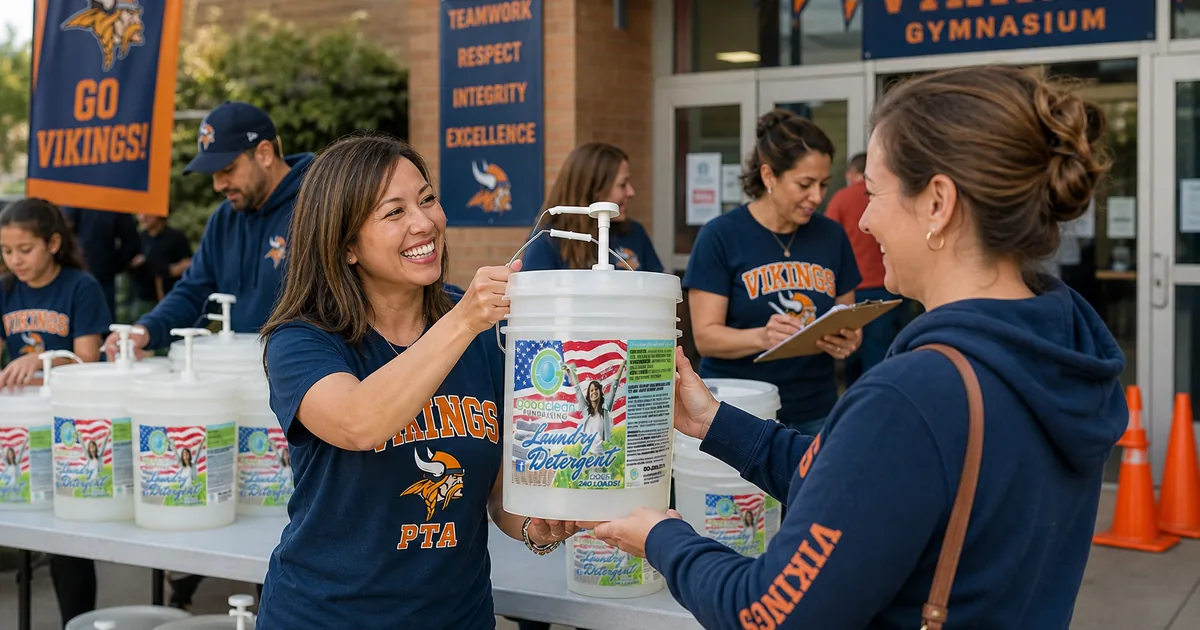
One program elementary schools can use is a bulk laundry detergent fundraiser. Families sell 5-gallon buckets of detergent for $49.95 — roughly half the per-ounce price of premium national brands at the store — and the school keeps about $13.45 to $15.45 per bucket at 100 or more buckets, depending on order volume. Supporters get genuine value, sellers have an easy pitch, and the PTA raises money without managing perishable inventory or upfront costs.
Traditional catalog and treat sales
Cookie dough, popcorn, candy, and gift catalogs have been elementary school staples for decades, and they still work for some groups — particularly schools with strong volunteer capacity and a community that has not hit catalog fatigue. The challenge is that these programs tend to have a narrow buyer pool (people who want a treat or a novelty gift), require managing perishable or seasonal inventory, and often come with upfront costs or minimum order requirements.
If you go this route, favor programs that are no-upfront-cost and offer a product with broad appeal. Avoid anything that requires frozen storage, has a short shelf life, or needs to be delivered on a specific day. And be realistic about participation: treat-based fundraisers tend to see strong sales from a small group of highly motivated families, but lower overall participation than necessity-based programs.
What are the best event-based fundraisers for elementary schools?
Events can be powerful fundraisers for elementary schools because they build community, get kids excited, and create a shared experience that catalog sales never will. The trade-off is that events require more volunteer hours, more upfront planning, and often more logistical coordination than a product sale. The events that work best are the ones with simple mechanics, minimal setup, and a clear sponsorship model that does not rely on selling items door-to-door.
Fun runs and walk-a-thons
Fun runs are one of the most popular elementary fundraisers because they are active, inclusive, and easy to scale. Students collect pledges from family and friends (usually through an online platform), then participate in a school-wide run or walk event. The best programs provide a turnkey coordinator, promotional materials, and an online donation portal so parents are not chasing checks or managing spreadsheets.
The key to a successful fun run is keeping the pledge process simple. If parents have to print forms, collect cash, and manually track donations, participation drops. Modern fun run companies handle the tech side and some provide incentives and prizes for top fundraisers, so ask what is included and whether there is a cost.
Read-a-thons and academic challenges
Read-a-thons work on the same pledge model as fun runs but tie fundraising to reading goals, which aligns with academic priorities and tends to get strong teacher buy-in. Students set a reading goal (pages read, books completed, minutes logged), collect sponsorships, and track progress over two to three weeks. The best read-a-thon platforms integrate with school reading programs and provide real-time leaderboards that keep kids engaged.
Read-a-thons may raise less per student than fun runs, but they require almost no volunteer coordination beyond the initial kickoff and a final celebration. For schools that want a low-effort, curriculum-aligned fundraiser, it is a strong option.
Family events: carnivals, bingo nights, and movie nights
Family events like school carnivals, bingo nights, and outdoor movie nights are community builders first and fundraisers second. They can raise meaningful money through ticket sales, concessions, and raffles, but they require significant volunteer hours to plan and execute. The schools that do these well treat them as annual traditions with a core team of experienced volunteers who know the playbook.
If your PTA is small or volunteer capacity is limited, a large event can become a burnout risk. Consider starting with a simpler format — a single-evening bingo night or movie on the field — before committing to a full carnival with inflatables, game booths, and food trucks.
What about hybrid and passive fundraising programs?
Hybrid programs combine elements of product sales and events, while passive fundraisers generate ongoing revenue with minimal effort. Both can be effective supplements to a main campaign, though they rarely raise enough on their own to fund a major budget line.
Receipt-scanning and grocery rewards programs
Passive programs like receipt-scanning rewards apps and grocery store rewards cards can generate small, steady income without requiring active selling. They work best as always-on programs that families opt into once and forget about. The totals are typically modest, but the effort required is minimal, so they are worth setting up as a background revenue stream.
Promote these programs at the start of the school year, send one reminder per semester, and do not expect them to replace an active fundraiser. They are supplemental income, not a primary strategy.
Spirit wear and school store sales
Spirit wear sales (t-shirts, hoodies, hats with the school logo) work well as a back-to-school or holiday fundraiser. Some schools run two sales per year — one in August and one before winter break — using an online platform that handles ordering, payment, and fulfillment. Profit margins are moderate, but the program requires almost no volunteer time once the design and platform are set up.
A school store stocked with pencils, erasers, and small items can generate ongoing revenue, but it requires a dedicated parent or staff member to manage inventory and run the store during lunch or recess. For schools with the volunteer capacity, it is a steady income source; for schools without it, the juice is rarely worth the squeeze.
How do you choose the right fundraiser for your elementary school?
The right fundraiser for your school depends on three variables: your volunteer capacity, your community's tolerance for asks, and your financial goal. A large, well-organized PTA with a strong volunteer base can run a carnival or a multi-week catalog sale. A small PTO with three active parents and a full-time-working board needs something simpler — a no-upfront-cost product sale or a turnkey fun run with a dedicated coordinator.
Start by asking: how much do we need to raise, how many volunteers do we have, and how many times have we asked families this year? If this is your second or third ask of the semester, favor something with broad appeal and minimal friction. If your goal is large and your volunteer bench is thin, look for programs that provide a Getting Started packet, instructions, marketing materials, and social media strategies.
The schools that raise the most are usually the ones that picked one or two strong programs and ran them well, rather than running five mediocre fundraisers that all competed for the same families' attention and dollars.
| Factor | Product Fundraiser | Event Fundraiser |
|---|---|---|
| Volunteer time | Low to moderate (order collection, distribution) | High (planning, setup, day-of coordination) |
| Upfront cost | Can be zero with order-first programs | Often requires upfront spending |
| Participation breadth | Wide base with broad-appeal products | Strong from engaged families, may miss working parents |
| Profit potential | Steady per-unit profit, scales with participation | High potential but variable margins |
| Community building | Minimal beyond transaction | Strong — creates shared experiences |
Common mistakes to avoid
Choosing a fundraiser that is too complex for your volunteer capacity
A carnival sounds great until you realize it requires forty volunteers and six weeks of planning. Match the fundraiser to the team you actually have, not the team you wish you had.
Running too many fundraisers in one school year
Asking families four or five times a year creates fatigue and lowers participation across the board. One or two strong campaigns often raise more than five mediocre ones.
Picking a product with a narrow buyer pool
If only a small segment of your community wants the product, participation will be limited no matter how high the margin is. Broad appeal beats high margin in many cases.
Leaving the fundraiser open for too long
A six-week selling window sounds generous, but it kills urgency. A focused two-to-three-week campaign with a clear deadline raises more than an open-ended one.
Skipping a real kickoff
When families trickle in whenever they get around to it, most never start. A single kickoff day where everyone launches together drives the majority of early momentum.
Not communicating the goal clearly
Families participate more when they know exactly what the money is for. Specific goals like new playground equipment or classroom technology raise more than vague asks for general funds.
- Editorial guidance: general planning advice on this page reflects the authors' editorial judgment and common school fundraising practice; it is not based on measured campaign data or a cited study.
- USDA Smart Snacks in School standards — federal guidelines that affect food-based fundraisers in elementary schools participating in the National School Lunch Program. — source
- Good Clean Fundraising program terms — $49.95 per bucket; $13.45 profit per bucket at 100 to 299 buckets (usually $5 to $12 at 50 to 99 buckets, depending on actual shipping costs), $14.45 at 300 to 499, $15.45 at 500 or more; $0 upfront cost; free shipping at 100+ buckets; 50-bucket minimum (smaller orders are not accepted); 100% money-back guarantee under which, according to the company, any customer who is not satisfied is refunded and the group keeps its profit. — GCF pricing, GCF how it works, and GCF refund and returns.
Our recommendation for elementary schools
If your elementary PTA or PTO wants broad participation, no upfront cost, and a product that every family can sell, a household-necessity fundraiser is the strongest play. Good Clean Fundraising runs The Good Clean Fundraiser, a bulk laundry detergent program built specifically for schools. Families sell 5-gallon pump buckets of detergent for $49.95 — roughly half the per-ounce price of premium national brands — and your school keeps about $13.45 to $15.45 per bucket at 100 or more buckets, depending on order volume. There is no upfront cost, free shipping on orders of one hundred buckets or more, and a Getting Started packet, instructions, marketing materials, and social media strategies. It is simple enough that a kindergarten parent can explain it in one sentence, and it reaches buyers who would never purchase a treat or novelty item. Good Clean Fundraising advertises a 100% money-back guarantee under which, according to the company, any unsatisfied customer is refunded and the group keeps its profit. Orders under 50 buckets are not accepted.
Frequently asked questions
The best fundraiser for an elementary school is one that balances broad participation, minimal volunteer burden, and a product or activity that appeals to young families. Household-necessity fundraisers like laundry detergent or cleaning supplies often outperform treat-based sales because they reach every household, require no upfront cost, and give supporters real value. Events like fun runs work well when paired with a turnkey coordinator and simple online sponsorship tools.
It depends on your school size, participation rate, and what you sell, so set a realistic goal based on your enrollment rather than a headline number. With strong participation, a school can raise meaningful money from a single well-run product fundraiser or event; at $13.45 per bucket, for example, 200 buckets would keep $2,690 in one detergent program. Total raised is roughly participants times average sales per family times profit per item, so growing participation matters more than chasing a high per-item margin.
Small PTAs should favor no-upfront-cost product fundraisers or turnkey events that come with a dedicated coordinator. Programs that require minimal volunteer hours, no inventory management, and simple logistics are the best fit. A bulk household-necessity fundraiser or a read-a-thon with an online platform both work well for schools with limited volunteer capacity.
It depends on your district's wellness policies and whether your school participates in the National School Lunch Program, which is subject to USDA Smart Snacks standards. Some elementary schools have moved away from food fundraisers due to allergy concerns, wellness policies, and the logistical challenges of managing perishable inventory. Check with your principal or district office before planning a food-based fundraiser.
Most successful elementary fundraisers run for two to three weeks. A short, focused timeline creates urgency and keeps families engaged, while campaigns that drag on for months tend to lose momentum and raise less. Set a clear start date, a firm deadline, and send reminders at the one-week and final-day marks.
The easiest fundraisers are the ones parents can complete in under five minutes without leaving home. Online giving campaigns, read-a-thons with digital pledge forms, and product fundraisers where families share a link and supporters order directly all remove friction. Avoid anything that requires door-to-door selling, collecting cash, or managing order forms by hand.
Participation rises when the ask is simple, the product is useful, and the goal is clear. Start with a real kickoff so everyone launches on the same day, communicate exactly what the money will fund, keep the selling window short, and send a couple of friendly reminders. When the product is something supporters actually want and the process takes less than five minutes, participation goes up across the board.
One or two strong fundraisers per year often raise more than four or five smaller asks. Multiple campaigns create donor fatigue, lower participation rates, and burn out volunteers. If your budget requires multiple revenue streams, pair one major fundraiser with passive programs like receipt-scanning rewards or spirit wear sales that require minimal effort.
Household necessities like laundry detergent reach a much wider buyer pool than treats because every household already buys them. Supporters are not spending extra money on something they do not need — they are shifting a purchase from the store to the fundraiser and saving money doing it. These products are also non-perishable, so there is no frozen delivery day or spoilage risk, and profit per unit varies by program, so compare what the group keeps per item.
The Good Clean Fundraiser is Good Clean Fundraising's bulk laundry detergent program for schools. Families sell 5-gallon pump buckets of detergent for $49.95, and the school keeps about $13.45 to $15.45 per bucket at 100 or more buckets, depending on order volume. There is no upfront cost, free shipping on larger orders, and a Getting Started packet, instructions, marketing materials, and social media strategies. Supporters get a household staple at roughly half the per-ounce price of premium national brands, and the company advertises a 100% money-back guarantee.
Elementary school fundraising does not have to be complicated or burn out your volunteers. Pick a program with broad appeal, keep the timeline short, communicate a clear goal, and give families an easy way to participate. When the product is something every household needs and the logistics are handled for you, participation rises and the money follows.