
School Fundraising
Virtual & Online School Fundraising Ideas That Actually Work
How schools are raising money online — from product fundraisers with digital order forms to virtual events and hybrid models that reach more supporters.
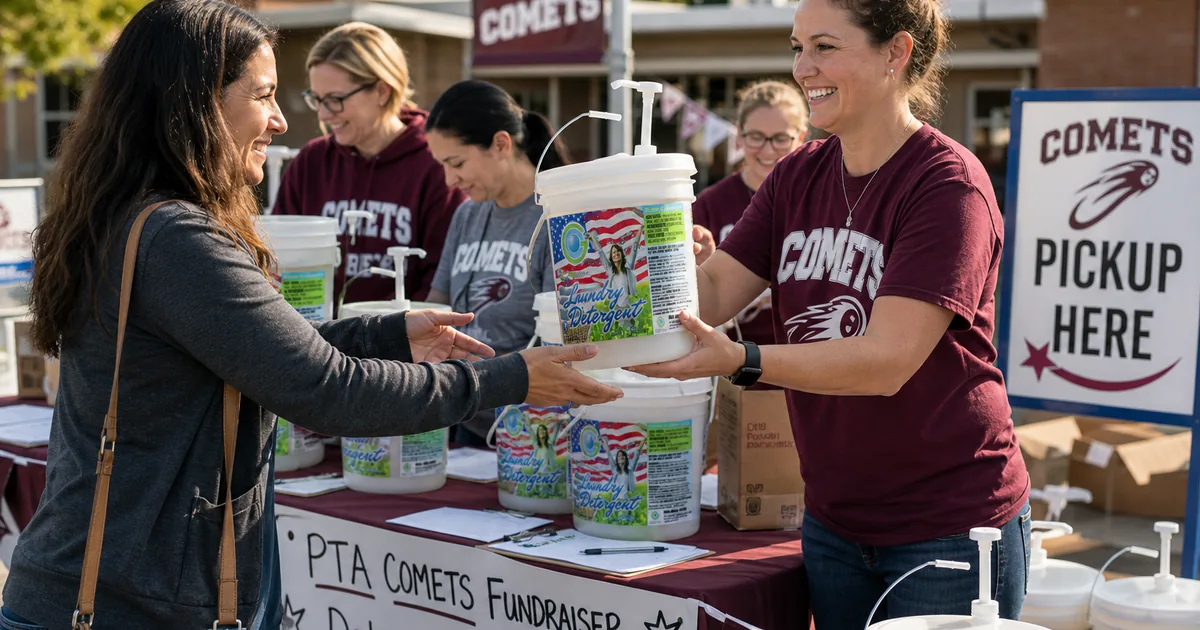
The most effective online school fundraising ideas fall into three categories: product fundraisers with digital ordering (where supporters buy something useful and the school keeps a share), virtual events (online auctions, read-a-thons, and talent shows), and hybrid models that combine online promotion with offline delivery. Product fundraisers with digital order forms tend to raise the most because they reach supporters beyond the immediate school community, require no in-person event coordination, and give buyers something of real value. The strongest performers sell household necessities people already purchase — like laundry detergent or cleaning supplies — because the buyer pool is wide, the product is easy to explain online, and supporters feel they are getting genuine value rather than paying a premium for a novelty item. When choosing an online fundraiser, schools should prioritize ease of sharing, broad appeal, clear profit terms, and whether the program provides the digital infrastructure or the school has to build it.
Virtual and online fundraising has become a common option for schools, and the digital tools remain useful alongside in-person activities. The reason is simple: online fundraising can reach more people. A parent can share a link with grandparents across the country, a teacher can post it to social media, and supporters can participate without attending an event or being home when a student knocks on the door.
But not all online fundraisers perform equally. Some are genuinely easier to run and raise more; others add complexity without adding reach. The difference usually comes down to whether the program is built for digital sharing from the ground up or whether it is a traditional fundraiser with a website tacked on.
This guide covers the online and virtual fundraising models that tend to work for schools, how they compare on ease and profit, what to look for in a digital fundraising platform, the mistakes that sink online campaigns, and how to choose the right approach for your school.
- Product fundraisers with digital order forms reach the widest audience and tend to raise the most because supporters get something useful.
- Household-necessity products outperform novelty items online because they appeal to nearly every buyer and are easy to explain in a text or email.
- Virtual events like online auctions and read-a-thons work well but require more coordination and promotion than product fundraisers.
- Hybrid models that combine online ordering with offline delivery often deliver the best participation rates.
- The best online fundraising platforms provide the digital infrastructure — order forms, payment processing, tracking — so the school does not have to build it.
- A short, focused online campaign with a clear deadline raises more than an open-ended one that runs for months.
What are the main types of online school fundraisers?
Online school fundraisers generally fall into three models, each with different logistics and profit potential. Understanding the structure helps you pick the one that fits your school's capacity and goals.
Product fundraisers with digital ordering are common and can be the highest-grossing. Supporters browse and order online, the school collects payment digitally, and the product is delivered according to the program's process. The school keeps a set profit per item. These work well because they require no event coordination, reach supporters far beyond the school community, and give buyers something tangible. The strongest performers in this category sell everyday necessities — laundry detergent, cleaning products, household staples — because the buyer pool is wide and the value proposition is clear.
Virtual events include online auctions, talent shows, trivia nights, read-a-thons, and similar activities where participation happens digitally. These can build community and engagement, but they require more planning, promotion, and volunteer coordination than a product fundraiser. Profit depends on participation rates and ticket or pledge levels, which can vary widely.
Hybrid models combine online promotion and ordering with some offline component — for example, a product fundraiser where students promote the fundraiser online but deliver the product in person, or a virtual event with an in-person kickoff. These often deliver the highest participation because they leverage both digital reach and personal connection.
Why do product fundraisers with digital ordering raise the most?
In our editorial view, product fundraisers often have an edge with digital order forms, and the reason comes down to friction. A supporter can click a link, place an order in under two minutes, and be done — no event to attend, no pledge form to mail, no coordination required. That ease translates directly into higher participation.
The second advantage is reach. A student can share a fundraising link with relatives in another state, a teacher can post it to a community Facebook group, and a principal can email it to the school's alumni list. Virtual events are limited to people who can attend at a specific time; product fundraisers are open to anyone with a link.
The third factor is value perception. When supporters buy a product they actually need — especially at a price lower than retail — they feel they are getting something for their money, not just making a donation. That removes the guilt or obligation dynamic and makes it easier for students to ask and for supporters to say yes.
What products work best for online school fundraisers?
The products that perform best online share three traits: broad appeal, clear value, and easy explanation. If a supporter has to read three paragraphs to understand what they are buying or why it is worth the price, the conversion rate drops.
Household necessities — laundry detergent, cleaning supplies, paper products — are strong candidates because everyone needs them, they are easy to explain in a text or email, and supporters can see the value immediately. A 5-gallon bucket of laundry detergent at roughly half the per-ounce price of a national brand is a straightforward value proposition that works in a two-sentence pitch.
Food and treat items like cookie dough, popcorn, and candy can work online but tend to have a narrower buyer pool because they appeal mainly to people who want that specific treat. They also carry perishability concerns that complicate shipping and storage.
Novelty and gift items — candles, wrapping paper, discount cards — can perform inconsistently online. Some buyers love them; others scroll past. The challenge is that these items are not necessities, so the pitch has to overcome the question of whether the supporter actually wants the product, not just whether they want to support the school.
What virtual events work well for schools?
Virtual events can raise meaningful money and build community, but they require more planning and promotion than product fundraisers. The events that work best are simple to participate in, appeal to a wide audience, and have a clear call to action.
Online auctions are the most common and can be highly profitable if the school has strong donated items and an engaged parent base willing to bid. The logistics require auction software, item procurement, promotion, and payment collection, so plan for a dedicated committee.
Read-a-thons and walk-a-thons adapted for virtual participation work well because they are easy to explain, family-friendly, and allow supporters to pledge online. Students log their reading minutes or steps, and supporters donate based on participation or a flat pledge.
Virtual talent shows, trivia nights, and game nights can engage families and raise money through ticket sales or donations, but they depend heavily on turnout. Success requires strong promotion, a compelling program, and a simple way for attendees to give during the event.
The common thread among successful virtual events is a short, focused timeline and multiple reminders. An event that is promoted for two weeks and happens on one night is likely to outperform one that is open-ended or poorly promoted.
What should you look for in an online fundraising platform?
The platform or program you choose will determine how much work falls on your volunteers and how smooth the experience is for supporters. A good online fundraising platform should handle the heavy lifting so your team can focus on promotion and participation.
First, evaluate what digital tools the program provides — for example, student-specific order links, a mobile-friendly order form, secure payment processing, and automatic order tracking are features some platforms offer. If your school has to build or manage that infrastructure itself, the program is not fully digital. Not every program includes all of these, so confirm what is available before you commit.
Second, look for clear, transparent profit terms. You should know exactly what the school keeps per item or per dollar raised, with no hidden fees or complicated tier structures. If the profit explanation takes more than one sentence, it is probably more complicated than it needs to be.
Third, the platform should handle customer support and fulfillment. If a supporter has a question about their order or a problem with a product, they should be able to contact the company directly rather than going through the school. That removes a major administrative burden from volunteers.
Finally, the best platforms provide marketing materials and clear support. Pre-written emails, social media graphics, and someone who can answer questions make the difference between a campaign that launches smoothly and one that stalls because no one knows what to do next.
How do online school fundraisers compare on profit?
Profit varies widely depending on the model, the product, and how many families participate, so be cautious of any program that promises a fixed percentage without context. The more useful way to think about it is total dollars raised, which is driven by participation rate, average order size, and profit per transaction.
Product fundraisers can deliver a high total because they may reach more supporters and convert at higher rates. A household-necessity program where supporters get genuine value may see stronger repeat participation and larger order sizes than novelty items.
Virtual events can be highly profitable if attendance is strong and the school has low overhead, but they can also underperform if turnout is weak or if the event requires significant volunteer time and expense to produce. Auctions with high-value donated items can raise the most; participation-based events like read-a-thons may be more predictable but often bring in less per participant.
Hybrid models often deliver the best of both worlds — the reach of online promotion combined with the personal connection of in-person delivery or a kickoff event. Participation rates tend to be higher, which lifts the total even if the per-item profit is the same as a purely online model.
Common mistakes schools make with online fundraisers
The most common mistake is choosing a platform or program that requires the school to build the digital infrastructure. If your volunteers are setting up payment processing, managing a spreadsheet of orders, or troubleshooting technical issues, the program is not truly online-ready — it is a traditional fundraiser with a website.
The second mistake is leaving the campaign open too long. Online fundraisers without a clear deadline lose urgency, and participation fades. A two-to-three-week campaign with a firm end date and a couple of reminders is likely to raise more than an open-ended one.
The third mistake is under-promoting the fundraiser. Just because the order form is online does not mean supporters will find it. Successful online campaigns require multiple touchpoints — an initial email, a reminder halfway through, a final push before the deadline, and social media posts throughout.
Finally, schools sometimes choose a product or event based on what sounds interesting rather than what will actually sell. Novelty and complexity are the enemies of online fundraising. The programs that raise the most are the ones that are easy to explain, easy to share, and offer clear value.
| Factor | Online Product Fundraiser | Virtual Event Fundraiser |
|---|---|---|
| Reach | Anyone with a link, no geography or schedule limits | Only people who can attend at a specific time |
| Setup complexity | Minimal if platform is turnkey | Significant planning and coordination required |
| Profit predictability | Predictable per item, driven by participation | Depends heavily on turnout, can vary widely |
| Volunteer time | Low after launch (promotion and tracking) | High (planning, execution, day-of coordination) |
| Supporter value | Tangible, useful product | Experience or community engagement |
Common mistakes to avoid
Choosing a platform that requires the school to build the digital infrastructure
If your volunteers are managing payment processing, order tracking, or technical support, the program is not truly turnkey. A good online fundraising platform handles all of that so your team can focus on promotion.
Leaving the campaign open too long without a deadline
Online fundraisers without urgency lose momentum. A focused two-to-three-week campaign with a clear end date raises more than an open-ended one that runs for months.
Under-promoting the fundraiser
Just because the order form is online does not mean supporters will find it. Successful campaigns require multiple emails, reminders, and social media posts to drive participation.
Picking a product or event based on novelty rather than broad appeal
The programs that raise the most online are simple to explain, easy to share, and offer clear value. Complexity and niche appeal are the enemies of digital fundraising.
- Editorial guidance: general planning advice on this page reflects the authors' editorial judgment and common school fundraising practice; it is not based on measured campaign data or a cited study.
- Good Clean Fundraising program terms — $49.95 per bucket; $13.45 profit per bucket at 100 to 299 buckets (usually $5 to $12 at 50 to 99 buckets, depending on actual shipping costs), $14.45 at 300 to 499, $15.45 at 500 or more; $0 upfront cost; free shipping at 100+ buckets; 50-bucket minimum (smaller orders are not accepted); 100% money-back guarantee under which, according to the company, any customer who is not satisfied is refunded and the group keeps its profit. — GCF pricing, GCF how it works, and GCF refund and returns.
Our recommendation
If your school is looking for an online fundraiser that is simple to run and reaches a wide base of supporters, a household-necessity product fundraiser with a complete digital platform is a strong option to evaluate. Good Clean Fundraising's program sells laundry detergent in 5-gallon buckets for $49.95, about half the per-ounce price of premium national brands, and the school keeps about $13.45 to $15.45 per bucket at 100 or more buckets with no upfront cost and free shipping at 100 buckets or more. The program includes a Getting Started packet, instructions, marketing materials, and social media strategies that support online sharing. If online ordering and payment options matter to your group, ask Good Clean Fundraising which are available before you commit. Orders under 50 buckets are not accepted.
Frequently asked questions
The best online school fundraisers are product fundraisers with digital ordering, virtual events like online auctions and read-a-thons, and hybrid models that combine online promotion with offline delivery. Product fundraisers with turnkey platforms can raise the most because they reach more supporters, require less volunteer coordination, and give buyers something useful.
Virtual school fundraisers happen entirely or primarily online. Supporters place orders, make pledges, or participate in events through a website or app, and the school collects payment digitally. The best programs provide the digital infrastructure — order forms, payment processing, tracking — so the school does not have to build it.
Household necessities like laundry detergent and cleaning supplies sell best online because they appeal to nearly every buyer, are easy to explain in a text or email, and offer clear value. Supporters feel they are getting something useful at a good price rather than paying a premium for a novelty item.
Online fundraisers reach more people because supporters can participate from anywhere without attending an event or being home for a door-to-door sale. They also require less volunteer coordination. In-person fundraisers can build stronger community engagement, so many schools use hybrid models that combine the reach of online promotion with the connection of in-person delivery.
It depends on the size of your school, the product or event, and how many families participate. Total raised is roughly participants times average order size times profit per transaction. Schools with strong participation in a household-necessity product fundraiser may raise more than they did with traditional in-person programs because the digital reach can be wider.
Many online product fundraisers are no-upfront-cost, meaning the school collects orders first and never fronts money for inventory. Virtual events may have platform fees or require purchasing software, so confirm costs before committing.
Most successful online fundraisers run for two to three weeks. A short, focused campaign with a clear deadline creates urgency and keeps families engaged. Campaigns that stay open for months tend to lose momentum and raise less.
The easiest online fundraiser is one with broad product appeal and low logistics complexity. Household-necessity fundraisers can be among the simplest because the product is easy to explain and the value is obvious — though program features vary, so confirm whether a program includes digital order tools or uses a group-managed collect-then-submit process before you commit.
Successful online fundraisers require multiple touchpoints: an initial email to families, a reminder halfway through the campaign, a final push before the deadline, and regular social media posts. Encourage students and families to share the fundraiser with relatives, neighbors, and coworkers to maximize reach.
Yes. Many product fundraisers and virtual events run entirely online, with digital ordering, payment, and delivery. Some schools find that adding a brief in-person kickoff or delivery day boosts participation, but it is not required for a successful online campaign.
Online and virtual fundraising is no longer just a fallback option — for many schools, it is a primary model because it can reach more supporters and require less volunteer coordination than traditional in-person programs. The schools that raise the most online are the ones that pick a simple, high-value product or event, use a platform that handles the logistics, promote it clearly and repeatedly, and set a firm deadline. Keep it simple, make it easy to share, and give supporters something they actually want — that is the whole game.