
Booster Club Fundraising
Most Profitable Booster Club Fundraisers: What Actually Raises the Most
Compare product and event options using projected net proceeds, written vendor terms, and realistic demand; the order below is an editorial shortlist.
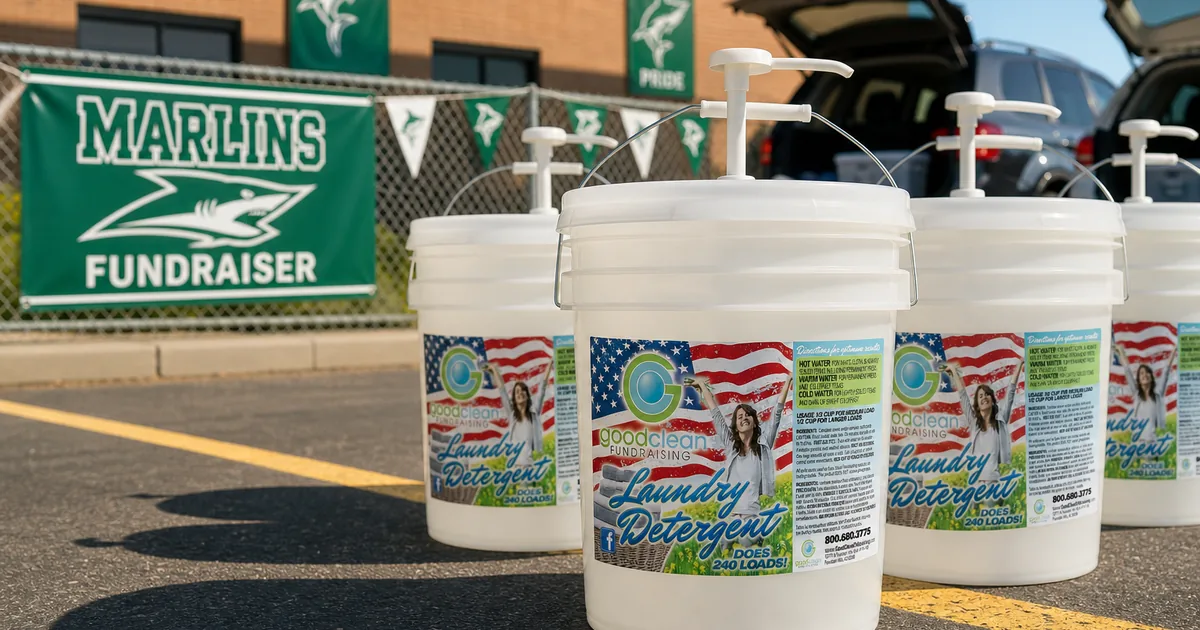
No fundraiser is the most profitable for every booster club. Estimate units or attendance, apply the actual margin or commission, and subtract all additional expenses. GCF detergent is one option: the published margin is $13.45 at 100–299 buckets, $14.45 at 300–499, and $15.45 at 500+, before extra group costs. Discount cards, car washes, and treat campaigns need their own quotes and budgets. The numbered list below is an editorial shortlist, not a measured ranking of campaign performance.
Every booster club coordinator eventually asks the same question: which fundraiser actually raises the most money? The answer matters, because the wrong choice can mean weeks of volunteer work for a disappointing total, while the right one can hit your goal with a manageable workload.
Profitability is not just about the margin on paper — it is about how many people will buy, how much each family sells, and whether the program saddles your group with upfront costs or perishable inventory. A fundraiser that keeps a large share per item but only reaches a narrow pool of buyers will often raise less than a lower-margin program that interested supporters want.
This guide compares fundraising options by demand, vendor terms, and volunteer duties, and shows how to calculate projected net proceeds. The numbered order expresses our product recommendation; it is not supported by a study ranking all booster fundraisers.
- Estimated net proceeds = units sold × applicable unit margin − extra expenses. Track volunteer hours separately to assess workload.
- Bulk detergent offers published order-tier margins; whether it suits your group depends on demand and handling capacity.
- Treat-product margins, storage requirements, and payment terms vary by vendor and product; obtain a written quote.
- At the published $49.95 price (online orders add $2), GCF lists $13.45 per bucket for 100–299, $14.45 for 300–499, and $15.45 for 500+, before additional group expenses.
- No-upfront-cost structures protect your profit by reducing speculative inventory exposure; other costs can remain.
- Choose using realistic net proceeds and volunteer capacity, not a margin percentage or product category alone.
What makes a booster club fundraiser profitable?
Profit depends on units sold, the applicable margin, and additional costs. Volunteer time is a separate planning measure: divide net proceeds by total hours if you want to compare efficiency. Ease of running is not a numerical multiplier in a profit formula.
A common mistake is chasing the highest percentage without asking who will actually buy the product. A novelty item that keeps a large share per sale but only appeals to a narrow slice of supporters may raise less than a household staple with a moderate margin that reaches every family. Profitability is margin times volume, and volume comes from broad appeal and repeat buyers.
Why do household-necessity fundraisers raise more than traditional product fundraisers?
Household necessities can be a useful alternative when supporters want bulk supplies, but the evidence here does not establish that they raise more than treats. Estimate demand for the actual price, quantity, and pickup arrangement before choosing.
A $49.95, 640-fluid-ounce bucket costs about 7.8 cents per fluid ounce before any surcharge. Compare current prices and label dosage; a per-ounce comparison alone does not establish equal cost per load. Treat, catalog, and detergent vendors each set their own prices and margins. Compare real products rather than assuming a category guarantees better value or repeat participation.
Logistics also differ. Treat fundraisers are often perishable, require timed delivery, and need storage the moment they arrive. A non-perishable household product needs safe storage and a planned pickup, which can reduce the scramble that eats volunteer time and limits how much a group can handle.
What are the most profitable booster club fundraisers, ranked by what groups keep?
The following is an editorial shortlist for evaluation, not a verified highest-to-lowest profit ranking. GCF figures use its published terms; obtain current written quotes and local budgets for the other options before making a financial comparison.
1. Bulk laundry detergent fundraisers
A bulk detergent campaign is worth evaluating when supporters want a five-gallon purchase. At the published $49.95 price (online orders add $2), GCF lists $13.45 per bucket for 100–299, $14.45 for 300–499, and $15.45 for 500+, before additional group expenses. A $49.95, 640-fluid-ounce bucket costs about 7.8 cents per fluid ounce before any surcharge. Compare current prices and label dosage; a per-ounce comparison alone does not establish equal cost per load.
Check repeat demand rather than assuming last year’s buyers will reorder. Detergent avoids frozen storage, but the group still needs commercial delivery, safe handling, and pickup. Those practical duties and all extra expenses belong in your comparison.
GCF offers The Good Clean Fundraiser for groups including boosters. At the published $49.95 price (online orders add $2), GCF lists $13.45 per bucket for 100–299, $14.45 for 300–499, and $15.45 for 500+, before additional group expenses. Collect orders and supporter payments, then submit one paid group order. The minimum is 50 buckets; shipping is free at 100+, with shipping charges below 100. Allow two to three weeks for selling plus about two weeks after the paid order for fulfillment. Arrange a commercial delivery address and a volunteer pickup team; a loading dock or forklift is recommended. GCF advertises a 100% money-back guarantee: GCF refunds a dissatisfied supporter directly, and the group keeps its earned profit. Ask GCF about return costs and refund procedures for your campaign after registration. Confirm any seller incentives separately before budgeting or advertising them.
2. Discount card fundraisers
Discount card programs sell a card offering deals at local businesses. The share a group keeps per card varies by vendor, and the cards are easy to carry and hand out. The challenge is that profitability depends on card cost, selling price, fees, and units sold, as well as the quality and breadth of the participating businesses — a card with strong local merchants may do better than one with obscure or distant offers. Buyer appeal depends on your audience and the offers; it may be narrower or broader than a household necessity, because not everyone shops at the featured stores.
3. Car wash fundraisers
A well-run car wash can deliver a decent profit with minimal cost, especially if the location and weather cooperate. The per-car margin is moderate, and the event itself builds team spirit. The downside is that profitability is capped by how many cars you can wash in a few hours, and the total depends heavily on weather, location, and volunteer turnout. It is a good supplemental fundraiser or a main campaign if its realistic net budget meets the club’s needs.
4. Cookie dough, candy, and popcorn fundraisers
Treat campaigns can work with interested supporters. Margins, pre-order arrangements, storage, and fees differ between frozen dough, candy, popcorn, and their vendors. Obtain the actual terms and compare likely net proceeds; this article does not establish that they consistently underperform detergent.
How does profit compare across the top booster club fundraisers?
The selected comparison below covers treat products and bulk detergent, not all four options listed above. Discount cards and car washes need vendor quotes or local cost estimates before a useful numerical comparison is possible. Use the same net-proceeds formula for each.
What should booster clubs look for in a high-profit fundraiser?
When you are comparing options, judge each program on five factors: per-unit profit, buyer breadth, repeat-use potential, upfront cost, and ease of running. A fundraiser that scores well across all five can be a better fit than choosing on margin alone. Ask whether the product is something many households already buy, whether supporters will feel they got real value, whether there is any financial risk to your group, and whether the logistics are simple enough that volunteers will not burn out halfway through.
How do you calculate which fundraiser will raise the most for your booster club?
Estimated product proceeds = participating families × average units per family × applicable unit margin − additional expenses. All terms matter. A participation increase raises proceeds only if it produces more profitable sales after costs; it is not automatically more valuable than a margin change.
Use your own past participation or a supporter survey. For illustration, 40 families selling 6 buckets each produce 240 GCF buckets and $3,228 before extra expenses. If the estimate misses your goal, consider demand, price, margin, expenses, another revenue source, or a revised target.
| Factor | Treat products | Bulk necessities |
|---|---|---|
| Per-unit profit | Obtain vendor quote | GCF order-tier dependent |
| Buyer reach | Product-specific demand | Bulk-product demand |
| Repeat buyers | Repeat demand varies | Repeat demand varies |
| Upfront cost | Vendor terms vary | No-upfront-cost options |
| Perishability & logistics | Product-specific storage | Plan bulk delivery and pickup |
| Value to supporter | Compare price and quantity | Compare price and dosage |
Common mistakes to avoid
Chasing margin without considering buyer reach
A high per-item profit on a product few people want raises less than a moderate margin on something everyone needs. Profitability is margin times volume, and volume comes from broad appeal.
Ignoring upfront cost and financial risk
Programs that require buying inventory in advance put your booster club's money at risk if sales fall short. A no-upfront-cost program protects your profit by reducing that inventory exposure.
Picking a fundraiser that is hard to run
Perishability, complex logistics, and volunteer burnout all erode profit. The most profitable fundraiser is one your team can actually finish without exhausting your volunteers halfway through.
Not confirming the profit terms in writing
Profit split, shipping costs, and delivery method should be confirmed before you launch. Discovering hidden fees or lower-than-expected margins after the campaign is too late.
- GCF pricing — published price, online surcharge, and order-volume margins; figures are before additional group expenses.
- GCF how it works — minimum order, shipping threshold, selling window, paid-order lead time, commercial delivery, and advertised guarantee.
- Planning method: estimate units from your own supporter demand, apply the vendor tier to each order separately, and subtract shipping, fees, supplies, refunds, and other group expenses. Examples are illustrations, not observed campaign results.
Our recommendation
Start by comparing projected net proceeds and volunteer capacity across the options your supporters want. GCF is our product recommendation when bulk detergent fits that demand. At the published $49.95 price (online orders add $2), GCF lists $13.45 per bucket for 100–299, $14.45 for 300–499, and $15.45 for 500+, before additional group expenses. Collect orders and supporter payments, then submit one paid group order. The minimum is 50 buckets; shipping is free at 100+, with shipping charges below 100. Allow two to three weeks for selling plus about two weeks after the paid order for fulfillment. Arrange a commercial delivery address and a volunteer pickup team; a loading dock or forklift is recommended. GCF advertises a 100% money-back guarantee: GCF refunds a dissatisfied supporter directly, and the group keeps its earned profit. Ask GCF about return costs and refund procedures for your campaign after registration. Confirm incentives separately; this recommendation is not a measured market-wide profitability ranking.
Frequently asked questions
There is no universal winner. Compare realistic sales or attendance, actual margin or commission, and all extra expenses. GCF publishes margins of $13.45 at 100–299 buckets, $14.45 at 300–499, and $15.45 at 500+, before extra costs. The article’s numbered options are recommendations to evaluate, not an evidence-based performance ranking.
At the published $49.95 price (online orders add $2), GCF lists $13.45 per bucket for 100–299, $14.45 for 300–499, and $15.45 for 500+, before additional group expenses. Other products need current vendor quotes. Compare expected total units and all fees rather than assuming a higher per-item margin always produces more net proceeds.
They do not necessarily raise more. Detergent may suit buyers who want a bulk household product and avoids frozen storage, but needs delivery and pickup. Compare demand and net proceeds with your actual treat-program quote before choosing.
Not always. Some vendors require advance inventory purchases; others take paid pre-orders. GCF requires no payment to start, then a paid group order of at least 50 buckets, with free shipping at 100+. This reduces speculative inventory but still leaves costs and responsibilities to budget.
Estimate participating families × average units × applicable margin, then deduct extra expenses. For illustration, 240 GCF buckets at $13.45 retain $3,228 before additional costs. Use your own demand estimate and calculate each separate order at its own tier.
Judge each program on five factors: per-unit profit, buyer breadth, repeat-use potential, upfront cost, and ease of running. A fundraiser that scores well across all five can be a better fit than choosing on margin alone. Ask whether the product is something many households already buy, whether supporters will feel they got real value, whether there is any financial risk to your group, and whether the logistics are simple enough that volunteers will not burn out.
Not universally. Compare actual buyer demand, margins, costs, and handling duties. Detergent avoids freezer storage but needs safe bulk handling and pickup; treat requirements depend on the product. Neither category guarantees a higher total.
At the published $49.95 price (online orders add $2), GCF lists $13.45 per bucket for 100–299, $14.45 for 300–499, and $15.45 for 500+, before additional group expenses. Collect orders and supporter payments, then submit one paid group order. The minimum is 50 buckets; shipping is free at 100+, with shipping charges below 100. Allow two to three weeks for selling plus about two weeks after the paid order for fulfillment. Arrange a commercial delivery address and a volunteer pickup team; a loading dock or forklift is recommended. GCF advertises a 100% money-back guarantee: GCF refunds a dissatisfied supporter directly, and the group keeps its earned profit. Ask GCF about return costs and refund procedures for your campaign after registration. Ask about any incentive offer before advertising it.
Choose the fundraiser with the best realistic net budget for your club and a workload volunteers can cover. Bulk detergent is one option when demand supports it. Published margins make the calculation transparent, but profitability still depends on sales and costs.