
Church, Ministry & Youth Group Fundraising
Church Fundraiser Products: What to Sell to Raise More
The best products for church fundraisers — what sells, what supporters actually want, and which programs raise the most with the least effort.
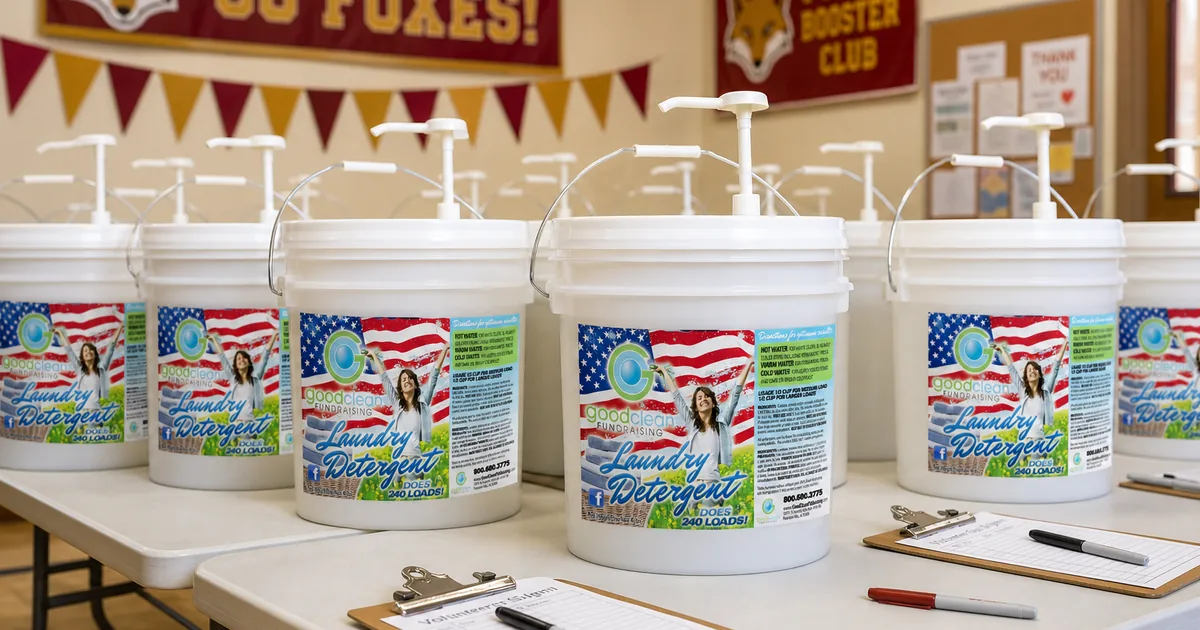
Choose church fundraiser products by local demand, supporter value, margin, payment terms, and delivery work. Bulk laundry detergent is one household-staple option; food, discount cards, and seasonal items may fit other supporters. No category is established here as the highest-performing choice. The published customer price is $49.95 per 5-gallon pump bucket (online orders add $2). Before additional group expenses, the margin is $13.45 at 100–299 buckets, $14.45 at 300–499, and $15.45 at 500+. The minimum order is 50 buckets; shipping is free at 100+, while shipping below 100 reduces the margin. These are planning options, not measured performance rankings.
Choosing what to sell is the decision that shapes everything else about a church fundraiser — who buys, how much you raise, how hard it is to run, and whether your congregation feels good about asking. Get the product right and participation may rise; get it wrong and even the most committed volunteers may struggle to find buyers.
The challenge is that many church groups default to a familiar catalog of treats and novelties without asking whether it still fits their supporters. Supporters may be asked often and may care about price and usefulness, so check current demand rather than assuming that what worked before will work now.
This guide covers what makes a church fundraiser product effective, the categories to compare, how household necessities compare with traditional options, the profit and value dynamics that drive participation, and the mistakes that quietly cap how much a church can raise.
- A practical product should fit supporters’ needs, preferences, and budget; household necessities are one option.
- Compare interested buyers for each product rather than assuming a treat or household staple has universal demand.
- State the actual price and quantity so supporters can decide whether the product offers value.
- Non-perishable products avoid the food-refrigeration requirements that make food fundraisers hard to manage.
- No-upfront-cost programs reduce advance-inventory risk and make it easier for smaller churches to launch a campaign.
- Total proceeds depend on units sold, the applicable margin, and extra expenses; compare all three.
What makes a good church fundraiser product?
Before comparing specific products, it helps to have a framework. Church fundraisers can be compared on the same five factors, and weakness on any one of them may help explain why a campaign underperforms.
First, buyer breadth: how many people in your congregation and community will actually want it? Check demand rather than assuming everyone wants the product. Second, repeat use: is it something supporters consume and repurchase, or a one-time novelty? Third, profit per unit: what does the church keep after cost? Fourth, upfront cost and risk: does the church have to buy inventory first, or is it no-cost? Fifth, ease of running: perishability, delivery logistics, and vendor support all decide how much work falls on volunteers.
Judge every product against that scorecard. A fundraiser that scores well on all five may outperform one that wins on margin alone.
What are the best products to sell for a church fundraiser?
Use those factors to compare the following categories. The order reflects an editorial preference, not a measured ranking.
Household necessities: the standout category
Everyday consumables — laundry detergent, cleaning supplies, and similar staples — may appeal to households that need them. Bulk size, formula, price, and storage still affect demand. Detergent avoids food refrigeration, but requires safe handling and distribution.
Good Clean Fundraising offers a bulk detergent program for fundraising groups. The published customer price is $49.95 per 5-gallon pump bucket (online orders add $2). Before additional group expenses, the margin is $13.45 at 100–299 buckets, $14.45 at 300–499, and $15.45 at 500+. The minimum order is 50 buckets; shipping is free at 100+, while shipping below 100 reduces the margin. GCF materials and support help with planning; the church remains responsible for collecting payments and arranging distribution.
For a buyer who wants the product, the offer can combine a planned purchase with ministry support. Explain the price and quantity clearly rather than promising that this framing will increase participation.
GCF refunds a dissatisfied supporter directly, and the group keeps its earned profit. Ask GCF about return costs and refund procedures for your campaign after registration. Ask GCF to confirm any proposed incentive availability and funding before advertising prizes.
Traditional food and treat products
Cookie dough, candy, and popcorn can suit interested supporters. Check actual margins and handling requirements: frozen dough needs cold storage, while shelf-stable snacks have different needs. Neither the buyer pool nor campaign results can be inferred from the category alone.
Discount cards and coupon books
Discount cards and coupon books depend on participating merchants and whether supporters will use the offers. Check any printing or card-purchase costs, minimum quantities, expiration dates, and restrictions before committing.
Seasonal and specialty items
Wreaths, candles, gift wrap, and other seasonal items can fit supporters who want them. Check the sales window and repeat demand rather than assuming they score below consumables.
How do household-necessity fundraisers compare with traditional products?
The table compares two selected product formats across six factors. Discount cards and seasonal products are discussed separately above; this is not a complete ranking of all options.
What's the profit and value breakdown for church fundraiser products?
Total product proceeds before extra costs equal active sellers × average units sold × margin per unit. Subtract additional group expenses to estimate net proceeds. A higher margin does not compensate for every possible difference in demand.
The published customer price is $49.95 per 5-gallon pump bucket (online orders add $2). Before additional group expenses, the margin is $13.45 at 100–299 buckets, $14.45 at 300–499, and $15.45 at 500+. The minimum order is 50 buckets; shipping is free at 100+, while shipping below 100 reduces the margin. Illustrative calculation, not a reported campaign result: 150 buckets × $13.45 = $2,017.50 retained before additional group expenses. This uses the tier for one 150-bucket order; actual sales and costs determine the final result.
Useful products can support an honest offer. The outcome still depends on demand, price, and workload; this guide does not document higher sales per family than treat programs.
Why do household-necessity products work so well for churches?
Churches face a unique dynamic: they're asking their own congregation to support a cause those supporters already care about, which should make fundraising easier — but it also means people are asked repeatedly, and asking too often or for the wrong things erodes goodwill fast. A household-necessity fundraiser solves that problem by offering another way to participate.
A supporter may choose to replace a planned detergent purchase with a fundraiser order when the size, formula, and price suit them. The bulk payment is still an expense, and savings depend on the alternative product and dosing. Avoid assumptions about older members or families on tight budgets.
Consumables may create repeat demand when buyers need more and liked the product. Do not plan another campaign on the assumption that supporters will automatically reorder.
What about no-upfront-cost and low-risk options?
Preorders can reduce the risk of buying speculative inventory. Compare each program’s payment, minimum-order, shipping, and refund terms; traditional food and non-food programs may both offer preorders.
There is no payment to start. Collect orders and supporter payments, then submit a paid group order. Allow two to three weeks for selling plus about two weeks after the paid order for fulfillment. Your team arranges a commercial delivery address, unloading, and distribution; a loading dock or forklift is recommended.
Common mistakes churches make when choosing fundraiser products
| Factor | Traditional Treat Product | Household Necessity |
|---|---|---|
| Buyer pool | Interested snack buyers | Interested households |
| Repeat customers | May buy again | May need replenishment |
| Perishable? | Depends on product | No freezer needed |
| Delivery logistics | Check storage needs | Bulk pickup needed |
| Upfront cost | Check preorder terms | GCF: paid preorder |
| Profit per unit | Check vendor margin | GCF: $13.45–$15.45* |
Common mistakes to avoid
Choosing a product with a narrow buyer pool
If only a small slice of your congregation will actually want the product, participation caps fast. Compare interested buyers, likely units, and margin for each option.
Ignoring the value-to-supporter equation
Supporters participate more when they feel they're getting something genuinely useful for their money, not just helping the church. An overpriced treat feels like a donation disguised as a sale; a staple at the published price feels like a win for everyone.
Overlooking logistics and volunteer load
Perishable products, frozen delivery, and complex order tracking all add work for volunteers. The easier the product is to handle, the more likely your team will stay engaged through delivery.
Fronting money for inventory without a safety net
If a no-upfront-cost option exists, there's rarely a reason to take on financial risk. Smaller churches especially should favor programs where they collect orders and supporter payments first.
Picking a product that worked a decade ago without asking if it still works now
Do not assume that a familiar product still fits your supporters, or that a newer one must perform better. Ask about current demand and compare the complete costs before choosing.
- Good Clean Fundraising — published customer price, online surcharge, and order-volume margins. Pricing.
- Good Clean Fundraising — minimum order, selling window, paid-order lead time, delivery responsibilities, and advertised guarantee. How it works.
Our recommendation
If a household-staple product fits your supporters, Good Clean Fundraising is an option to consider. The published customer price is $49.95 per 5-gallon pump bucket (online orders add $2). Before additional group expenses, the margin is $13.45 at 100–299 buckets, $14.45 at 300–499, and $15.45 at 500+. The minimum order is 50 buckets; shipping is free at 100+, while shipping below 100 reduces the margin. There is no payment to start. Collect orders and supporter payments, then submit a paid group order. Allow two to three weeks for selling plus about two weeks after the paid order for fulfillment. Your team arranges a commercial delivery address, unloading, and distribution; a loading dock or forklift is recommended. GCF refunds a dissatisfied supporter directly, and the group keeps its earned profit. Ask GCF about return costs and refund procedures for your campaign after registration.
Frequently asked questions
Compare household products, treats, discount cards, and seasonal items by interested buyers, price, costs, and handling needs. Bulk detergent is one option, but there is no universal best product for every church.
No product is guaranteed to raise the most. Compare expected units × the applicable margin, then subtract additional costs. Participation, units per seller, price, and volunteer capacity all affect the result.
Food fundraisers can work when demand and handling requirements fit your group. Frozen cookie dough needs cold storage; shelf-stable snacks have different needs. Compare the actual terms and projected net proceeds with non-food options.
Illustrative calculation, not a reported campaign result: 150 buckets × $13.45 = $2,017.50 retained before additional group expenses. This uses the tier for one 150-bucket order; actual sales and costs determine the final result.
Some do and some don't. Some traditional programs require ordering inventory in advance, which puts financial risk on the church, while others offer preorders, so compare each program’s terms. No-upfront-cost programs let you collect orders and supporter payments first and use collected supporter payments for the paid order, which can help smaller churches or first-time fundraisers.
Ask supporters about product preference, quantity, price, and pickup. Useful household items may fit some buyers, while treats, seasonal goods, or direct giving may fit others. There is no verified participation ranking here.
A household-product sale offers another way to participate when a buyer wants the item. It still involves an invitation and a purchase; it does not guarantee savings, remove every awkward conversation, or suit every household.
The Good Clean Fundraiser is GCF’s bulk detergent program. The published customer price is $49.95 per 5-gallon pump bucket (online orders add $2). Before additional group expenses, the margin is $13.45 at 100–299 buckets, $14.45 at 300–499, and $15.45 at 500+. The minimum order is 50 buckets; shipping is free at 100+, while shipping below 100 reduces the margin. There is no payment to start. Collect orders and supporter payments, then submit a paid group order. Allow two to three weeks for selling plus about two weeks after the paid order for fulfillment. Your team arranges a commercial delivery address, unloading, and distribution; a loading dock or forklift is recommended. GCF refunds a dissatisfied supporter directly, and the group keeps its earned profit. Ask GCF about return costs and refund procedures for your campaign after registration.
Choosing the product affects demand, proceeds, and the work required. If household detergent fits your buyers and volunteers, consider it alongside other options, using the actual terms and your ministry’s goal.