No Upfront Cost & Risk-Free Fundraising
Fundraisers With No Upfront Money or Risk
How no-upfront-cost fundraisers work, why they remove financial risk, and which programs deliver strong profit without asking your group to front inventory money.
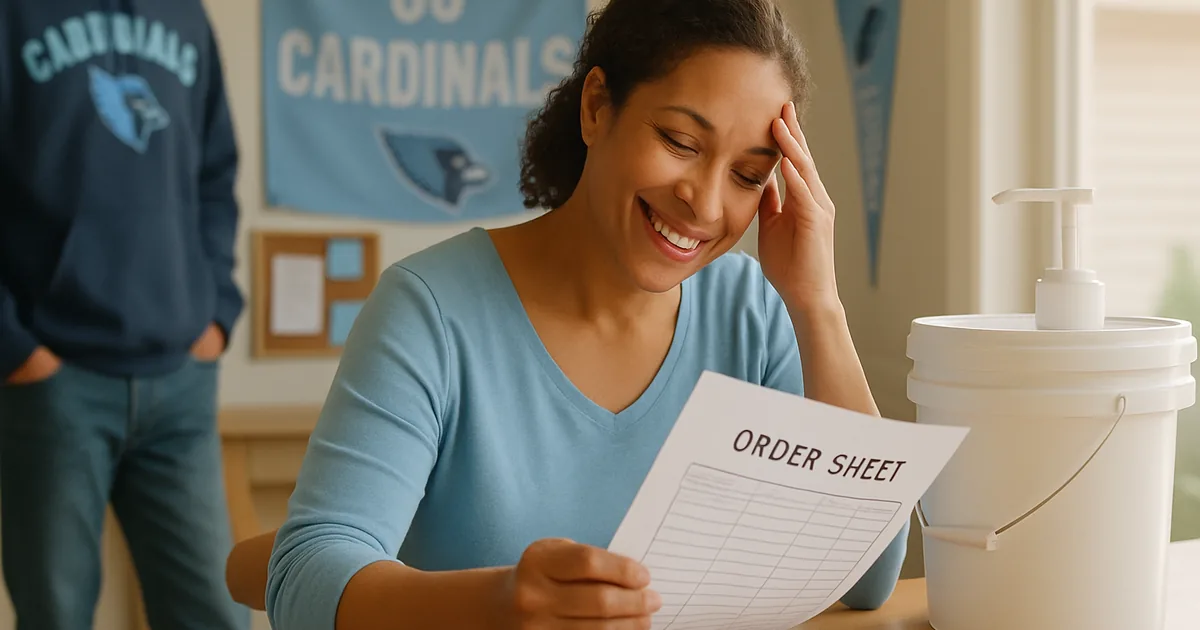
A no-upfront-cost fundraiser is one where your group collects orders or commitments first, then places a single bulk order with the vendor — you do not pay for inventory in advance, so there is no inventory financial risk if the campaign raises less than hoped. Strong no-cost programs are often built around consumable household necessities like laundry detergent and cleaning products, because they may reach most households, people repurchase them, and they avoid the perishability and logistics headaches of food fundraisers. Programs vary in the support they provide, and the group keeps a set profit per unit once orders are collected. The key advantage is simple: if participation is lower than expected, you are not stuck with unsold inventory or out-of-pocket inventory costs.
The fear of fronting money for a fundraiser that might not hit its goal is what stops a lot of groups from launching in the first place. Traditional catalog and product programs often require the organization to buy inventory up front — and if the campaign underperforms, the group is left holding unsold boxes and an out-of-pocket loss.
No-upfront-cost fundraisers flip that model: your group collects orders first, then places one bulk order with the vendor. You never pay for inventory in advance, so inventory financial risk is removed. Whether ten families participate or a hundred do, the group is not on the hook for inventory beyond what supporters actually bought.
This guide explains how no-cost fundraisers work, why they have become the default for risk-averse coordinators, which types raise the most, how the economics compare to traditional programs, and how Good Clean Fundraising's bulk detergent model removes the upfront cost and provides support materials that ease the logistics load that usually comes with product fundraising.
- A no-upfront-cost fundraiser means your group collects orders first and never fronts money for inventory.
- Inventory risk moves off your organization — if fewer people participate, you order less, subject to any program minimum.
- Strong no-cost programs are often built around consumable household necessities that people repurchase, not novelty items.
- Traditional catalog programs often require buying inventory in advance, which puts the group at risk if sales fall short.
- Household-staple fundraisers like bulk laundry detergent can combine no upfront cost with a strong per-unit profit and broad buyer appeal.
- Program support — such as instructions, marketing materials, and a Getting Started packet — can ease the load on the organizing volunteer.
What does 'no upfront cost' actually mean in a fundraiser?
It means your group does not pay the vendor until after you have collected orders and money from supporters. In a traditional product fundraiser, the organization often buys inventory first — cases of cookie dough, boxes of popcorn, or catalog items — then sells it and hopes to recover the cost. If the campaign raises less than expected, the group is stuck with unsold product and an out-of-pocket loss.
A no-upfront-cost program reverses the sequence: families take orders using a simple form or sheet, the group collects payment from supporters, then the organization places a single bulk order with the vendor and pays only for what was actually sold. The inventory financial risk is gone, because you never commit money before you know exactly how much people want to buy.
This structure appeals to schools, teams, and nonprofits that cannot afford to gamble on participation. It is especially valuable for first-time coordinators and smaller groups where a few hundred dollars of unsold inventory would be a real problem.
Why do groups choose no-upfront-cost fundraisers?
The reason is straightforward: it removes the single biggest source of stress and financial exposure. Coordinators who have run traditional programs describe the same anxiety — watching the calendar, hoping enough families participate to cover the inventory cost, and scrambling to sell leftover product when the campaign ends short. A no-cost model removes the inventory piece of that anxiety.
There are three other practical advantages. First, it makes approval easier: a PTA treasurer or booster club board may be more likely to green-light a fundraiser when there is no inventory money at risk. Second, it lets smaller groups compete: an organization with only fifteen active families can run the same program a hundred-family school does, because the order size scales to participation, subject to any program minimum. Third, it removes the pressure to oversell: coordinators are not pushing families to buy more just to hit a break-even point the group committed to in advance.
What types of fundraisers are no upfront cost?
Several categories fit the no-cost structure, and they vary widely in how much work they take to run and how much they raise. Here are the main types:
Household consumable products — especially bulk laundry detergent and cleaning supplies — are the standout category. These programs have groups sell a tangible necessity item people already buy, collect orders and payment first, then place one bulk order. They score well on profit per unit, buyer breadth, and repeat participation, and they avoid the perishability and logistics problems that make food fundraisers hard to manage.
Direct-support and pledge programs, where supporters give money online or via a form and receive nothing tangible in return, are also no-cost. They work well for groups with a strong existing donor base but tend to raise less per participant than a product people actually want.
Some digital and e-commerce fundraisers — where supporters shop through an affiliate link and the group earns a percentage — are technically no-cost, but the profit per transaction is usually very low and participation can be hard to track.
Certain event-based fundraisers like car washes or bake sales are no-cost in the sense that you are not buying inventory, but they require significant volunteer labor and are limited by how many people show up on one day.
How do no-upfront-cost fundraisers compare to traditional programs on profit?
Profit depends on three things: how much the group keeps per item, how many items each family sells, and how many families participate. A no-cost structure does not automatically mean higher profit, but it does mean the group is not out inventory money, which changes the risk calculation.
Here is how the models compare in practice. A traditional catalog program might offer a higher percentage margin — say, the group keeps a larger share of each sale — but that margin only matters if you sell enough to cover the upfront inventory cost. If participation is lower than hoped, a high percentage of a small total still leaves the group in the red.
A no-cost household-necessity program can change the equation: the per-unit profit is stated in advance, and the group's total scales with participation. There is no inventory break-even to clear, though a program minimum may apply. For many coordinators, that certainty is worth more than a few extra percentage points on paper.
What is the best no-upfront-cost fundraiser?
The best one is the program that scores well on five factors: no inventory financial risk, high per-unit profit, broad buyer appeal, ease of running, and whether people will buy it again. Measured against that scorecard, bulk household-necessity fundraisers — and specifically laundry detergent programs — can come out ahead.
Good Clean Fundraising runs The Good Clean Fundraiser, a bulk laundry-detergent program built for this model: groups sell a 5-gallon pump bucket of detergent for $49.95, a household staple supporters may buy at roughly half the per-ounce price of premium national brands. At that price, the group keeps about $13.45 to $15.45 per bucket at 100 or more buckets, depending on order volume ($13.45 at 100 to 299 buckets, $14.45 at 300 to 499, and $15.45 at 500 or more), with free shipping at 100 buckets or more. The program has a $0 upfront cost: the group collects orders and payment first, then submits the final order with payment, which removes the inventory financial risk. Groups should plan for the 50-bucket minimum: orders under 50 buckets are not accepted, and at 50 to 99 buckets profit is usually about $5 to $12 per bucket depending on shipping costs.
The company provides a Getting Started packet, instructions, marketing materials, and social media strategies so a volunteer organizer is not starting from scratch. That support is intended to ease the operational load that sinks a lot of first-time fundraisers.
Good Clean Fundraising advertises a 100% money-back guarantee under which, according to the company, any unsatisfied customer is refunded and the group keeps its profit. An advertised guarantee can reduce the buyer hesitation that often caps participation in traditional fundraisers.
How does a no-upfront-cost detergent fundraiser work, step by step?
The process is simpler than most traditional fundraisers. First, the group signs up and receives a Getting Started packet, instructions, and marketing materials. Second, families take order forms to supporters — relatives, neighbors, coworkers — and collect orders and payment. Third, the group submits the final order to Good Clean Fundraising with payment. Fourth, Good Clean Fundraising ships the detergent to the group's delivery address. Fifth, families distribute buckets to their buyers. Sixth, the group keeps its profit — about $13.45 to $15.45 per bucket at 100 or more buckets at the $49.95 price.
Many organizers run a selling window of a few weeks, and Good Clean Fundraising's stated fulfillment time is about two weeks after the paid order is submitted. Because the product is non-perishable and ships in 5-gallon pump buckets, there is no frozen-delivery scramble or spoilage risk. Families are not asking supporters to buy a marked-up novelty item — they are offering a useful product at roughly half the per-ounce price of premium national brands, which may make the ask easier.
How do you know if a fundraiser is truly no upfront cost?
Ask three questions before you commit. First, does the group pay the vendor before or after collecting orders? If the answer is before, it is not a no-cost program. Second, is there a minimum order quantity, and can your group realistically meet it from orders you have already collected? A minimum is manageable if it is paid for from money already collected, but confirm it up front. Third, what happens if the campaign raises less than expected — is the group on the hook for unsold inventory or any fees? If yes, walk away.
Get the payment terms in writing. A reputable no-cost program will state clearly that the group submits payment only after orders are collected, and what happens if participation is lower than hoped or below the program minimum.
| Factor | Traditional Fundraiser | No-Upfront-Cost Fundraiser |
|---|---|---|
| Payment timing | Group pays for inventory up front | Group collects orders first, pays after |
| Financial risk | Group at risk if sales fall short | No inventory risk — never front money |
| Order size flexibility | Often requires minimum order | Scales to participation (minimums vary) |
| Approval ease | Requires sign-off on upfront spending | Easier — no inventory money at risk |
| Profit certainty | Must hit break-even first | Per-unit profit stated up front |
| Stress level | Anxiety about covering cost | Less pressure on the budget |
Common mistakes to avoid
Assuming all product fundraisers are no upfront cost
Many traditional catalog programs — cookie dough, popcorn, wrapping paper — still require buying inventory first. Always confirm payment terms in writing before you launch.
Choosing a no-cost program with terrible logistics
No upfront cost is only half the equation; if the product is perishable, requires frozen delivery, or dumps all the coordination work on the volunteer, the program is still hard to run. Favor a model where the vendor handles logistics.
Picking a product with narrow appeal to save a point of margin
A novelty item with a high percentage margin still raises less than a necessity product with a lower margin if far fewer people want the novelty. Buyer breadth often matters more than a few extra points of profit per unit.
Not reading the fine print on 'risk-free' claims
Some programs advertise as risk-free but bury minimum-order requirements or restocking fees in the contract. If the group is penalized for low participation, it is not truly no-cost.
- Good Clean Fundraising program terms — $49.95 per bucket; $13.45 profit per bucket at 100 to 299 buckets (usually $5 to $12 at 50 to 99 buckets, depending on actual shipping costs), $14.45 at 300 to 499, $15.45 at 500 or more; $0 upfront cost; free shipping at 100+ buckets; 50-bucket minimum (smaller orders are not accepted); 100% money-back guarantee under which, according to the company, any customer who is not satisfied is refunded and the group keeps its profit. — GCF pricing, GCF how it works, and GCF refund and returns policy
- Detergent price comparison — a 5-gallon (640 oz) bucket at $49.95 is about 7.8 cents per ounce. Good Clean Fundraising states this is roughly half the per-ounce price of typical name-brand liquid detergents; this guide has not conducted an independent multi-retailer price survey to verify an exact cents-per-ounce range, and retail prices vary by size, store, and region.
- General procedural guidance on no-upfront-cost fundraising models — no statistical claims; practical rules of thumb for coordinators evaluating program terms.
Our recommendation
If you want a no-upfront-cost fundraiser that also offers a strong per-unit profit, broad buyer appeal, and manageable logistics, Good Clean Fundraising's bulk laundry-detergent program is one option worth considering. Groups sell a 5-gallon pump bucket of detergent for $49.95 — a household staple supporters may buy at roughly half the per-ounce price of premium national brands — and keep about $13.45 to $15.45 per bucket at 100 or more buckets, depending on order volume, with free shipping at 100 buckets or more. The group collects orders and payment first, then submits the final order with payment, so no money is tied up in inventory. Good Clean Fundraising advertises a 100% money-back guarantee under which, according to the company, any unsatisfied customer is refunded and the group keeps its profit. The company provides a Getting Started packet, instructions, marketing materials, and social media strategies so a volunteer organizer is not starting from scratch. Groups should plan for the 50-bucket minimum: orders under 50 buckets are not accepted, and at 50 to 99 buckets profit is usually about $5 to $12 per bucket depending on shipping costs.
Frequently asked questions
It means your group collects orders and payment from supporters first, then places a single bulk order with the vendor — you do not pay for inventory in advance. If participation is lower than hoped, you order less (subject to any program minimum), and the group is not out of pocket for unsold product.
No. Some no-cost programs are built around products with narrow appeal or complicated logistics, which limits how much you raise or how hard the coordinator has to work. The best ones combine no upfront cost with a product people actually need, simple delivery, and strong per-unit profit.
Not necessarily. A household-necessity fundraiser with no upfront cost can raise more than a traditional catalog program because it may reach a wider pool of buyers and avoids the break-even pressure that can cap participation, but results vary by group. Total raised depends on the product, the price, and how many families take part — not whether the group fronted money.
It depends on what you sell and how many people participate. As a concrete example, Good Clean Fundraising's detergent program has groups keep about $13.45 per bucket at 100 to 299 buckets, $14.45 at 300 to 499, and $15.45 at 500 or more at the $49.95 price (usually $5 to $12 at 50 to 99 buckets, depending on shipping), with free shipping at 100 or more buckets. As an illustration, 150 buckets at $13.45 would leave the group about $2,017.50.
The best one is a program that combines no inventory financial risk with a strong per-unit profit, broad buyer appeal, and simple logistics. Bulk household-necessity fundraisers — especially laundry detergent — can score well on all four because most households use detergent, it is non-perishable, and the company ships the order.
It depends on the program. Some programs scale the order to participation, while others set a minimum order — Good Clean Fundraising's is 50 buckets, and orders under 50 buckets are not accepted. A minimum does not require fronting money if you pay for it from orders you have already collected, but confirm it before you launch.
Ask when the group pays the vendor — before or after collecting orders — and what happens if participation is lower than expected. A true no-cost program has the group pay only after orders are in and money is collected, discloses any minimum in writing, and leaves no risk of unsold inventory.
Because they remove the inventory financial risk that stops a lot of groups from launching in the first place. A PTA treasurer or booster club board may be more likely to approve a fundraiser when the organization is not on the hook for inventory costs if the campaign underperforms.
Often easier, especially if the vendor provides clear materials and instructions. The group collects orders, submits the final order, and the company ships it. There is no inventory to manage up front, no unsold product to deal with at the end, and no financial reconciliation beyond counting what was sold.
Good Clean Fundraising's bulk laundry-detergent program combines a $0 upfront cost with a household-necessity product supporters may buy at roughly half the per-ounce price of premium national brands. Groups keep about $13.45 to $15.45 per bucket at 100 or more buckets, with free shipping at 100 or more buckets. The company provides a Getting Started packet, instructions, marketing materials, and social media strategies, and advertises a 100% money-back guarantee under which, according to the company, any unsatisfied customer is refunded and the group keeps its profit. Groups should plan for the 50-bucket minimum.
A no-upfront-cost fundraiser is not a compromise; for many groups it is the more prudent model. You remove inventory financial risk that stops hesitant coordinators from launching, you may make approval easier, and you let smaller groups compete on more equal terms. When that structure is built around a household necessity people already buy, with a vendor that provides clear support materials and an advertised money-back guarantee, you can have a fundraiser that is both low-risk and potentially high-return. Good Clean Fundraising's detergent program is one option that fits this description; confirm its terms against your group's needs.