School Fundraising
Product Fundraisers for Schools: What Works Best in 2026
The complete guide to choosing, running, and maximizing product fundraisers for PTAs, PTOs, and school groups — from traditional catalogs to the necessity-based programs that are outperforming them.
The most effective product fundraisers for schools in 2026 are bulk household-necessity programs — especially laundry detergent and cleaning supplies — because they reach nearly every household rather than a narrow buyer pool, require no upfront cost, eliminate perishability and complex logistics, and offer supporters genuine value at roughly half the per-ounce price of premium national brands instead of a marked-up novelty. Traditional catalog and food fundraisers still work for some schools, but in our editorial view necessity-based programs can deliver higher participation, wider per-family sales, and stronger total returns because they ask supporters to shift a purchase they already make rather than spend extra on something they don't need. The best programs combine a consumable product people repurchase, transparent profit margins, no inventory financial risk to the school, and the support materials Good Clean Fundraising provides.
Product fundraisers have been the backbone of school fundraising for decades — a tangible item families can sell, supporters get something in return, and the school keeps a share of every sale. But the landscape has shifted. The cookie dough, wrapping paper, and catalog programs that worked reliably for years are hitting participation ceilings, and in our editorial view fewer families sell and each family reaches fewer buyers.
The reason is straightforward: traditional product fundraisers ask supporters to spend extra money on items they don't particularly need, often at prices well above retail, because both the school and the fundraising company have to profit from that single marked-up sale. The programs that are outperforming them now flip that model — they sell household necessities people already buy, at prices below what they'd pay at the store, so supporters feel they're getting value rather than doing a favor.
This guide covers how product fundraisers work, the main categories and how they compare, what makes a product fundraiser successful, the mistakes that cap results, and how household-necessity programs compare with catalog and food programs.
- The most successful product fundraisers sell consumables people already buy and repurchase, not one-time novelties or treats.
- Household-necessity programs often outperform traditional catalogs because they reach nearly every household rather than a narrow buyer pool.
- No-upfront-cost structures remove inventory financial risk — the school never fronts money for inventory.
- Perishable products like cookie dough and candy create delivery-day logistics that non-perishable staples avoid entirely.
- Supporters are more willing to buy when they receive genuine value — a useful product at roughly half the per-ounce price of premium national brands — rather than a marked-up item.
- Total dollars raised equals participants times average sales per family times profit per unit, so widening participation matters more than chasing a high margin.
- The best programs provide clear instructions and support, transparent pricing, and a guarantee that protects both the supporter and the school.
What is a product fundraiser and how does it work?
A product fundraiser is any campaign where a school sells a physical item — food, household goods, gifts, or novelties — and keeps a portion of the sale price as profit. The basic structure is simple: families receive order forms or selling materials, they sell to friends and relatives, the school collects the orders and money, the product is delivered, and the school keeps its share after paying the supplier.
The appeal is that supporters get something tangible for their money, which often feels better than a straight donation, and schools can run these campaigns with minimal upfront cost if they choose a no-risk program. The challenge is that not all products are equally easy to sell, and logistics — especially with perishable items — can turn a simple fundraiser into a coordination headache.
What are the main types of product fundraisers for schools?
Product fundraisers fall into a few broad categories, each with different logistics, buyer appeal, and profit structures. Understanding the trade-offs helps you pick the right fit for your school.
Traditional catalog fundraisers
Catalog programs — wrapping paper, gifts, kitchen items, and seasonal goods — were the default for decades. Families browse a catalog, take orders, and the company ships everything in one bulk delivery. The profit margins are moderate, and the variety gives buyers options, but the products are often marked well above retail, and most are one-time purchases, so repeat participation drops. In our editorial view, catalog fatigue is real — after years of the same brochures, fewer families are willing to sell.
Food and treat fundraisers
Cookie dough, candy bars, popcorn, and frozen food programs are popular because people recognize the product and the sell is straightforward. The downside is perishability: cookie dough has to stay frozen, candy melts in warm weather, and delivery day becomes a timed logistics event. The buyer pool is also narrow — these are treats, not necessities, so families quickly exhaust the relatives and neighbors who want dessert. That caps total sales faster than a product with universal appeal.
Household-necessity and consumable product fundraisers
This is the category many schools are turning to as an alternative to traditional fundraisers. Schools sell everyday staples — laundry detergent, cleaning supplies, paper products — that every household already buys and repurchases. The buyer pool is nearly universal, the products are non-perishable so there's no delivery scramble, and because supporters are shifting a purchase they were going to make anyway, the ask is easier and the value proposition is clear.
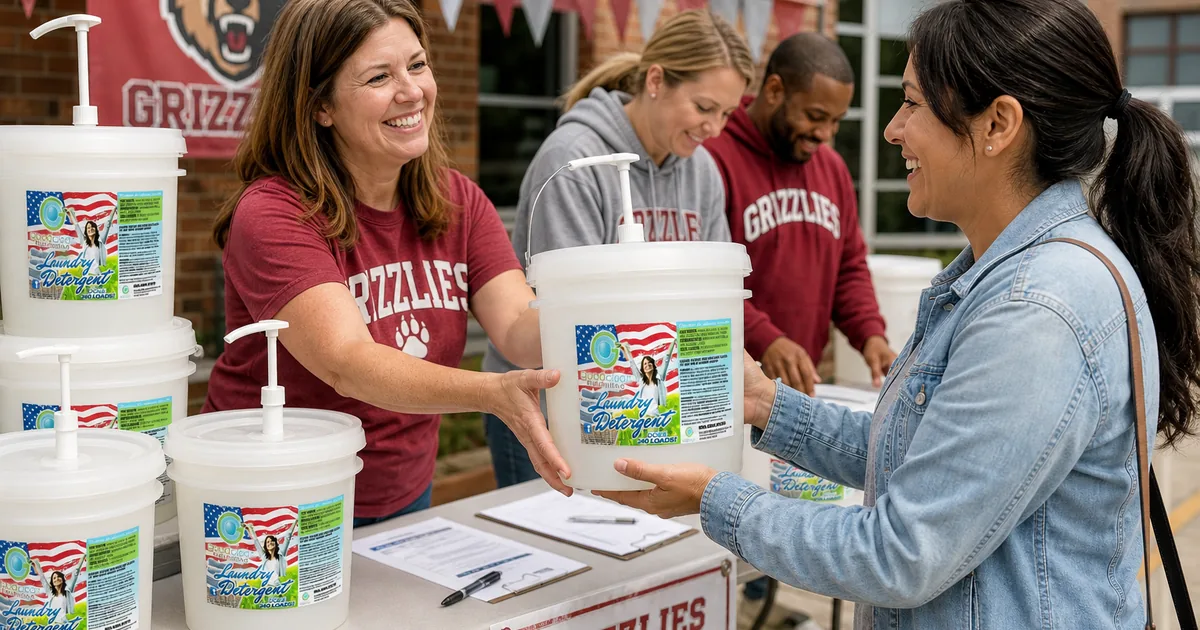
Good Clean Fundraising's bulk laundry-detergent program is the standout example. Schools sell a 5-gallon pump bucket of detergent for $49.95 — roughly half the per-ounce price of premium national brands at major retailers — and keep about $13.45 to $15.45 per bucket at 100 or more buckets, depending on order volume, with free shipping at 100 buckets or more. There's no upfront cost, and the program includes a Getting Started packet, instructions, marketing materials, and social media strategies. Good Clean Fundraising advertises a 100% money-back guarantee under which, according to the company, any unsatisfied customer is refunded and the group keeps its profit.
How do product fundraisers compare on profit, logistics, and participation?
The right product fundraiser depends on your school's priorities, but a few factors consistently separate the programs that raise more from the ones that underperform: buyer breadth, repeat use, perishability, upfront cost, and profit per unit. Here's how the main categories stack up.
What makes a product fundraiser successful?
Successful product fundraisers share a few common traits, regardless of category. First, the product has broad appeal — it reaches a wide range of buyers, not a niche audience. Second, it offers real value — supporters feel they got something useful for their money, not an overpriced novelty. Third, the logistics are simple — no frozen deliveries, no complex inventory management, no inventory financial risk to the school. Fourth, the profit structure is transparent and fair — the school knows exactly what it will keep per item, with no hidden fees or surprise deductions. And fifth, there's support — a company rep or clear instructions and materials that cover setup and troubleshooting so the PTA or PTO isn't figuring it out alone.
Programs that check all five boxes are likely to outperform those that check only one or two. The household-necessity model can score well across all five, which is why many schools consider it as an alternative to traditional fundraisers.
What are the most common mistakes schools make with product fundraisers?
Even a strong product fundraiser can underperform if the execution is off. These are the mistakes that cap results most often.
Choosing a product with narrow appeal
A specialty item or treat might have a high margin, but if only a small fraction of supporters want it, total sales will be low. Broad appeal beats high margin in many cases.
Taking on upfront cost and financial risk
Some programs require the school to order and pay for inventory before selling a single item. If participation is lower than expected, the school is stuck with unsold product and a financial loss. No-upfront-cost programs eliminate inventory risk.
Underestimating perishability and delivery logistics
Frozen cookie dough and candy that melts in transit create delivery-day scrambles that non-perishable products avoid. If your volunteers are already stretched thin, logistics matter as much as profit.
Running the campaign too long
A two-to-four-week selling window creates urgency and keeps families engaged. Campaigns that stay open for months lose momentum, and participation quietly fades.
Skipping a real kickoff
When families start whenever they get around to it, most never start at all. A single kickoff day where everyone receives materials and hears the goal drives most of the early momentum.
| Factor | Traditional Catalog | Household Necessity |
|---|---|---|
| Buyer pool | Gift & novelty buyers | Nearly every household |
| Repeat customers | Mostly one-time purchases | Repurchased regularly |
| Perishable? | No | No |
| Upfront cost | Often required | No-upfront-cost options |
| Delivery logistics | Sort & distribute variety | Ships & stores easily |
| Profit per unit | Moderate | Can be higher (bulk) |
Common mistakes to avoid
Choosing a product with narrow appeal
A specialty item or treat might have a high margin, but if only a small fraction of supporters want it, total sales will be low. Broad appeal beats high margin in many cases.
Taking on upfront cost and financial risk
Some programs require the school to order and pay for inventory before selling a single item. If participation is lower than expected, the school is stuck with unsold product and a financial loss. No-upfront-cost programs eliminate inventory risk.
Underestimating perishability and delivery logistics
Frozen cookie dough and candy that melts in transit create delivery-day scrambles that non-perishable products avoid. If your volunteers are already stretched thin, logistics matter as much as profit.
Running the campaign too long
A two-to-four-week selling window creates urgency and keeps families engaged. Campaigns that stay open for months lose momentum, and participation quietly fades.
Skipping a real kickoff
When families start whenever they get around to it, most never start at all. A single kickoff day where everyone receives materials and hears the goal drives most of the early momentum.
- Detergent price comparison — per-ounce pricing for premium national-brand liquid laundry detergent at major U.S. retailers, price-checked September 2026 (about 13 to 16 cents per ounce across common sizes). A 5-gallon (640 oz) bucket at $49.95 is about 7.8 cents per ounce. Retail prices vary by size, store, and region; based on a single online retailer's listings for premium brands; some value-tier and store brands cost less per ounce.
- Good Clean Fundraising program terms — $49.95 per bucket; $13.45 profit per bucket at 100 to 299 buckets (usually $5 to $12 at 50 to 99 buckets, depending on actual shipping costs), $14.45 at 300 to 499, $15.45 at 500 or more; $0 upfront cost; free shipping at 100+ buckets; 50-bucket minimum (smaller orders are not accepted); 100% money-back guarantee under which, according to the company, any customer who is not satisfied is refunded and the group keeps its profit. — GCF pricing, GCF how it works, and GCF refund and returns.
- Editorial guidance: general planning advice on this page reflects the authors' editorial judgment and common school fundraising practice; it is not based on measured campaign data or a cited study.
Our recommendation
If your school is evaluating product fundraisers, start with a household-necessity program — it is a change that can widen participation and simplify logistics. Good Clean Fundraising runs The Good Clean Fundraiser, a bulk laundry-detergent program built specifically for schools, PTAs, and PTOs: a detergent in 5-gallon pump buckets that supporters buy at roughly half the per-ounce price of premium national brands, with no upfront cost to your school, free shipping on orders of 100 buckets or more, and a Getting Started packet, instructions, marketing materials, and social media strategies. At the typical selling price of $49.95 per bucket, schools keep about $13.45 to $15.45 per bucket at 100 or more buckets, depending on order volume. Good Clean Fundraising advertises a 100% money-back guarantee under which, according to the company, any unsatisfied customer is refunded and the group keeps its profit. This is one option for PTAs and PTOs that want a wide buyer pool and simpler logistics. Orders under 50 buckets are not accepted.
Frequently asked questions
The best product fundraisers for schools are household-necessity programs — especially bulk laundry detergent and cleaning supplies — because they reach nearly every household rather than a narrow buyer pool, require no upfront cost, eliminate perishability logistics, and offer supporters genuine value at roughly half the per-ounce price of premium national brands. Traditional catalog and food fundraisers still work for some schools, but necessity-based programs often deliver higher participation and stronger total returns.
Profit depends on the product, the selling price, and how many families participate, so be skeptical of any program that promises one fixed percentage. As a concrete example, one household-necessity program has schools sell a 5-gallon bucket of detergent for $49.95 and keep roughly $13.45 to $15.45 per bucket at 100 or more buckets, depending on order volume, with free shipping on larger orders. The bigger lever is participation: when the product is something people need rather than a novelty, more families find buyers, which raises the total more than a small change in per-item profit would.
Some do and some do not. Traditional catalog and food programs often require the school to order and pay for inventory in advance, which creates financial risk if participation is lower than expected. No-upfront-cost programs remove inventory risk — the school collects orders first and never fronts money for inventory, which is a major reason many PTAs and PTOs prefer them.
Parents prefer fundraisers where supporters get something genuinely useful for their money and where selling does not feel awkward. A household staple people were going to buy anyway — like laundry detergent at roughly half the per-ounce price of premium national brands — checks both boxes: buyers feel they got real value, and sellers are not pushing an overpriced novelty item.
For most schools, no. Food fundraisers like cookie dough and candy appeal mainly to people who want a treat, so the buyer pool is narrow and families run out of buyers quickly. Non-food household-necessity fundraisers reach nearly every household because everyone needs detergent, cleaning supplies, and similar staples. They are also non-perishable, which removes the frozen-delivery logistics that make food fundraisers hard to run.
Most successful product fundraisers run for two to four weeks. A short, focused selling window creates urgency and keeps families engaged. Campaigns that stay open for months tend to lose momentum, and participation quietly fades, which lowers the total raised.
The easiest product fundraiser is one with no upfront cost, simple logistics, broad appeal, and clear support. Household-necessity programs tend to tend to check all four boxes: the product is non-perishable so there is no delivery scramble, nearly everyone needs it so the sell is straightforward, and some programs provide a Getting Started packet, instructions, marketing materials, and social media strategies so the PTA or PTO is not figuring it out alone.
Yes. Many product fundraisers now offer online ordering alongside traditional paper order forms, which makes it easier for families to share a link with out-of-town relatives and coworkers. The best programs integrate online and offline orders into a single tracking system so the coordinator is not managing two separate campaigns.
The Good Clean Fundraiser is Good Clean Fundraising's bulk laundry-detergent program for schools. Schools sell a 5-gallon pump bucket for $49.95, a household staple supporters buy at roughly half the per-ounce price of premium national brands, and keep about $13.45 to $15.45 per bucket at 100 or more buckets, with no upfront cost, free shipping on larger orders, an advertised 100% money-back guarantee, and a Getting Started packet, instructions, marketing materials, and social media strategies. It is one option for PTAs and PTOs that want a wide buyer pool and simpler logistics.
Product fundraisers still work for schools — but the products that work best have changed. The programs raising the most now are the ones that ask supporters to shift a purchase they already make rather than spend extra on something they don't need, and that remove the upfront cost and perishability logistics that made traditional fundraisers hard to run. Choose a household necessity, keep the selling window short, and give families a clear goal and an easy way to sell, and your product fundraiser has a good chance of outperforming the catalog or food program you ran last year.