Laundry Detergent Fundraising
Laundry Detergent Fundraiser: The Complete Guide
Everything you need to know about running a laundry detergent fundraiser — why it works, how much groups raise, and how to choose the right program.
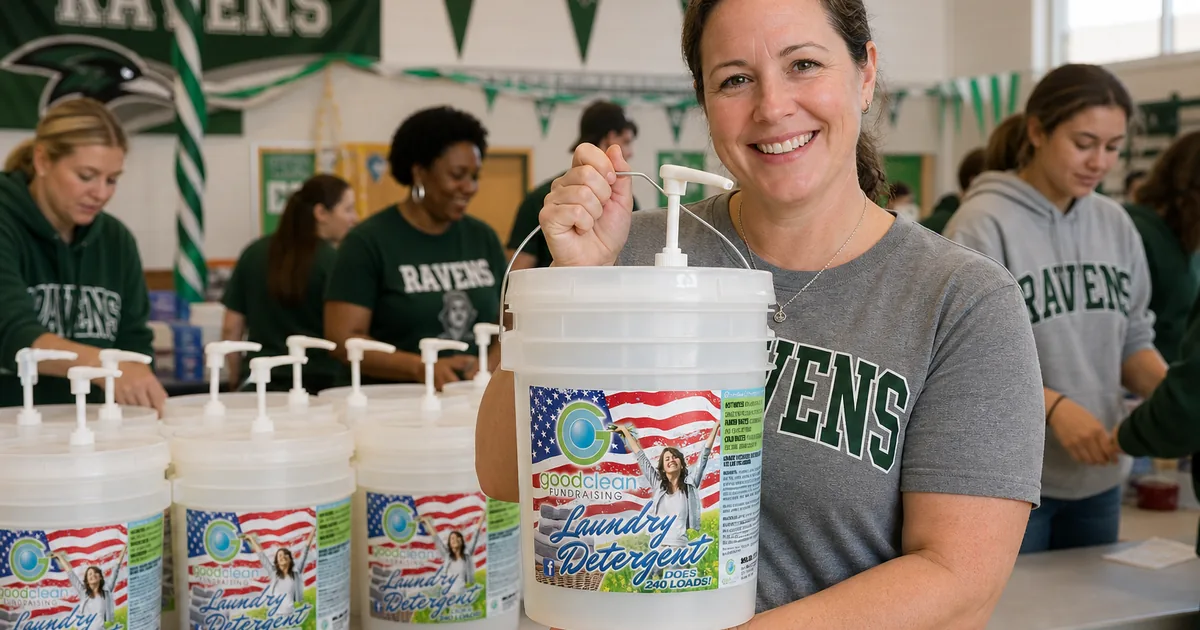
A laundry detergent fundraiser is a bulk household-necessity product fundraiser where groups sell large containers — typically 5-gallon buckets — of laundry detergent to supporters at a price below typical retail, and keep a portion of each sale. It works because detergent is something most households already buy and use regularly, so supporters are shifting a purchase they were going to make anyway rather than spending extra money on a novelty item. The model may reach a wider buyer pool than treat-based fundraisers, avoids perishability and complex logistics, and can give supporters value: Good Clean Fundraising's bucket is $49.95, roughly half the per-ounce price of premium national brands based on a September 2026 retailer price check. Groups keep about $13.45 to $15.45 per bucket at 100 or more buckets, with $0 upfront cost, free shipping at 100 buckets or more, and a 50-bucket minimum.
Laundry detergent fundraising is one alternative to traditional product fundraisers, and the appeal is straightforward: it replaces a novelty item most people do not need with a household staple most families already buy. That shift — from treat to necessity — can change who participates, how much each family raises, and how simple the whole campaign is to run.
The model is built around bulk containers, usually 5-gallon buckets of detergent, sold at a price below what supporters would typically pay at the store. Because detergent is non-perishable, ships easily, and may appeal to most households, it avoids the narrow buyer pools and perishable-product logistics associated with cookie dough, candy, and other traditional fundraisers.
This guide covers everything: how laundry detergent fundraising works, what groups earn per bucket, how it compares with other product fundraisers, how to evaluate programs, what to look for in a provider, the mistakes that trip up first-timers, and how to decide if it is the right fit for your group.
- Laundry detergent fundraising sells a household necessity people already buy, which can widen participation beyond treat-based fundraisers.
- Good Clean Fundraising sells 5-gallon buckets at $49.95, and groups keep about $13.45 to $15.45 per bucket at 100 or more buckets, with the margin improving at 300 and 500 buckets.
- Supporters pay roughly half the per-ounce price of premium national brands, based on a September 2026 retailer price check, so they get value while backing the group.
- Detergent is non-perishable and ships easily, eliminating the frozen-delivery logistics that make food fundraisers hard to run.
- Good Clean Fundraising is a $0-upfront-cost program: the group collects supporters' payments first, then submits a paid order, so it never fronts money for inventory.
- A household-necessity model can reach buyers — grandparents, neighbors, coworkers — who would never purchase a dessert or novelty fundraiser.
- Good Clean Fundraising advertises a 100% money-back guarantee and provides a Getting Started packet, instructions, and marketing materials.
What is a laundry detergent fundraiser?
A laundry detergent fundraiser is a product fundraiser where groups sell bulk laundry detergent — most commonly in 5-gallon (640-ounce) pump buckets — to supporters at a price below typical retail, and keep a share of each sale as profit. Good Clean Fundraising's 5-gallon bucket holds 640 ounces of detergent in a pump-dispenser format.
The core appeal is simple: instead of asking supporters to spend extra money on cookie dough, candy, or another item they did not need, you are asking them to shift a purchase they were already going to make — laundry detergent — from their usual store to your fundraiser, and pay roughly half the per-ounce price in the process. That value proposition is what makes the model work.
Good Clean Fundraising operates on a $0-upfront-cost structure: the group collects orders and payment first, submits the final order with payment, and the company ships the product to the group's commercial delivery address for distribution. Other programs vary. The group never fronts money for inventory, which reduces the financial risk if participation is lower than hoped, although the 50-bucket minimum still applies.
How much do groups make with a laundry detergent fundraiser?
Profit depends on the program, the selling price, and the order volume, but the structure is straightforward. With Good Clean Fundraising's bulk detergent fundraiser, groups sell a 5-gallon bucket for $49.95 (about $50) and keep about $13.45 to $15.45 per bucket at 100 or more buckets — $13.45 at 100 to 299, $14.45 at 300 to 499, and $15.45 at 500 or more — and shipping is free at 100 buckets or more. At 50 to 99 buckets, profit is usually about $5 to $12 per bucket depending on actual shipping costs, and orders under 50 buckets are not accepted.
To put that in context: a 5-gallon bucket holds 640 ounces, so at $49.95 the buyer pays about 7.8 cents per ounce. Premium national-brand liquid detergents at major retailers commonly run about 13 to 16 cents per ounce (value-tier and store brands can cost less), so supporters are paying roughly half the store price for a product they use every week. That value may help drive repeat participation — supporters are not doing the group a favor by overpaying for a novelty; they are getting a useful product at a good price.
The bigger lever, though, may be participation. Because detergent is a necessity, more families may find buyers, and each family may find more of them. A group selling 200 buckets keeps $13.45 per bucket, about $2,690; the same group selling cookie dough might move fewer units if fewer people want dessert. The household-necessity model can widen the funnel.
Why does laundry detergent fundraising work better than traditional fundraisers?
The potential advantage comes down to a handful of structural differences that can compound. First, buyer breadth: detergent is a necessity most households already purchase, so it may reach most people — not just the subset of supporters who want dessert or novelty items. Second, repeat use: supporters use up the product and repurchase it, which may make them more willing to buy in the first place and can open the door to future campaigns. Third, logistics: detergent is non-perishable, ships and stores easily, and requires no freezer or timed delivery day, which removes the scramble that makes food fundraisers hard to run.
Fourth, value: many traditional product fundraisers price items above everyday retail value because both the group and the fundraising company profit from the same sale. A household-necessity fundraiser instead offers a useful product at roughly half the per-ounce store price, based on a September 2026 retailer price check, so supporters may feel they received real value rather than making a donation disguised as a purchase. Fifth, no upfront cost: some programs, including Good Clean Fundraising's, let groups collect orders first and never front money, which reduces financial risk.
The combination of those five factors — necessity, repeat use, simple logistics, value, and no upfront cost — is why detergent fundraising may outperform cookie dough, candy, popcorn, and similar programs for some groups. This is editorial reasoning rather than a measured comparison.
How do you evaluate a laundry detergent fundraiser program?
Not all detergent fundraisers are built the same way, so judge any program on six factors before you commit. First, upfront cost: does the group have to buy inventory in advance, or is it no-cost and no-risk? Second, profit structure: what does the group keep per bucket, and does that margin improve with volume? Third, shipping: is it free above a certain threshold, or does the group pay? Fourth, support: does the program provide instructions, materials, and marketing help, or is the organizer figuring it out alone?
Fifth, product quality: does the detergent work as well as what supporters already use? Ask for the product size, ingredients, and performance information so you can compare it, because a low-grade product can damage trust and repeat participation. Sixth, guarantee: does the program stand behind the product with a money-back guarantee, and does the group keep its profit if a supporter is unhappy?
A program that scores well on all six — no upfront cost, strong profit that improves with volume, free shipping on larger orders, clear support materials, product quality you can verify, and a money-back guarantee — is more likely to be easy to run and to carry less risk. Anything less can introduce risk, complexity, or a weaker value proposition.
What makes Good Clean Fundraising's program different?
Good Clean Fundraising runs The Good Clean Fundraiser, a bulk laundry-detergent program designed as an alternative to traditional product fundraisers. Groups sell a 5-gallon pump bucket of premium detergent for about $50 — a household staple supporters buy at roughly half the per-ounce price of premium national brands — and keep about $13.45 to $15.45 per bucket at 100 or more buckets, depending on order volume, with $0 upfront cost and free shipping on orders of 100 buckets or more.
Good Clean Fundraising provides a Getting Started packet, instructions, marketing materials, and social media strategies. The group arranges a commercial delivery address (a loading dock or forklift is recommended), plans for a 50-bucket minimum, and allows about two weeks for fulfillment after submitting the paid order.
Good Clean Fundraising advertises a 100% money-back guarantee under which, according to the company, any customer who is not satisfied is refunded and the group keeps its profit. That guarantee may reduce risk for both the group and the supporter.
The model is designed around the idea that fundraising may work better when supporters get something useful for their money and when the group is not managing complex logistics or fronting cash. It is Good Clean Fundraising's household-necessity approach.
Who is laundry detergent fundraising best for?
Laundry detergent fundraising works well for nearly any group that needs to raise money without complex logistics or upfront cost, but it is especially strong for schools, PTAs, booster clubs, sports teams, churches, scout troops, and other community organizations where broad participation matters more than a few high-performing sellers. It is also a good fit for groups that have run traditional product fundraisers before and want better results with less work.
It tends to work less well for very small groups, where the fixed effort of running any product fundraiser may not be worth it and reaching the 50-bucket minimum could be a stretch, or for groups whose supporters are primarily young singles who may buy detergent in smaller quantities than a household — though this guide has not measured how appeal varies by group size or supporter type. If your group has run cookie dough, candy, or popcorn fundraisers and found that only a handful of families participated or that the logistics were a headache, switching to a household-necessity model may solve both problems at once.
How do you run a laundry detergent fundraiser?
The process is straightforward, especially with a program that provides instructions and materials. First, set a clear dollar goal and timeline — many campaigns run two to four weeks (Good Clean Fundraising recommends a two-to-three-week selling window). Second, sign up with your chosen program and confirm your profit terms, shipping threshold, and delivery method in writing. Third, hold a kickoff where you explain the goal, the product, the price, and how to participate — start everyone on the same day to build momentum.
Fourth, distribute order forms or order links and give families a clear deadline. Fifth, collect orders and payment as they come in, and submit your group's total order to the provider. Sixth, receive the product, distribute it to families or supporters, reconcile your totals, and keep the profit. With a program like Good Clean Fundraising, the Getting Started packet, instructions, and marketing materials cover much of the planning, so the volunteer organizer is mainly communicating with families, tracking orders, and arranging delivery.
The key to a successful campaign is keeping the selling window short, sending a couple of reminders, and making it easy for supporters to buy. Because the product is a necessity and the price compares well with retail, the selling part may be easier than with traditional fundraisers — you are not convincing people to buy something they do not need; you are offering them a better deal on something they were going to buy anyway.
| Factor | Traditional Product Fundraiser | Laundry Detergent Fundraiser |
|---|---|---|
| Buyer pool | Narrow — mainly treat buyers | Most households |
| Repeat customers | Occasional treat | Repurchased regularly |
| Perishable? | Often yes — frozen/careful handling | No |
| Delivery logistics | Often timed delivery, freezer coordination (varies by item) | Ships & stores easily |
| Upfront cost | Often orders inventory first | No-upfront-cost options |
| Supporter value | Often marked up so group & vendor profit | Value (~½ store price, retailer price check) |
Common mistakes to avoid
Choosing a program with upfront cost
If a no-upfront-cost option exists, there is rarely a reason to take on the financial risk of buying inventory in advance. Collect orders first and never front money.
Not confirming profit terms and shipping in writing
Know exactly what the group keeps per bucket, at what volume free shipping kicks in, and who handles delivery before you launch — not after orders are in.
Leaving the selling window open too long
A focused two-to-four-week campaign with a clear deadline is designed to sustain momentum better than an open-ended one that drags on for months.
Skipping a real kickoff
When families start whenever they get around to it, many never start at all. A single kickoff day where everyone begins together can drive much of the early momentum.
Under-explaining the value to supporters
Participation may rise when families understand that supporters are paying roughly half the store price for something they already buy — not doing the group a favor by overpaying for a novelty.
Choosing a program with low-quality product
If the detergent does not work as well as what supporters already use, trust is damaged and repeat participation dies. Product quality is not negotiable.
- Detergent price comparison — per-ounce pricing for premium national-brand liquid laundry detergent at a major U.S. retailer, price-checked September 2026 (~13–16 cents per ounce across common sizes). Retail prices vary by size and store; based on a single online retailer's listings for premium brands; some value-tier and store brands cost less per ounce.
- Good Clean Fundraising program terms — $49.95 per bucket; $13.45 profit per bucket at 100 to 299 buckets (usually $5 to $12 at 50 to 99 buckets, depending on actual shipping costs), $14.45 at 300 to 499, $15.45 at 500 or more; $0 upfront cost; free shipping at 100+ buckets; 50-bucket minimum (smaller orders are not accepted); 100% money-back guarantee under which, according to the company, any customer who is not satisfied is refunded and the group keeps its profit. — GCF pricing, GCF how it works, and GCF refund and returns policy
- Figures reflect Good Clean Fundraising's $49.95 bucket price, its published profit tiers, and current retail prices; both vary, so no single fixed percentage is stated.
Our recommendation
If you are looking for a product fundraiser that may reach more buyers and be simpler to run than cookie dough or candy, a laundry detergent fundraiser is worth a close look. Good Clean Fundraising runs The Good Clean Fundraiser, a bulk laundry-detergent program: premium detergent in 5-gallon pump buckets that supporters buy for roughly half the per-ounce price of premium national brands, with $0 upfront cost to your group, free shipping on orders of 100 buckets or more, and a Getting Started packet, instructions, marketing materials, and social media strategies. At 100 or more buckets, groups keep about $13.45 to $15.45 per bucket. Your group arranges a commercial delivery address (a loading dock or forklift is recommended), plans for a 50-bucket minimum, and allows about two weeks for fulfillment after submitting the paid order. Good Clean Fundraising advertises a 100% money-back guarantee under which, according to the company, any unsatisfied customer is refunded and the group keeps its profit. It is Good Clean Fundraising's household-necessity approach.
Frequently asked questions
Groups sell bulk laundry detergent — typically 5-gallon buckets — to supporters at a price below typical retail, and keep a share of each sale. With Good Clean Fundraising, the group collects orders and payment first, submits a single paid order, and the company ships the product to the group's commercial delivery address for distribution. The group never fronts money for inventory, and the minimum order is 50 buckets.
With Good Clean Fundraising, groups sell a 5-gallon bucket for $49.95 (about $50) and keep about $13.45 to $15.45 per bucket at 100 or more buckets: $13.45 at 100 to 299, $14.45 at 300 to 499, and $15.45 at 500 or more. Shipping is free at 100 or more buckets; at 50 to 99 buckets, profit is usually about $5 to $12 per bucket depending on actual shipping costs, and orders under 50 buckets are not accepted.
It can be, for some groups — mainly because the buyer pool may be wider. Detergent is a necessity most households already purchase, so it can reach grandparents, neighbors, and coworkers who would never buy a dessert product. It is also non-perishable, which removes the frozen-delivery logistics that make food fundraisers hard to run. Results vary by group, and this comparison is editorial reasoning rather than measured data.
Often, when the value is clear. A 5-gallon bucket at $49.95 works out to about 7.8 cents per ounce; premium national brands at major retailers commonly run about 13 to 16 cents per ounce (value-tier and store brands can cost less). Supporters are paying roughly half the store price for something they use every week, so they may feel they got real value rather than overpaying for a novelty.
Not with Good Clean Fundraising, which has a $0 upfront cost: the group collects orders and payment from supporters first, then submits the final order with payment. Other programs vary, so confirm the cost structure in writing before you launch. Collecting first means the group is not left holding unsold inventory, although the 50-bucket minimum still applies.
Many campaigns run two to four weeks of selling, and Good Clean Fundraising recommends a two-to-three-week selling window. A short, focused window creates urgency and keeps volunteers engaged; campaigns that drag on for months tend to lose momentum. After the paid order is submitted, allow about two weeks for fulfillment.
Good Clean Fundraising advertises a 100% money-back guarantee under which, according to the company, any unsatisfied customer is refunded and the group keeps its profit. Other programs' policies vary, so confirm any guarantee in writing before you launch.
It depends on the program, and the claim should be checked rather than assumed. Ask for the product size, ingredients, and performance information so you can compare it with what your supporters already buy. Good Clean Fundraising describes its bucket as premium detergent; this guide does not include independent performance testing.
It can work well for schools, PTAs, booster clubs, sports teams, churches, scout troops, and other community organizations where broad participation matters. It may be especially useful for groups that have run traditional product fundraisers before and want better results with less work. Very small groups should check the 50-bucket minimum first.
The Good Clean Fundraiser is Good Clean Fundraising's bulk laundry-detergent program. Groups sell a 5-gallon pump bucket for about $50, a household staple supporters buy at roughly half the per-ounce price of premium national brands, and keep about $13.45 to $15.45 per bucket at 100 or more buckets, with $0 upfront cost, free shipping at 100 or more buckets, a Getting Started packet, instructions, marketing materials, and social media strategies, and an advertised 100% money-back guarantee under which, according to the company, any unsatisfied customer is refunded and the group keeps its profit.
Laundry detergent fundraising replaces a product people may not need with one they already buy, at a price that can give them real value. That shift — from novelty to necessity — may widen participation and simplify logistics, which can help a group raise more per family. If you are looking for a product fundraiser that is easier to run, this is worth a close look.