Scouts, 4-H, FFA & Youth Organizations
JROTC Program Fundraising Ideas That Actually Work
Practical fundraising strategies for JROTC units — from necessity products and service projects to no-upfront-cost programs that build leadership while raising funds.
The most effective JROTC fundraisers combine three elements: they raise meaningful money, they reinforce the program's leadership and service values, and they're manageable for cadets and advisors who already have full schedules. Household-necessity products like laundry detergent can reach a wider buyer pool than traditional treat fundraisers, because they appeal to a wider buyer pool — supporters aren't buying to be nice, they're shifting a purchase they already make to support the unit. Service-based fundraisers like car washes and color guards for community events build visibility and esprit de corps but require more coordination. No-upfront-cost product programs remove inventory financial risk, which matters for units operating on tight budgets. The best choice depends on your unit's size, available volunteer support, and whether your priority is maximum dollars, leadership development, or community engagement.
JROTC units face a fundraising challenge most school groups don't: you're raising money not just for trips and equipment, but to build a program that teaches leadership, discipline, and service. That means your fundraiser needs to do more than generate dollars — it should reinforce the values your cadets are learning, fit into an already-packed training calendar, and avoid becoming a distraction from your core mission.
The advisors and booster parents who run successful JROTC fundraisers tend to follow a pattern: they pick programs that are simple enough for cadets to execute independently, that teach real-world skills like goal-setting and accountability, and that don't require the unit to front money it can't afford to lose. Complexity is the enemy — a straightforward program that cadets can explain and run themselves can match or outperform an elaborate event that requires constant adult supervision.
This guide covers the fundraising approaches that work best for JROTC units: necessity-product programs that reach beyond the usual buyer pool, service fundraisers that build unit visibility, event-based options, and how to choose based on your unit's size, goals, and available support. We'll also cover the common mistakes that sink JROTC fundraisers and how to structure a campaign that builds leadership skills while raising funds.
- The strongest JROTC fundraisers balance three goals: raising money, reinforcing leadership values, and fitting into a packed training schedule.
- Household-necessity products reach a wider buyer pool than treats because supporters shift an existing purchase rather than buying something extra.
- No-upfront-cost programs remove financial risk, which matters for units operating on limited budgets.
- Service fundraisers like car washes and color guards build community visibility and unit cohesion but require more volunteer coordination.
- Cadet-led execution teaches real leadership skills — goal-setting, accountability, and follow-through — that classroom instruction alone cannot.
- A two-to-three-week selling window with clear cadet accountability creates urgency without dragging on so long that momentum fades.
- The best fundraiser for your unit depends on your size, volunteer support, and whether your priority is maximum revenue, skill-building, or community engagement.
Why do JROTC units need different fundraising strategies than other school groups?
JROTC programs operate under constraints most clubs don't face. Confirm any fundraiser with your school or district and the senior instructor before you start, since rules on fundraising and outside vendors vary. You're raising money for uniforms, competition travel, awards ceremonies, and program equipment while also running a leadership curriculum, drill practice, physical training, and community service commitments. Your cadets are already balancing academics, JROTC obligations, and often part-time jobs or other activities. That means your fundraiser needs to be efficient — it can't become a second job for cadets or advisors.
There's also a values alignment question. JROTC teaches service, integrity, and personal responsibility, so a fundraiser that feels like begging or selling overpriced novelties sits poorly with both cadets and the community supporters you're asking. The programs that work best are the ones where supporters feel they're getting genuine value, where cadets can execute with minimal adult hand-holding, and where the process itself reinforces the leadership lessons your program exists to teach.
Finally, budget risk matters more for JROTC than for a PTA. Many units operate on tight budgets with limited discretionary funds, so a fundraiser that requires buying inventory upfront introduces financial risk the unit can't absorb if sales fall short. No-upfront-cost programs that collect orders first and never require the unit to front money remove inventory risk.
What are the best product fundraisers for JROTC units?
Product fundraisers work well for JROTC because they're cadet-led, they run on a defined timeline, and the best ones teach real sales and accountability skills. But not all products perform equally — the key is choosing something with broad appeal that cadets can sell without feeling like they're pushing junk on family and neighbors.
Household-necessity products (the standout)
Everyday staples — laundry detergent, cleaning supplies, paper products — can reach a wider buyer pool than traditional fundraising treats for JROTC units, because the buyer pool is much wider. A cadet selling cookie dough or candy can only reach people who want dessert; a cadet selling a household necessity reaches grandparents, neighbors, coworkers, and community members who were never going to buy a treat but always need detergent. Supporters aren't buying to be nice — they're shifting a purchase they already make to back the unit, and they're often getting a better price than they'd pay at the store.
The leadership development piece is real: cadets set individual sales goals, track their own orders, follow up with buyers, and see a direct connection between their effort and the unit's results. There's no ambiguity about who sold what, which builds accountability in a way a group car wash never does. And because the product is non-perishable, there's no frozen-delivery scramble or spoilage risk.
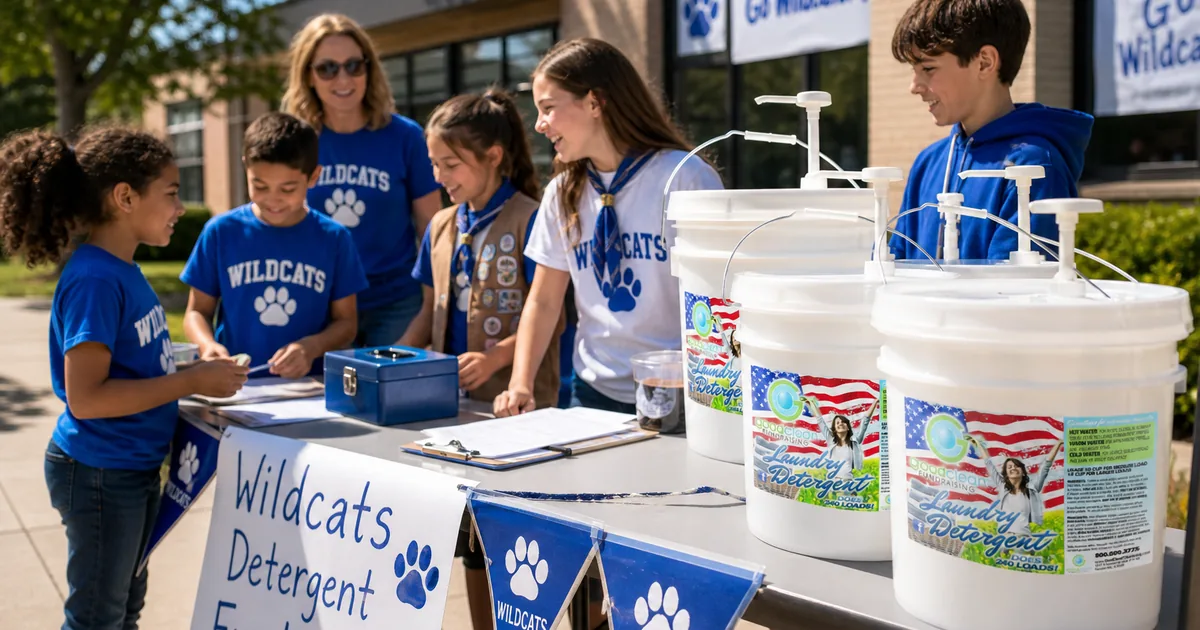
Good Clean Fundraising's bulk laundry-detergent program is purpose-built for this: units sell 5-gallon buckets of detergent for $49.95 — roughly half the per-ounce price of premium national brands — and keep about $13.45 to $15.45 per bucket at 100 or more buckets, depending on order volume, with no upfront cost and free shipping on orders of 100 buckets or more. Good Clean Fundraising advertises a 100% money-back guarantee under which, according to the company, any unsatisfied customer is refunded and the group keeps its profit. For a JROTC unit, that combination — a product people genuinely want, strong per-unit profit, no inventory financial risk, and a structure that teaches individual accountability — is hard to beat.
Traditional catalog and treat fundraisers
Cookie dough, popcorn, candy bars, and catalog items are familiar and easy to set up, but they share the same limitation: narrow buyer appeal. These are impulse or treat purchases, so each cadet exhausts their buyer pool quickly. Profit margins vary widely, and many programs require ordering inventory upfront, which introduces financial risk. They can work for smaller units with strong parent involvement, but they rarely generate the per-cadet totals that necessity products do.
What service-based fundraisers work well for JROTC?
Service fundraisers align naturally with JROTC values — they build unit visibility, teach teamwork, and give cadets a chance to serve while raising funds. The trade-off is logistics: these require more planning, volunteer supervision, and day-of coordination than a product sale.
Car washes
A well-run car wash can raise solid money in a single day, build unit cohesion, and give your community a visible reminder that your program exists. The keys to success are location (high traffic, easy access), weather (have a rain date), and enough cadets to keep lines moving. Profit per car is modest, so volume matters. It's also labor-intensive — you'll need a core group of cadets and parent volunteers committed to a full day of work.
Color guard and ceremony services
Offering color guard services for community events, local government meetings, sports games, or veteran ceremonies builds goodwill and can generate donations or service fees. This works especially well if your unit already has a strong drill and ceremony program. The revenue is often modest and unpredictable, but the community visibility and cadet pride are real benefits. Treat this as a supplemental fundraiser, not your primary revenue source.
Community service events (with sponsorships)
Some units organize community events — a 5K run, a veteran appreciation breakfast, a holiday parade — and fund them through sponsorships and entry fees. These can raise significant money and build deep community ties, but they require months of planning, liability insurance, permits, and a large volunteer base. This is an advanced option best suited to established units with strong booster support.
What about event-based and hybrid fundraisers?
Events like dinners, auctions, or military balls can generate large sums if you have the volunteer capacity and community support to pull them off. The challenge is the upfront work: venue, catering, promotion, ticket sales, and day-of logistics. For many units, these work best as annual signature events that supplement — rather than replace — simpler ongoing fundraisers. A hybrid approach — running a necessity-product sale in the fall and a military ball in the spring — spreads revenue across the year and gives cadets different leadership opportunities.
How do you choose the right fundraiser for your JROTC unit?
Start by asking three questions: How much do we need to raise? How many cadets and parent volunteers can we count on? And what matters more right now — maximum revenue, leadership skill-building, or community visibility? A small unit with limited parent help should favor a simple no-upfront-cost product program that cadets can run independently. A large unit with strong booster support can handle a car wash or event. If your priority is teaching individual accountability and goal-setting, a product sale where each cadet tracks their own orders can work better than a group service project.
Also consider your calendar. JROTC units are busy — drill competitions, inspections, PT tests, community service commitments. A fundraiser that drags on for months competes with everything else and loses momentum. A focused two-to-three-week product sale or a single-day service event fits into the schedule without becoming a distraction.
How do you structure a JROTC fundraiser to build leadership skills?
The best JROTC fundraisers are the ones where cadets lead and advisors coach. Assign clear roles: a cadet fundraising officer who owns the timeline and communication, squad leaders who track their team's progress, and individual cadets who set personal sales goals and report results. Use the same accountability structures you use in the rest of your program — regular check-ins, public progress tracking, recognition for top performers.
Tie the fundraiser to your leadership curriculum. Have cadets brief the plan, set SMART goals, conduct after-action reviews, and present results to the battalion. When a fundraiser is structured as a leadership exercise rather than just a money grab, cadets take it seriously and the skills transfer to everything else they do in the program.
| Factor | Product Fundraisers | Service Fundraisers |
|---|---|---|
| Buyer reach | Broad (necessities reach every household) | Local community supporters |
| Cadet leadership | High individual accountability | Moderate team-based leadership |
| Time commitment | 2–3 weeks selling | 1 day + setup |
| Upfront cost/risk | Can be $0 (no-upfront-cost programs) | Low (supplies only) |
| Revenue potential | Steady, scalable by participation | Modest, volume-dependent |
| Best for | Reliable revenue, minimal supervision | Unit visibility & cohesion |
Common mistakes to avoid
Choosing a fundraiser that requires too much adult supervision
If cadets can't run it themselves with coaching, it's not building leadership — it's creating work for advisors and parents. Pick something cadets can own.
Letting the fundraiser drag on for months
A two-to-three-week focused push creates urgency and keeps cadets engaged. Open-ended campaigns lose momentum and raise less.
Fronting money the unit can't afford to lose
If a program requires buying inventory upfront, you're taking financial risk. No-upfront-cost options exist — use them.
Skipping individual cadet accountability
Group fundraisers where nobody tracks who did what teach cadets they can coast. Individual sales goals and public tracking build the accountability your program is supposed to teach.
Picking a product with narrow appeal
Treats and novelties limit how many buyers each cadet can reach. Necessities widen the pool and raise the unit's total.
Not tying the fundraiser to your leadership curriculum
A fundraiser is a real-world leadership exercise. Use it to teach goal-setting, planning, execution, and after-action review — don't waste the opportunity.
- Editorial guidance: general planning advice on this page reflects the authors' editorial judgment and common youth-group fundraising practice; it is not based on measured campaign data or a cited study.
- Good Clean Fundraising program terms — $49.95 per bucket; $13.45 profit per bucket at 100 to 299 buckets (usually $5 to $12 at 50 to 99 buckets, depending on actual shipping costs), $14.45 at 300 to 499, $15.45 at 500 or more; $0 upfront cost; free shipping at 100+ buckets; 50-bucket minimum (smaller orders are not accepted); 100% money-back guarantee under which, according to the company, any customer who is not satisfied is refunded and the group keeps its profit. — GCF pricing, GCF how it works, and GCF refund and returns.
Our recommendation for JROTC units
Before committing to any outside vendor program, confirm it with your school or district administration and senior instructor — approval requirements and restrictions vary by program, school, and state. Once that gate is cleared, a household-necessity product fundraiser is worth evaluating for its combination of revenue, leadership development, and manageable logistics. Good Clean Fundraising's bulk laundry-detergent program is built for exactly this: cadets sell 5-gallon buckets of detergent for $49.95 — roughly half the per-ounce price supporters pay for premium national brands — and the unit keeps about $13.45 to $15.45 per bucket at 100 or more buckets, depending on order volume. There's no upfront cost, free shipping on orders of 100 buckets or more, and the program includes a Getting Started packet, instructions, marketing materials, and social media strategies. Good Clean Fundraising advertises a 100% money-back guarantee under which, according to the company, any unsatisfied customer is refunded and the group keeps its profit. The structure teaches real accountability — each cadet sets goals, tracks orders, and sees a direct connection between effort and results — and because the product is something every household already buys, cadets can reach more buyers than they would selling treats. It's the fundraiser that is structured to reinforce the leadership lessons your program exists to teach while raising money for unit needs.
Frequently asked questions
The best fundraiser balances three things: revenue, leadership development, and fit with your unit's schedule and volunteer capacity. Household-necessity products like laundry detergent often perform well because they reach a wide buyer pool, teach individual accountability, and can be structured with no upfront cost. Service fundraisers like car washes build visibility and teamwork but require more coordination. The right choice depends on your unit's size, goals, and available support.
It depends on your unit size, the product or service you choose, and how many cadets actively participate. Total raised is roughly participating cadets times average sales per cadet times profit per item. A focused product sale with strong cadet participation may outperform a service event with modest turnout, even if the per-transaction profit is lower. Set a realistic goal based on your unit's size and past participation rates rather than chasing a headline number.
Not always. Many product programs are no-upfront-cost, meaning you collect orders first and never front money for inventory. This removes inventory financial risk, which matters for units operating on tight budgets. Service fundraisers like car washes have minimal upfront costs (soap, supplies), while events may require deposits for venues or permits. Always confirm cost and risk in writing before committing.
A two-to-three-week window is common for product fundraisers. That's long enough for cadets to reach their buyers but short enough to maintain urgency and momentum. Campaigns that stay open for months lose focus and raise less. Service events are typically single-day, while major events like military balls require months of planning but happen on one night.
Fundraisers where cadets set individual goals, track their own progress, and report results teach accountability and follow-through in ways group projects don't. Product sales with clear individual sales targets and public tracking build these skills naturally. Service events teach teamwork and coordination. The key is structuring the fundraiser as a leadership exercise — with cadet officers owning the plan, squad leaders tracking their teams, and after-action reviews at the end — rather than just a money grab.
Confirm with your school or district and senior instructor first, since rules vary. If approved, a household-necessity fundraiser can be a strong option because the buyer pool is wider — a necessity like laundry detergent reaches grandparents, neighbors, and coworkers who would never buy a treat, so cadets find more buyers and the unit's total rises. Supporters also feel they're getting real value rather than paying a premium to be nice. The leadership development is stronger too, because individual sales are easier to track and cadets see a direct connection between effort and results.
Yes, and many do. A common approach is a product sale in the fall and a service event or military ball in the spring. This spreads revenue across the year, gives cadets different leadership opportunities, and avoids donor fatigue from asking the same supporters repeatedly for the same thing. Just make sure each fundraiser has a clear purpose and timeline so they don't blur together or compete for cadet attention.
Tie participation to your existing leadership structure. Have cadet officers brief the plan, set squad-level goals, and track progress publicly. Recognize top performers the same way you recognize drill or PT excellence. Make it clear that fundraising is part of the program, not optional, and that the money raised directly benefits the unit — new uniforms, competition travel, awards. When cadets see the connection between their effort and tangible results, and when their chain of command holds them accountable, participation rises.
The Good Clean Fundraiser is Good Clean Fundraising's bulk laundry-detergent program. Units sell 5-gallon buckets for $49.95 — roughly half the per-ounce price of premium national brands — and keep about $13.45 to $15.45 per bucket at 100 or more buckets, with no upfront cost, free shipping on larger orders, and a Getting Started packet, instructions, marketing materials, and social media strategies. The structure teaches individual accountability because each cadet tracks their own sales, and the product reaches a wide buyer pool because it's a household staple everyone already purchases. For JROTC units, that combination of strong profit, no inventory financial risk, and built-in leadership development is hard to beat.
JROTC fundraising works best when it does double duty — raising the money your unit needs while reinforcing the leadership, accountability, and service values your program exists to teach. A simple, well-structured fundraiser that cadets can own and execute independently may compare favorably to a complicated event that requires constant adult supervision, and a product people genuinely need will reach more buyers than a novelty treat ever will. Pick something that fits your unit's capacity, tie it to your leadership curriculum, and give your cadets the chance to prove they can plan, execute, and deliver results.