
Booster Club Fundraising
No-Cost Booster Club Fundraisers: How to Raise Money Without Upfront Investment
Fundraisers with no upfront inventory payment — compare pre-orders, pledges, and digital options while budgeting fees, minimums, and delivery duties.
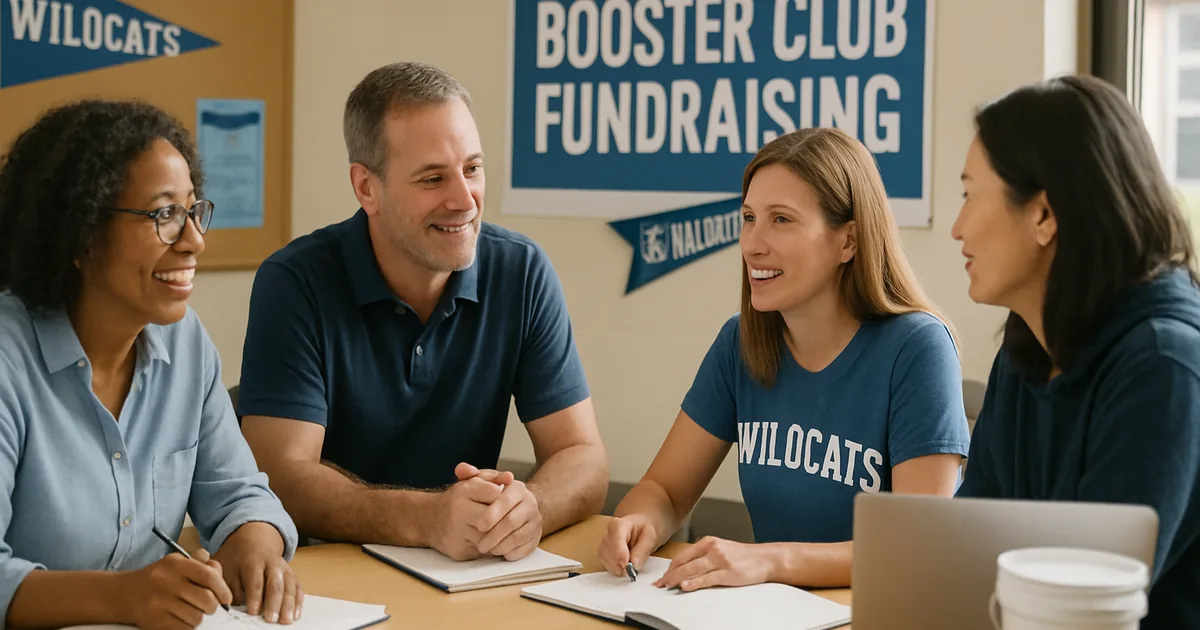
“No-cost” here means no payment to start, not an absence of all expenses or risk. Booster clubs can compare pre-order products, pledge activities, and digital fulfillment programs. Confirm who collects payments, when the vendor is paid, minimum orders, shipping, fees, refunds, and cancellation duties. GCF uses paid group orders rather than direct household fulfillment. The best fit depends on demand, volunteer capacity, and net proceeds after all costs; no category is universally the highest earner.
Most booster clubs operate on tight budgets with volunteer coordinators who are not in a position to front hundreds or thousands of dollars for inventory that might not sell. The fear of being stuck with unsold product — or worse, personally liable for the cost — is enough to stop many fundraisers before they start.
Pre-order fundraisers reduce the need to buy inventory before demand is known: the club collects orders and payments first. The club still needs a plan for fees, shipping, minimum quantities, and refunds. Limited starting cash is a reason to check those terms carefully, not to assume the vendor takes every risk.
This guide covers what qualifies as a true no-cost fundraiser, the three main categories and how they compare, which programs raise the most for booster clubs, the hidden costs and trade-offs to watch for, and how to choose the right one for your group.
- A true no-cost fundraiser requires zero upfront payment — the club collects orders or pledges first, then fulfills after the money is collected.
- The three main no-cost categories are pre-order product programs, pledge-based fundraisers, and digital fulfillment platforms.
- Pre-orders reduce speculative inventory exposure; fees, minimums, refund duties, and other costs can remain.
- Pre-order product fundraisers that sell household necessities may suit supporters who want those products; compare net budgets with other options.
- Watch for hidden costs: some no-cost programs charge setup fees, delivery fees, or require minimum order quantities that function as a soft upfront cost.
- No payment to start does not mean no work: budget time for payment tracking, promotion, and distribution.
- Booster clubs with strong parent participation may find pre-order product programs manageable; smaller or less engaged groups may prefer fully digital options.
What qualifies as a no-cost booster club fundraiser?
A no-payment-to-start fundraiser has no required inventory purchase, deposit, or setup charge before launch. That does not mean the campaign cannot incur later expenses. Ask how payments, minimums, shipping, refunds, and cancellation work if participation falls short.
This differs from a program requiring an initial deposit or starter kit, and from consignment, where inventory is supplied under payment and return terms. Each arrangement has obligations; compare the full agreement rather than treating any label as a guarantee of zero financial exposure.
The key question to ask any vendor is: does the club pay anything before we collect orders? If the answer is yes — even a small setup fee — it is not a no-cost program.
What are the main types of no-cost fundraisers for booster clubs?
No-cost fundraisers fall into three broad categories, each with different logistics, profit structures, and levels of volunteer effort required.
Pre-order product fundraisers
In pre-order product programs, the club collects orders and payments before purchasing the agreed quantity. Examples include detergent, specialty food, or discount cards; cards are not consumable household products. Fulfillment varies by vendor. GCF ships a group order to a commercial address for the club to distribute, not directly to each buyer.
Pre-order product fundraisers can suit booster clubs because they combine tangible value for the buyer with a clear profit margin for the club. Household necessities people already purchase may widen the buyer pool beyond just parents to extended family, neighbors, and coworkers, depending on the product, price, and demand.
The trade-off is coordination: someone has to collect and track orders, handle the money, and manage delivery. For booster clubs with strong parent participation, that is manageable; for smaller or less organized groups, it can feel like a lot of work.
Pledge-based and activity fundraisers
Pledge programs tie donations to an activity such as a walk-a-thon. There is no product inventory, but venue, permits, insurance, equipment, and processing costs may apply. Net proceeds equal collected donations minus all campaign expenses, not just online fees.
These work well for booster clubs with a motivated core group and a cause that resonates emotionally. The downside is that supporters give money and receive nothing tangible in return, which can limit how much each participant raises and how often you can run the same type of event without donor fatigue setting in.
Digital and hybrid fulfillment platforms
Some vendors offer online storefronts where supporters browse and order products directly, and the vendor handles fulfillment and shipping. The booster club promotes the link, and a percentage of each sale goes to the organization. There is no inventory, no order collection, and minimal volunteer work.
The appeal is simplicity, but commissions, fees, and promotion duties vary. Compare likely net proceeds before deciding whether to use the platform as a main campaign or a supplement.
Which no-cost fundraisers raise the most for booster clubs?
For product sales, estimate participating families × average units × applicable margin, then deduct extra expenses. For pledges, estimate donations actually collected minus costs. For digital sales, use the vendor’s payout terms and fees. There is no general ranking that replaces those calculations.
Pledge events can work with motivated donors and a manageable activity budget. Digital fulfillment can reduce handling work, but promotion and fees still matter. Either can be a primary campaign if realistic net proceeds meet the club’s needs.
For some booster clubs, a pre-order product fundraiser selling a consumable household staple may offer a workable balance of participation, profit, and manageable effort; compare it with pledge and digital options using your own demand and cost estimates.
What are the hidden costs and trade-offs in no-cost fundraisers?
A no-payment-to-start program can still charge later fees or require minimum orders. Ask what happens if sales fall short before accepting supporter payments. For GCF, the minimum is 50 buckets, shipping is free at 100+, and smaller qualifying orders incur shipping; do not assume a published penalty or automatic waiver.
Volunteer duties also vary. GCF group orders require collection, payment reconciliation, commercial delivery arrangements, and distribution. A direct-fulfillment platform may handle more transaction work but still needs promotion and oversight. Compare duties as well as fees.
The other hidden cost is opportunity cost. A no-cost program that raises less than a low-cost alternative might save the club from financial risk but cost more in lost revenue. The question is not just whether a program is free to start — it is whether it raises enough to be worth running.
How do you choose the right no-cost fundraiser for your booster club?
Start by asking three questions. First, how much volunteer coordination can your group realistically handle? If you have a strong parent network and a dedicated coordinator, a pre-order product program may be worth comparing first. If your volunteer base is thin, a fully digital platform might be a better fit even if the profit is lower.
Second, what is your goal? If you need to raise a specific amount by a firm deadline, choose a program with a clear profit structure and terms confirmed in writing. If you are running a supplemental fundraiser or testing something new, a lower-effort option makes sense.
Third, what will supporters actually buy or give to? Survey demand for the product or activity, including quantity, affordability, and pickup needs. A necessity label does not prove that it will attract more support than a treat or donation ask.
Our recommendation
For booster clubs whose supporters want bulk detergent, GCF is one pre-order option to compare. It requires no payment to start, but the club must plan a paid group order, minimum volume, delivery duties, and other potential costs.
At the published $49.95 price (online orders add $2), GCF lists $13.45 per bucket for 100–299, $14.45 for 300–499, and $15.45 for 500+, before additional group expenses. A $49.95, 640-fluid-ounce bucket costs about 7.8 cents per fluid ounce before any surcharge. Compare current prices and label dosage; a per-ounce comparison alone does not establish equal cost per load.
Collect orders and supporter payments, then submit one paid group order. The minimum is 50 buckets; shipping is free at 100+, with shipping charges below 100. Allow two to three weeks for selling plus about two weeks after the paid order for fulfillment. Arrange a commercial delivery address and a volunteer pickup team; a loading dock or forklift is recommended. Coordinator support can help with questions, while club volunteers retain payment and distribution duties. GCF advertises a 100% money-back guarantee: GCF refunds a dissatisfied supporter directly, and the group keeps its earned profit. Ask GCF about return costs and refund procedures for your campaign after registration.
Assess the combination of demand, margin, payment terms, and volunteer responsibilities. Use a written budget and the vendor’s current terms rather than an unverified claim about the number of past campaigns.
| Factor | Pre-Order Product | Pledge-Based |
|---|---|---|
| Upfront cost | Confirm vendor terms | Activity costs may apply |
| Profit per unit/donor | Vendor and order dependent | Variable (donation-based) |
| Buyer appeal | Product-specific demand | Emotional cause-driven |
| Volunteer coordination | Moderate (order tracking, delivery) | Plan activity and collection |
| Repeat potential | Depends on repeat demand | Depends on donor interest |
| Best for | Product demand | Donor interest |
Common mistakes to avoid
Assuming no-cost means no work
No payment to start does not mean zero effort or zero exposure. Confirm costs and assign responsibility for orders, money, promotion, and delivery before committing.
Ignoring hidden fees and minimums
Some vendors charge setup fees, delivery fees, or require minimum orders that function as a soft upfront cost. Confirm all terms in writing before launch.
Choosing a product with narrow appeal
A novelty item or niche product limits your buyer pool. Survey demand rather than assuming necessities will sell more.
Running a no-cost fundraiser without a clear goal
Even a no-upfront-inventory program needs a specific dollar target and deadline. Without a goal, participation drifts and the campaign underperforms.
Picking a program based on ease alone
The easiest fundraiser is not always the one that raises the most. Balance simplicity with profit potential and participation breadth.
- GCF pricing — published price, online surcharge, and order-volume margins; figures are before additional group expenses.
- GCF how it works — minimum order, shipping threshold, selling window, paid-order lead time, commercial delivery, and advertised guarantee.
- Planning method: estimate units from your own supporter demand, apply the vendor tier to each order separately, and subtract shipping, fees, supplies, refunds, and other group expenses. Examples are illustrations, not observed campaign results.
Our recommendation
Consider GCF when supporters want bulk detergent and volunteers can manage the group order. At the published $49.95 price (online orders add $2), GCF lists $13.45 per bucket for 100–299, $14.45 for 300–499, and $15.45 for 500+, before additional group expenses. Collect orders and supporter payments, then submit one paid group order. The minimum is 50 buckets; shipping is free at 100+, with shipping charges below 100. Allow two to three weeks for selling plus about two weeks after the paid order for fulfillment. Arrange a commercial delivery address and a volunteer pickup team; a loading dock or forklift is recommended. GCF advertises a 100% money-back guarantee: GCF refunds a dissatisfied supporter directly, and the group keeps its earned profit. Ask GCF about return costs and refund procedures for your campaign after registration.
Frequently asked questions
It means no payment is required to start, such as an inventory deposit or setup charge. Later shipping, fees, minimums, activity expenses, and refunds may still apply. Confirm written terms before launch; the label does not guarantee zero financial loss.
Compare pre-order products, pledge activities, and digital fulfillment using demand, written costs, payout timing, and volunteer duties. Household necessities are one product option; discount cards are another, distinct category. No format always raises the most.
Not always. Some vendors charge setup fees, delivery fees, or processing fees, and others require minimum order quantities that function as a soft upfront cost. Always confirm in writing: are there any fees, minimums, or penalties, and who pays for shipping?
For illustration, 200 GCF buckets at the 100–299 tier retain 200 × $13.45 = $2,690 before extra expenses. At the published $49.95 price (online orders add $2), GCF lists $13.45 per bucket for 100–299, $14.45 for 300–499, and $15.45 for 500+, before additional group expenses. Estimate demand from your own supporters.
Pre-ordering can reduce starting inventory needs, but it does not remove all costs or work. For GCF, volunteers collect orders and payments, submit the paid order, and arrange commercial delivery and pickup. Direct-fulfillment programs have different duties.
A pre-order arrangement collects demand before buying the product. Consignment supplies inventory under terms for payment, returns, damage, and unsold items. Both can have costs and obligations; read the agreement rather than treating pre-ordering as risk-free.
Yes, if demand supports the vendor’s minimum and the volunteers can manage the work. GCF requires at least 50 buckets, with shipping charges below 100. Budget those charges and other expenses before accepting orders.
Compare expected product sales and vendor costs with expected donations and activity costs. Include volunteer hours, payment handling, and delivery or event duties. The right choice depends on those estimates rather than a rule that products always raise more.
At the published $49.95 price (online orders add $2), GCF lists $13.45 per bucket for 100–299, $14.45 for 300–499, and $15.45 for 500+, before additional group expenses. Collect orders and supporter payments, then submit one paid group order. The minimum is 50 buckets; shipping is free at 100+, with shipping charges below 100. Allow two to three weeks for selling plus about two weeks after the paid order for fulfillment. Arrange a commercial delivery address and a volunteer pickup team; a loading dock or forklift is recommended. GCF advertises a 100% money-back guarantee: GCF refunds a dissatisfied supporter directly, and the group keeps its earned profit. Ask GCF about return costs and refund procedures for your campaign after registration.
Pre-orders can reduce the starting cash barrier for a booster club. Compare the product with pledge and digital options, estimate demand, and confirm every fee and responsibility in writing. The goal is a manageable campaign with positive net proceeds, not a promise of zero risk.