
Church, Ministry & Youth Group Fundraising
Christian School Fundraising Ideas That Align With Your Mission
Proven fundraising ideas for Christian schools that honor your values, engage families, and raise meaningful support without compromising your mission.
Choose a Christian school fundraiser that fits your mission, gives families voluntary ways to participate, and has a manageable budget and workload. Household products, school events, service projects, and giving campaigns can each fit. A useful product may appeal to interested buyers, but is not established here as the highest-earning or least-wasteful choice. These are planning options, not measured performance rankings.
Christian schools face a unique fundraising challenge: you need to raise real money to fund programs, cover gaps, and keep tuition accessible, but you also need every fundraiser to reflect the values you teach. That means no high-pressure sales tactics, no junk products that end up in landfills, and no asks that feel more like manipulation than partnership.
The good news is that the fundraisers that work best for Christian schools are often the ones that align most naturally with your mission. Programs built on stewardship, service, and genuine value can fit the school’s values, and they do it in a way that strengthens your community rather than straining it.
This guide covers the fundraising ideas to consider for Christian schools, how to evaluate any program against your values, what to avoid, and how to structure a campaign that raises funds while honoring the mission that makes your school distinct.
- The best Christian school fundraisers align with your mission, offer real value to supporters, and build community rather than create competition.
- Household products are one option; check whether supporters want the quantity, formula, and price.
- Faith-friendly events that combine service, fellowship, and fun tend to engage families more deeply than pure sales campaigns.
- Stewardship-focused fundraisers let supporters shift existing spending rather than asking them to buy things they do not need.
- Programs with no upfront cost reduce the school’s speculative inventory exposure and reflect responsible resource management.
- Fundraisers to consider are those where families feel good about the ask and what supporters receive in return.
What makes a fundraiser right for a Christian school?
Before you look at specific ideas, it helps to have a filter. Not every fundraiser that works for a public school or sports team is a good fit for a Christian school, and the difference is not just about avoiding certain products. The right fundraiser should pass three tests: does it align with your stated values of stewardship and service, does it offer genuine value rather than asking people to overpay for something they do not need, and does it build community or create pressure and competition.
A fundraiser that asks families to sell overpriced novelty items to friends and relatives might raise money, but it often leaves everyone feeling uncomfortable. A program that lets supporters buy something they already need at a fair price, while supporting the school, reflects the kind of integrity and mutual care that Christian schools exist to model. The filter is simple: if you would not feel good explaining this fundraiser in chapel, it is probably not the right fit.
What are the best product fundraisers for Christian schools?
Product fundraisers can reflect good stewardship when the offered item, price, and quantity suit supporters. Compare household necessities with other products using local demand and complete costs rather than assuming one category raises the most.
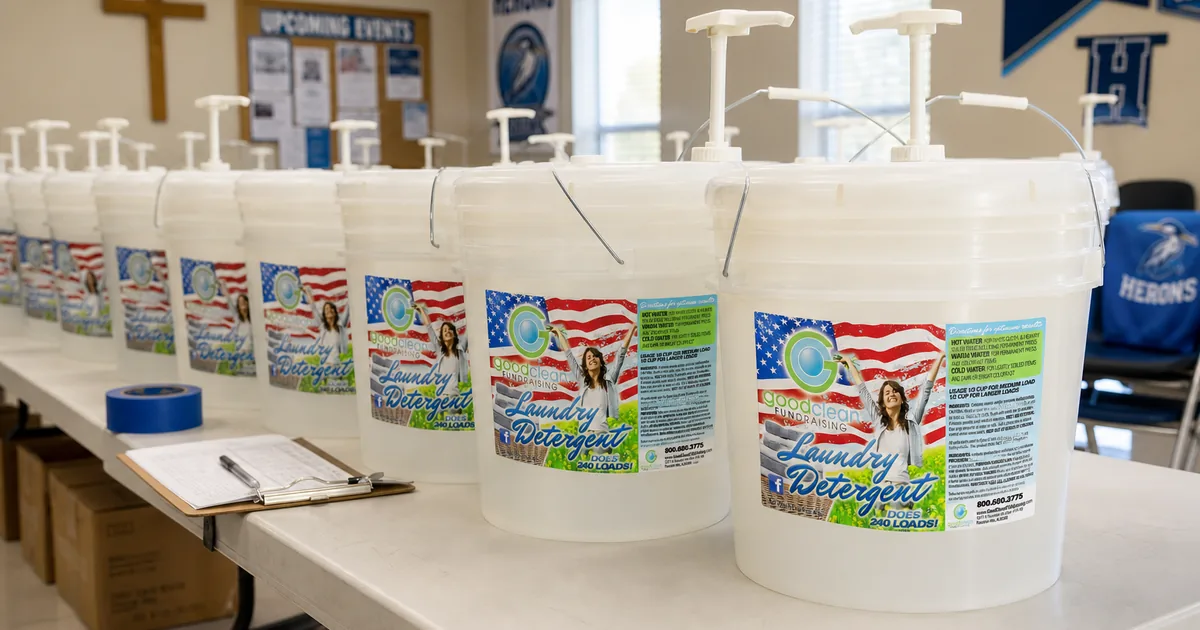
Bulk laundry detergent is one household-staple option to evaluate against your families’ preferences, budgets, and storage capacity. The published customer price is $49.95 per 5-gallon pump bucket (online orders add $2). Before additional group expenses, the margin is $13.45 at 100–299 buckets, $14.45 at 300–499, and $15.45 at 500+. The minimum order is 50 buckets; shipping is free at 100+, while shipping below 100 reduces the margin.
Other strong product options include practical consumables like coffee, cleaning supplies, or seasonal items that families actually use. The key is to avoid products that are marked up far beyond their value or that end up in a closet unused. If the product is something supporters would buy anyway, the fundraiser becomes an easy yes rather than a reluctant obligation.
What faith-friendly events work well for Christian schools?
Event-based fundraisers can be powerful community builders when they are designed around fellowship and service rather than pure sales. The events that work best for Christian schools are those that bring families together, reflect the school's values, and create memories rather than just transactions.
Service projects with sponsorships are a natural fit: students participate in a read-a-thon, a work day for a local ministry, or a community service project, and supporters sponsor their participation. This model teaches students about service and sacrifice while raising funds, and it gives supporters a way to invest in both the school and the students' character development.
A family festival can combine fellowship with fundraising when costs and volunteer capacity fit. Assign adults to money and safety, and keep student roles voluntary and age-appropriate.
How do you run a fundraiser that teaches stewardship?
One of the unique opportunities Christian schools have is to use fundraising as a teaching tool. When structured intentionally, a fundraiser can reinforce lessons about stewardship, generosity, and serving others rather than just being a necessary task to check off the calendar.
Start by framing the fundraiser in terms of mission rather than just money. Instead of announcing that the school needs to raise a certain dollar amount, explain what that money will accomplish and how it serves students and families. When students understand that they are raising funds for new curriculum, mission trips, or financial aid for families who could not otherwise afford Christian education, the work takes on meaning beyond the transaction.
Choose programs that model good stewardship in their structure. A no-upfront-cost fundraiser demonstrates responsible financial management. A product that offers real value at a fair price teaches integrity. A service-based fundraiser that asks students to work rather than just sell teaches the dignity of effort. The fundraiser itself becomes a lesson in the values the school exists to instill.
Should Christian schools avoid certain types of fundraisers?
Yes. Some fundraising models are effective at raising money but create dynamics that run counter to what Christian schools are trying to build. High-pressure sales competitions that pit students against each other, fundraisers built on guilt or manipulation, and programs that ask supporters to overpay for low-value products all raise money, but they do it in ways that can damage trust and community.
Door-to-door sales of overpriced novelty items are a common example. They can raise funds, but they often leave families feeling uncomfortable about asking neighbors to pay a premium for something they do not need. Raffles and games of chance are another category many Christian schools avoid on principle, even when they are legal and effective.
The test is not just whether a fundraiser works, but whether it reflects the kind of community and values the school is trying to cultivate. If a fundraiser requires behavior or messaging that contradicts what you teach in the classroom, it is worth finding a different approach.
How do you get families to participate in a Christian school fundraiser?
Participation in Christian school fundraisers tends to be higher when families understand the why behind the ask and when the fundraiser itself is easy and values-aligned. Start by communicating clearly about what the funds will support and why it matters. Families may be more willing to engage when they see the direct connection between their effort and the mission they have chosen to support by enrolling their children.
Make participation as simple as possible. Provide clear instructions, set a short timeline, and offer multiple ways to participate so families can choose what works for their situation. Some families will be comfortable selling to extended networks; others will prefer to buy a few items themselves and share the opportunity with close friends. Both approaches are valid, and making space for both increases overall participation.
Celebrate effort and service rather than just top sellers. Recognize families who participate, thank supporters publicly, and frame the fundraiser as a community effort rather than a competition. When the culture around fundraising is one of partnership and gratitude rather than pressure and comparison, participation rises and the experience strengthens the school community rather than straining it.
Common mistakes to avoid
Choosing fundraisers that contradict your stated values
If you teach stewardship and integrity in the classroom but run fundraisers built on overpriced novelty items and high-pressure sales, families notice the disconnect. Choose programs that reflect what you believe.
Framing fundraisers as obligations rather than opportunities
When fundraising feels like a burden or a requirement, participation drops and resentment builds. Frame every fundraiser as an invitation to partner in the school's mission, and make space for families to participate in ways that fit their situation.
Running too many fundraisers in a single year
Choose the number of campaigns around your actual goal, volunteer capacity, and supporters’ feedback. Two or three focused efforts may be manageable, but they are not guaranteed to raise more than six smaller events.
Failing to communicate what the funds will accomplish
Families need to know why they are being asked to fundraise. Be specific about what the money will support and how it serves the mission. Vague asks get vague responses.
Ignoring the teaching opportunity
Every fundraiser is a chance to reinforce lessons about stewardship, generosity, and service. When you treat fundraising as just a necessary task, you miss the opportunity to make it formative.
- Good Clean Fundraising — published customer price, online surcharge, and order-volume margins. Pricing.
- Good Clean Fundraising — minimum order, selling window, paid-order lead time, delivery responsibilities, and advertised guarantee. How it works.
- Product comparisons and campaign-planning suggestions are editorial guidance, not measured performance rankings. Illustrative calculations use the published GCF tier for one order and exclude additional group expenses.
Our recommendation for Christian schools
If a household-staple product fits your school’s mission and families, Good Clean Fundraising is an option to evaluate. The published customer price is $49.95 per 5-gallon pump bucket (online orders add $2). Before additional group expenses, the margin is $13.45 at 100–299 buckets, $14.45 at 300–499, and $15.45 at 500+. The minimum order is 50 buckets; shipping is free at 100+, while shipping below 100 reduces the margin. There is no payment to start. Collect orders and supporter payments, then submit a paid group order. Allow two to three weeks for selling plus about two weeks after the paid order for fulfillment. Your team arranges a commercial delivery address, unloading, and distribution; a loading dock or forklift is recommended. GCF refunds a dissatisfied supporter directly, and the group keeps its earned profit. Ask GCF about return costs and refund procedures for your campaign after registration.
Frequently asked questions
Choose a mission-aligned campaign with voluntary participation, clear costs, and manageable duties. Products, events, services, and donations are all options; test fit with your own families rather than assuming a category winner.
Ask three questions: does it reflect the stewardship and integrity you teach, does it offer real value rather than asking people to overpay for something they do not need, and does it build community or create pressure and competition? If you would not feel good explaining the fundraiser in chapel, it is probably not the right fit.
Either can work. Product campaigns require orders, payments, and distribution; events require staffing, supplies, and attendance. Compare projected net proceeds and volunteer hours, and choose a mix your school can sustain.
Avoid fundraisers that require high-pressure sales tactics, that ask supporters to overpay for low-value novelty items, or that create competition and comparison among students. Many Christian schools also avoid raffles and games of chance on principle. The test is whether the fundraiser reflects the values you teach in the classroom.
Illustrative calculation, not a reported campaign result: 300 buckets × $14.45 = $4,335.00 retained before additional school expenses. This uses the tier for one 300-bucket order; actual sales and costs determine the final result.
Communicate clearly about what the funds will support and why it matters, make participation as simple as possible, and celebrate effort and service rather than just top sellers. Families engage more when they understand the mission connection and when the fundraiser itself is easy and values-aligned.
Yes, and it should be. When structured intentionally, a fundraiser can reinforce lessons about stewardship, generosity, and service. Frame the fundraiser in terms of mission rather than just money, choose programs that model good stewardship in their structure, and use the experience to teach students about working for a purpose beyond themselves.
There is no payment to start. Collect orders and supporter payments, then submit a paid group order. Allow two to three weeks for selling plus about two weeks after the paid order for fulfillment. Your team arranges a commercial delivery address, unloading, and distribution; a loading dock or forklift is recommended. The school still needs to budget for other expenses.
The Good Clean Fundraiser is GCF’s bulk detergent program. The published customer price is $49.95 per 5-gallon pump bucket (online orders add $2). Before additional group expenses, the margin is $13.45 at 100–299 buckets, $14.45 at 300–499, and $15.45 at 500+. The minimum order is 50 buckets; shipping is free at 100+, while shipping below 100 reduces the margin. GCF refunds a dissatisfied supporter directly, and the group keeps its earned profit. Ask GCF about return costs and refund procedures for your campaign after registration.
Set the number of fundraisers from your school’s funding needs and capacity. You might plan two or three focused efforts, but check the calendar and family feedback rather than treating any number as a proven optimum.
Christian school fundraising does not have to be a compromise between raising money and honoring your mission. Programs to consider are often the ones that align most naturally with the values you teach — stewardship, service, integrity, and community. Choose fundraisers that reflect those values, communicate clearly about why the funds matter, and make participation an invitation rather than an obligation. When you do, fundraising becomes one more way your school lives out its mission rather than a distraction from it.