
Laundry Detergent Fundraising
5-Gallon Detergent Fundraising: How Bulk Laundry Detergent Fundraisers Work
Why some schools, teams, and nonprofits consider bulk 5-gallon detergent fundraisers — and how the model may deliver wider participation and simpler logistics than traditional product fundraisers.
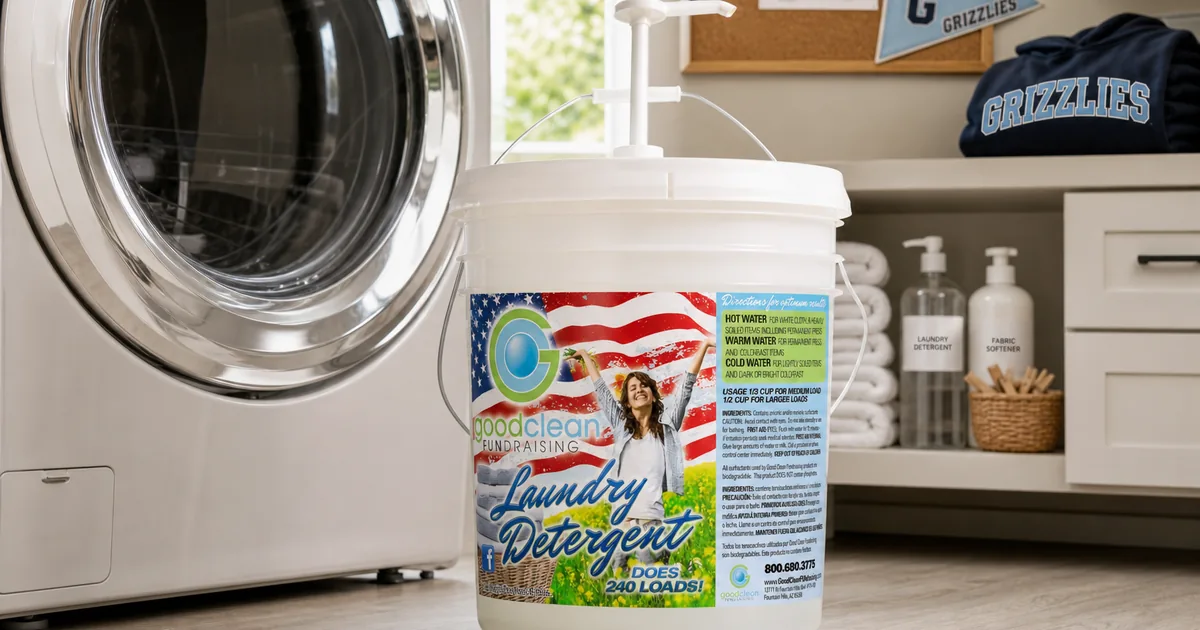
A 5-gallon detergent fundraiser is a bulk household-necessity fundraiser where groups sell large pump buckets of laundry detergent — typically 640 ounces per bucket — to supporters at a per-ounce price below typical retail. The model works because detergent is a consumable staple most households already buy, so the buyer pool may be wider than with novelty or treat fundraisers, and supporters get value rather than paying a premium for something they don't need. With Good Clean Fundraising, groups collect payment first and submit a paid order, so there is no upfront cost and no unsold inventory; the minimum order is 50 buckets. The buckets are non-perishable, ship and store easily, and require no freezer or timed delivery day. Because the product is a necessity priced at roughly half the store price per ounce, participation may be higher and supporters may reorder, which can lift total dollars raised compared with traditional catalog or food fundraisers.
If you are researching 5-gallon detergent fundraisers, you have probably noticed something: the model is built around a product people already buy, which can change who participates, how much they sell, and how simple the whole thing is to run. Compared with cookie dough or candy, it may mean fewer logistics headaches and a wider buyer pool, though results vary by group.
A 5-gallon bucket holds 640 ounces of laundry detergent in a pump dispenser. Groups sell it for $49.95 (about $50), supporters pay roughly half the per-ounce price of premium national brands, and the group keeps a per-bucket profit with no money down and no unsold inventory. It is a necessity fundraiser, not a novelty fundraiser, and that distinction is what makes the model work.
This guide explains how 5-gallon detergent fundraisers operate, what groups earn, how the bulk format compares with smaller bottles and traditional products, how the economics compare, what to look for in a program, and the mistakes coordinators make when they choose the wrong one.
- A 5-gallon detergent fundraiser sells bulk laundry detergent in large pump buckets — typically 640 ounces — at roughly half the per-ounce retail price of national brands, based on a September 2026 retailer price check.
- Groups collect payment first and submit a paid order for what they sell, so there is no upfront cost; the 50-bucket minimum still applies.
- The buyer pool may be wider than with treat or novelty fundraisers because detergent is a household necessity most families already purchase.
- Bulk buckets are non-perishable, ship and store easily, and require no freezer or timed delivery logistics.
- Supporters may see value — a premium product at about half the per-ounce store price — rather than paying a markup for something they don't need.
- Repeat orders and multi-bucket purchases are plausible because buyers use the product and may reorder when it runs out; this guide has no repeat-purchase data.
- Good Clean Fundraising advertises a 100% money-back guarantee, free shipping at 100 or more buckets, and a Getting Started packet, instructions, and marketing materials.
What is a 5-gallon detergent fundraiser?
A 5-gallon detergent fundraiser is a product fundraiser where groups sell bulk laundry detergent in large, pump-dispensed buckets. Each bucket typically holds 640 ounces and is sold at a price below what supporters would pay per ounce for a premium national brand at a major retailer. The group collects orders and payment, submits a paid order to the fundraising company, and the buckets are delivered to the group's commercial delivery address for distribution.
The model is a household-necessity fundraiser: instead of asking supporters to buy a treat or novelty item they don't need, it offers them a consumable staple they already purchase, at a better price. That shift — from discretionary to necessary — may widen the buyer pool and support higher participation, though results vary by group. Grandparents, neighbors, and coworkers who would never buy cookie dough may buy detergent, especially when a 5-gallon bucket runs about half the per-ounce cost of the brands they already use.
The bulk format matters. A 5-gallon bucket is a stock-up purchase — buyers are not just buying one load's worth. The pump dispenser makes it easy to use, and because detergent is non-perishable, there is no spoilage, no freezer logistics, and no timed delivery day. The trade-off is that the bulk order needs a commercial delivery address (a loading dock or forklift is recommended).
How does a 5-gallon detergent fundraiser work?
The process is straightforward and designed to remove the complexity that makes traditional fundraisers hard to run. The group signs up with a bulk detergent fundraising company, receives order forms or an online ordering link, and sets a selling window (Good Clean Fundraising recommends two to three weeks). Families and volunteers share the opportunity with their networks — friends, relatives, neighbors, coworkers — and collect orders and payment. At the end of the window, the group submits the total order and payment for the buckets, and the company ships the detergent to the group's commercial delivery address about two weeks later. The group distributes the buckets to buyers, and the profit is the difference between what supporters paid and what the group paid the company.
Because it is a no-upfront-cost model, the group never fronts money for inventory. Orders are collected first, so the group is not left holding unsold inventory. If a campaign raises less than hoped, the group orders only what supporters paid for, provided it still reaches the 50-bucket minimum. Good Clean Fundraising offers free shipping at 100 buckets or more; at 50 to 99 buckets, shipping is charged separately and profit is usually about $5 to $12 per bucket.
Good Clean Fundraising provides a Getting Started packet, instructions, marketing materials, and social media strategies. The group runs the campaign — kickoff, order collection, the paid final order, and distribution. For a first-time organizer, clear instructions can be the difference between a manageable project and a stressful one.
What do groups earn with a 5-gallon detergent fundraiser?
Profit depends on the selling price, the group's cost per bucket, and the order volume. Good Clean Fundraising sells its bucket for $49.95 (about $50). At that price, groups keep about $13.45 to $15.45 per bucket at 100 or more buckets, depending on order size: $13.45 at 100 to 299 buckets, $14.45 at 300 to 499, and $15.45 at 500 or more; at 50 to 99 buckets, profit is usually about $5 to $12 per bucket depending on actual shipping costs, and orders under 50 buckets are not accepted. The per-bucket cost drops by $1 at 300 buckets and by $2 at 500, and shipping is free at 100 buckets or more.
To put that in context: if a group of 50 families each sells an average of four buckets, that is 200 buckets total. At $13.45 per bucket, the group keeps about $2,690 with no upfront cost. The bigger lever, though, may be participation. Because detergent is a necessity, more families may find buyers, and some buyers may purchase multiple buckets or reorder in future campaigns. That repeat dynamic is plausible for a consumable product, though this guide has no repeat-purchase data.
The value to the buyer is also part of the equation. A 5-gallon bucket at $49.95 works out to about 7.8 cents per ounce. Premium national-brand liquid detergents at major retailers commonly run about 13 to 16 cents per ounce (value-tier and store brands can cost less), so supporters are paying roughly half the per-ounce store price for a product they already use, based on a September 2026 retailer price check.
Why does the 5-gallon bulk format work better than smaller bottles?
The bulk format solves three problems at once: it delivers real value to the buyer, it simplifies logistics for the group, and it gives the group a per-bucket profit without requiring a large markup on a small item. A 5-gallon bucket is large enough that supporters feel they are stocking up and saving money — it is not a token purchase. That perceived and actual value may drive repeat orders and multi-bucket sales.
Smaller bottles may not offer the same value proposition. A standard-size bottle sold at a fundraiser could cost about the same as or more than what a supporter would pay at a store, in which case the main reason to buy is to support the group rather than to get a deal. This guide has not surveyed small-bottle programs, so compare each program's per-ounce price. Bulk buckets change that dynamic: supporters can see a lower per-ounce price, and the group benefits as a result.
Logistically, bulk can also be simpler. Handling 200 large buckets may be easier than handling several times as many small bottles — fewer items to count, distribute, and reconcile. The buckets are non-perishable, so there is no spoilage risk or freezer requirement, though they are heavy and need a commercial delivery address. For a volunteer coordinator managing the campaign, that reduction in item count can be significant.
How do 5-gallon detergent fundraisers compare to traditional product fundraisers?
The comparison comes down to buyer breadth, value, logistics, and risk. Traditional product fundraisers — cookie dough, candy, popcorn, wrapping paper — appeal to a narrow slice of supporters: people who want that specific treat or item. A 5-gallon detergent fundraiser may appeal to most households because everyone does laundry. That difference in addressable market is a main reason a bulk detergent program may raise more.
On value, many traditional fundraisers price the product above its everyday worth because both the group and the fundraising company need to profit from that one sale. A tub of cookie dough or a box of candy at a fundraiser can cost more than a comparable item at a store, so supporters may be paying a premium to help the group. With a bulk detergent fundraiser, supporters pay roughly half the per-ounce retail price of a national brand, based on a September 2026 retailer price check, so they may see real value. That can make the ask easier and the buyer pool wider.
Logistically, food and treat fundraisers are often perishable, require freezer storage, and need a timed delivery day. Bulk detergent is non-perishable, ships and stores at room temperature, and can be distributed on the group's schedule. There is no scramble to find freezer space or coordinate a delivery window, which removes a major pain point for coordinators.
On risk, many traditional programs require the group to order inventory in advance, which means fronting money and hoping the campaign sells enough to cover the cost. Good Clean Fundraising has a $0 upfront cost: the group collects orders and payment first and submits a paid order for what supporters bought, subject to the 50-bucket minimum.
What should you look for in a 5-gallon detergent fundraiser program?
Not all bulk detergent programs are built the same, and the differences matter. Start with the fundamentals: Is there any upfront cost or financial risk? What is the profit per bucket at your expected order size? Is shipping free, and if so, at what volume? What instructions and materials does the program provide? And is there a money-back guarantee for supporters?
A money-back guarantee can signal that a company stands behind its product. Ask what it covers, who bears the cost of a refund, and whether the group's profit is affected. Good Clean Fundraising advertises a 100% money-back guarantee under which, according to the company, any customer who is not satisfied is refunded and the group keeps its profit.
Clear support is the other major differentiator. A program that provides instructions, materials, and marketing help can be easier to run than one that hands you a box of forms. Good Clean Fundraising provides a Getting Started packet, instructions, marketing materials, and social media strategies, and the group runs the campaign and arranges delivery.
Finally, look at how the program rewards larger campaigns. Good Clean Fundraising's cost per bucket drops by $1 at 300 buckets and by $2 at 500, which lifts profit from $13.45 to $14.45 to $15.45 per bucket. If a program offers seller prizes or incentives, ask who pays for them.
Common mistakes groups make with 5-gallon detergent fundraisers
The most common mistake is choosing a program based solely on the highest claimed profit percentage without confirming the details. A program that promises a high margin but requires upfront payment, charges for shipping, or provides no support can end up netting the group less than a program with a slightly lower margin and better terms. Always confirm the profit per bucket in dollars, not percentages, and factor in shipping, support, and risk.
Another mistake is setting the selling window too long. A focused two-to-four-week campaign creates urgency and keeps participants engaged. Campaigns that stay open for months lose momentum, and participation can fade. Set a clear deadline at the kickoff and hold to it.
Groups also underestimate the importance of a strong kickoff. When families start whenever they get around to it, many never start at all. A single kickoff day where everyone receives materials, hears the goal, and understands how to participate can drive much of the early sales and set the tone for the whole campaign.
Finally, some groups fail to communicate the value proposition to supporters. If sellers are framing the fundraiser as 'please buy this to help us' rather than 'you can stock up on detergent at about half the store price and support us at the same time,' they are missing the main reason people buy. The value is real — make sure your families know to lead with it.
| Factor | Traditional Product | 5-Gallon Bulk Detergent |
|---|---|---|
| Buyer pool | Narrow — treat or novelty buyers | Wide — most households need it |
| Value to supporter | Often marked up | ~½ per-ounce retail price |
| Perishable? | Often yes (frozen, spoils) | No — ships & stores easily |
| Delivery logistics | Often frozen, varies by item (e.g., cookie dough) | No freezer, flexible delivery |
| Upfront cost | Often requires inventory purchase | $0 upfront — orders first |
| Repeat purchases | Often one-time novelty | Possible — buyers may reorder |
| Profit structure | High markup, narrow base | Volume + broad participation |
Common mistakes to avoid
Choosing based on claimed percentage alone
A high percentage means nothing if the program requires upfront payment, charges for shipping, or provides no support. Confirm profit per bucket in dollars and factor in all terms.
Leaving the selling window open too long
A focused two-to-four-week campaign creates urgency and is intended to hold participants' attention better than a months-long one. Set a clear deadline and hold to it.
Skipping a real kickoff
When families start whenever they feel like it, many never start. A single kickoff day drives most of the early momentum.
Not communicating the value to supporters
Supporters may be more motivated by getting detergent at about half the store price than by the ask to help alone. Make sure your families lead with that value.
Ignoring the money-back guarantee
A money-back guarantee can make the ask easier and may signal confidence in the product. Ask what the guarantee covers and how refunds affect the group's profit.
- Detergent per-ounce retail pricing — premium national-brand liquid laundry detergent at a major U.S. retailer, price-checked September 2026 (~13–16 cents per ounce across common sizes). Retail prices vary by size, store, and region; based on a single online retailer's listings for premium brands; some value-tier and store brands cost less per ounce.
- Good Clean Fundraising program terms — $49.95 per bucket; $13.45 profit per bucket at 100 to 299 buckets (usually $5 to $12 at 50 to 99 buckets, depending on actual shipping costs), $14.45 at 300 to 499, $15.45 at 500 or more; $0 upfront cost; free shipping at 100+ buckets; 50-bucket minimum (smaller orders are not accepted); 100% money-back guarantee under which, according to the company, any customer who is not satisfied is refunded and the group keeps its profit. — GCF pricing, GCF how it works, and GCF refund and returns policy
- Household necessity vs. discretionary product fundraising — general category comparison based on buyer addressable market and repeat-purchase behavior. No statistical claims; qualitative assessment.
Our recommendation
If you are considering a 5-gallon detergent fundraiser, Good Clean Fundraising runs The Good Clean Fundraiser, a bulk laundry-detergent program for schools, teams, and nonprofits. Groups sell premium 5-gallon pump buckets for about $50 — supporters pay roughly half the per-ounce price of premium national brands — and keep about $13.45 to $15.45 per bucket at 100 or more buckets, depending on order volume, with $0 upfront cost, free shipping on orders of 100 buckets or more, and a Getting Started packet, instructions, marketing materials, and social media strategies. The group arranges a commercial delivery address (a loading dock or forklift is recommended), plans for a 50-bucket minimum, and allows about two weeks for fulfillment after submitting the paid order. Good Clean Fundraising advertises a 100% money-back guarantee under which, according to the company, any customer who is not satisfied is refunded and the group keeps its profit.
Frequently asked questions
A 5-gallon detergent fundraiser works by having groups sell bulk laundry detergent in large pump buckets — typically 640 ounces per bucket — to supporters at a per-ounce price below typical retail. With Good Clean Fundraising, the group collects orders and payment first, submits a single paid order, and pays only for what supporters bought, so there is no upfront cost; the minimum order is 50 buckets. The buckets are delivered to the group's commercial delivery address, distributed to buyers, and the group keeps the profit.
With Good Clean Fundraising at the $49.95 price, groups keep about $13.45 to $15.45 per bucket at 100 or more buckets, depending on order volume, with free shipping at 100 buckets or more; at 50 to 99 buckets profit is usually about $5 to $12 per bucket. The bigger factor in total dollars raised may be participation — because detergent is a necessity, more families may find buyers, which can lift the whole group's total.
It may be, depending on the terms. Bulk 5-gallon buckets can give supporters a lower per-ounce price — Good Clean Fundraising's is roughly half the per-ounce store price based on a September 2026 retailer price check — which may support repeat orders and multi-bucket purchases. Smaller bottles may cost about the same as or more than store prices, so compare each program's per-ounce price. Logistically, bulk can be simpler: fewer items to count, distribute, and reconcile, and no spoilage or freezer requirement.
Not with Good Clean Fundraising, which has a $0 upfront cost. The group collects orders and payment first and submits a paid order for the buckets supporters bought, so it is not left holding unsold inventory, subject to the 50-bucket minimum. Other programs vary, so confirm the terms before you commit.
Good Clean Fundraising sells its 5-gallon bucket for $49.95 (about $50), which works out to about 7.8 cents per ounce. Premium national-brand liquid detergents at major retailers commonly run about 13 to 16 cents per ounce (value-tier and store brands can cost less), so supporters are paying roughly half the per-ounce store price for a product they already use, based on a September 2026 retailer price check.
No. Bulk laundry detergent is non-perishable and stores at room temperature, so there is no freezer requirement and no timed delivery day. The buckets can be distributed on the group's schedule, which removes the frozen-delivery logistics that make food fundraisers hard to run.
Many campaigns run two to four weeks, and Good Clean Fundraising recommends a two-to-three-week selling window. A short, focused selling window creates urgency and keeps participants engaged. Campaigns that stay open for months tend to lose momentum and raise less than a tight, deadline-driven push. Allow about two weeks for fulfillment after you submit the paid order.
Look for no upfront cost, clear profit per bucket in dollars (not just percentages), free shipping at a reasonable volume, clear instructions and materials, and a money-back guarantee for supporters. Ask about volume-based profit tiers too; Good Clean Fundraising's cost per bucket drops at 300 and 500 buckets.
For some groups they may be — mainly because the buyer pool may be wider. Detergent is a necessity most households already purchase, so it can reach grandparents, neighbors, and coworkers who would never buy a treat. It is also non-perishable, which removes the frozen-delivery logistics, and supporters may see value at about half the store price rather than paying a premium for a novelty. Results vary by group.
The Good Clean Fundraiser is Good Clean Fundraising's bulk laundry-detergent program. Groups sell 5-gallon pump buckets for about $50 and keep about $13.45 to $15.45 per bucket at 100 or more buckets, with $0 upfront cost, free shipping on orders of 100 or more, and a Getting Started packet, instructions, marketing materials, and social media strategies. Good Clean Fundraising also advertises a 100% money-back guarantee under which, according to the company, any unsatisfied customer is refunded and the group keeps its profit.
A 5-gallon detergent fundraiser is built around a product people already buy, at a price that can deliver value. That shifts the dynamic from asking supporters to overpay for a novelty to offering them a purchase that also helps the group. The possible result is wider participation, simpler logistics, and campaigns groups want to run again, though this guide does not include measured results.