Laundry Detergent Fundraising
How Does a Laundry Detergent Fundraiser Work?
The mechanics, profit structure, and step-by-step process behind bulk detergent fundraising — and how it compares with other product fundraisers.
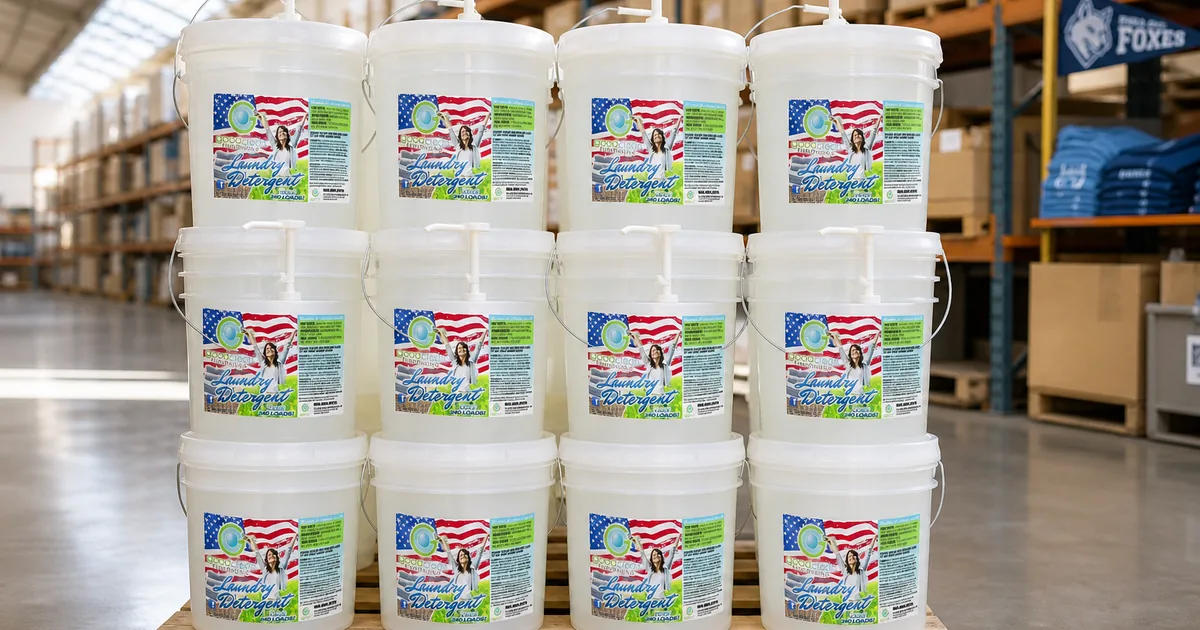
A laundry detergent fundraiser is a bulk household-necessity product program where groups sell premium 5-gallon detergent buckets to supporters at roughly half the per-ounce price of premium national brands, according to Good Clean Fundraising's price comparison. The group collects supporters' payments first and pays nothing upfront, then submits a single paid bulk order to the fundraising company. The company ships the buckets to the group's commercial delivery address, the group distributes them to buyers, and keeps the profit — about $13.45 to $15.45 per bucket at 100 or more buckets at the standard selling price of about $50, with free shipping at 100 buckets or more and a 50-bucket minimum. Because detergent is a necessity most households already buy and the price represents value, participation may be wider than with treat-based fundraisers, and supporters may reorder in future campaigns.
Laundry detergent fundraisers are one alternative groups consider to traditional product programs, and the appeal is straightforward: they sell a household necessity people already buy, at a price that represents real value, with logistics that are simpler than food or perishable products. But if you have never run one, the mechanics can feel opaque — how the ordering works, where the profit comes from, what the group actually does, and whether the math holds up.
This guide walks through exactly how a detergent fundraiser works, from the first order to the final payout. You will see the step-by-step process, the profit structure, what makes it different from other product fundraisers, how a program like Good Clean Fundraising runs it end to end, and the mistakes groups make when they misunderstand the model.
The short version: it is a bulk-order program where supporters buy a useful product at roughly half the store price, the group fronts nothing, and the profit per bucket depends on order volume, because the product has everyday value and a wide buyer pool.
- Groups collect supporters' payments first and pay nothing upfront — the group does not front money for inventory, and submits one paid order for the buckets sold.
- Supporters buy a 5-gallon bucket for about $50, roughly half the per-ounce price of premium national-brand liquid detergent at major retailers.
- The group keeps about $13.45 to $15.45 per bucket at 100 or more buckets, with profit rising at 300 and 500 buckets and shipping free at 100 buckets or more; the minimum order is 50 buckets.
- The fundraising company ships buckets in bulk to the group's commercial delivery address (a loading dock or forklift is recommended); the group distributes them to individual buyers.
- Because detergent is a necessity most households repurchase, the buyer pool may be wider than dessert or novelty fundraisers, and supporters may reorder.
- Good Clean Fundraising provides a Getting Started packet, instructions, marketing materials, and social media strategies so the group is not figuring it out alone.
What is a laundry detergent fundraiser?
A laundry detergent fundraiser is a bulk product program where a school, team, church, or nonprofit sells premium laundry detergent in large 5-gallon buckets to supporters. The detergent is offered at roughly half the per-ounce retail price of premium national brands, according to Good Clean Fundraising's price comparison. Supporters are not donating or buying an overpriced novelty; they are shifting a purchase they already make from the store to the group's campaign, getting value, and backing the organization at the same time.
The model works because laundry detergent is a true household necessity. Most families buy it, use it up, and buy it again. That universality is what separates it from treat-based fundraisers: a cookie dough or candy catalog appeals to a narrow slice of buyers, while detergent may reach most people — parents, grandparents, neighbors, coworkers, and anyone with a washing machine.
The structure is simple: the group collects orders over a selling window, submits a single paid bulk order to the fundraising company, receives the buckets, distributes them to buyers, and keeps the profit. There is no inventory to purchase upfront, no perishable product to manage, and no complex event logistics.
How does the ordering and payment process work?
The process is designed to avoid upfront cost and reduce financial risk for the group. Here is how it unfolds step by step:
First, the group runs a campaign — typically two to four weeks — where families and supporters place orders. Programs typically provide order forms, and some offer online ordering tools. The group collects payment from buyers as orders come in, so the organization is holding supporter money, not fronting its own.
At the end of the campaign, the group tallies the total number of buckets sold and submits a single bulk order to the fundraising company with payment for the buckets ordered. The company ships the full order to the group's commercial delivery address in one delivery, and Good Clean Fundraising allows about two weeks for fulfillment after the paid order is submitted.
Once the buckets arrive, the group distributes them to individual buyers, typically on a designated pickup day or through a coordinated delivery. The group has already collected payment from supporters, so distribution is simply handing out product. After delivery is complete, the group keeps the difference between what supporters paid and what the company charged — that difference is the profit.
What does the group actually do during the campaign?
The group's role is straightforward: promote the fundraiser, collect orders, and coordinate distribution. In practice, that breaks into a few concrete tasks:
At the start, the coordinator holds a kickoff — a meeting, email, or announcement explaining the goal, the product, the price, and how to order. Families receive order forms or a link to an online order page, along with any promotional materials the program provides.
During the two-to-four-week selling window, families reach out to their networks — relatives, neighbors, coworkers, friends — and collect orders. The coordinator sends a couple of reminders to keep momentum up and tracks orders as they come in.
At the campaign close, the coordinator tallies the total, submits the bulk order to the fundraising company, and arranges a delivery or pickup day. When the buckets arrive, volunteers help distribute them to buyers, and the fundraiser is complete.
Good Clean Fundraising provides a Getting Started packet, instructions, marketing materials, and social media strategies; the group still runs the kickoff, collects the orders, submits the paid final order, and arranges a commercial delivery address (a loading dock or forklift is recommended). That guidance is meant to make the program manageable for a first-time organizer or a volunteer-stretched group.
How much profit does the group make per bucket?
At the standard selling price of about $50 per 5-gallon bucket, groups keep about $13.45 to $15.45 per bucket at 100 or more buckets, depending on order volume. The per-bucket cost to the group drops at 300 and 500 buckets, and shipping is free at 100 buckets or more, so larger campaigns see higher per-bucket profit. At 50 to 99 buckets, profit is usually about $5 to $12 per bucket because shipping is charged separately, and orders under 50 buckets are not accepted.
Use the tier that matches your expected order size when planning: $13.45 per bucket at 100 to 299 buckets, $14.45 at 300 to 499, and $15.45 at 500 or more. A 100-bucket campaign, for example, returns about $1,345 at $13.45 per bucket. The per-bucket margin is strong, and the group never has to front money to access it.
To put that in context, the supporter is paying roughly 7 to 8 cents per ounce for a premium detergent ($49.95 ÷ 640 ounces ≈ 7.8 cents), while premium national-brand liquid detergents at major retailers commonly run about 13 to 16 cents per ounce (value-tier and store brands can cost less). The buyer is getting a useful product at roughly half the per-ounce store price, and the group is keeping a solid margin.
Why does a detergent fundraiser raise more than traditional product fundraisers?
For many groups, the potential advantage is less a few points of margin than the width of the buyer pool and the repeat-purchase dynamic. Detergent is a necessity most households already buy, so it can reach grandparents, neighbors, and coworkers who would never purchase a tub of cookie dough or a box of candy. That wider pool can help more families find buyers, which can lift the whole group's total. Results vary by group; this is editorial reasoning, not a measured comparison.
Second, supporters are not paying a premium for a novelty item they did not need. They are shifting a purchase they were going to make anyway, at a price that saves them money. That value proposition is easy to sell and does not feel like a favor or a guilt purchase — it is a transaction where both sides may benefit.
Third, because detergent is consumable and repurchased, supporters may buy again in future campaigns. A treat fundraiser is often a one-time purchase; a necessity fundraiser can build a base of repeat buyers, which may make subsequent campaigns easier to plan.
Finally, the logistics are simpler. Detergent is non-perishable, ships and stores easily, and does not require refrigeration or a timed delivery day. That operational simplicity may mean fewer volunteers, less stress, and a higher likelihood the group will run the fundraiser again.
How does Good Clean Fundraising run a detergent fundraiser?
Good Clean Fundraising operates The Good Clean Fundraiser, a bulk laundry-detergent program built specifically for schools, teams, churches, and nonprofits. The program sells premium 5-gallon pump buckets — 640 ounces of detergent — at $49.95 per bucket, with groups keeping about $13.45 to $15.45 per bucket at 100 or more buckets, depending on order volume. Shipping is free on orders of 100 buckets or more, and the minimum order is 50 buckets.
The structure is $0 upfront cost: the group collects supporters' payments first, then submits the final order with payment and receives the buckets about two weeks later. Good Clean Fundraising provides a Getting Started packet, instructions, marketing materials, and social media strategies. The group arranges a commercial delivery address (a loading dock or forklift is recommended) and plans for the 50-bucket minimum.
Good Clean Fundraising advertises a 100% money-back guarantee under which, according to the company, any customer who is not satisfied is refunded and the group keeps its profit. That guarantee can reduce buyer hesitation and give groups confidence when promoting the campaign.
Volume discounts lower the group's cost per bucket by $1 at 300 buckets and by $2 at 500 buckets, which is why profit rises from $13.45 to $14.45 to $15.45 per bucket. Those tiers apply to the group's total order.
The combination — a necessity product at value, $0 upfront cost, free shipping at 100 or more buckets, a Getting Started packet and marketing materials, and an advertised money-back guarantee — is what Good Clean Fundraising offers groups comparing options in the detergent fundraising category.
What are the common mistakes groups make with detergent fundraisers?
The most common mistake is underselling the value. Coordinators sometimes present the fundraiser as 'help us raise money' rather than 'get premium detergent at half the store price.' The second framing is intended to drive participation — supporters may respond better when they understand they are getting real value, not doing a favor.
Another mistake is running the campaign too long. A two-to-four-week window creates urgency; a campaign left open for months can lose momentum and may raise less. Set a firm end date at the kickoff and hold to it.
Some groups also fail to brief families on why detergent is easier to sell than a treat product. A short explanation at the kickoff — 'this is something most households already buy, so your buyer pool is much wider' — is intended to boost confidence and participation.
Finally, groups sometimes try to run a detergent fundraiser without clear instructions or materials from the program, which means they are figuring out ordering, promotion, and delivery logistics on their own. Programs like Good Clean Fundraising provide a Getting Started packet, instructions, and marketing materials, though the group still runs the campaign and arranges delivery.
Common mistakes to avoid
Underselling the value to supporters
Frame it as 'get premium detergent at half the store price,' not 'help us raise money.' The value proposition is intended to drive participation.
Running the campaign too long
A two-to-four-week window creates urgency. Campaigns left open for months can lose momentum and may raise less.
Not explaining why detergent is easier to sell
A short kickoff explanation — 'everyone already buys this' — is intended to boost confidence and widen participation.
Trying to run it without vendor support
Programs like Good Clean Fundraising provide a Getting Started packet, instructions, and marketing materials, but the group still runs the campaign. Going it alone without any vendor guidance adds unnecessary complexity.
- Detergent price comparison — per-ounce pricing for premium national-brand liquid laundry detergent at a major U.S. retailer, price-checked September 2026 (commonly ~13–16 cents per ounce across standard sizes). Retail prices vary by size and store; based on a single online retailer's listings for premium brands; some value-tier and store brands cost less per ounce.
- Good Clean Fundraising program terms — $49.95 per bucket; $13.45 profit per bucket at 100 to 299 buckets (usually $5 to $12 at 50 to 99 buckets, depending on actual shipping costs), $14.45 at 300 to 499, $15.45 at 500 or more; $0 upfront cost; free shipping at 100+ buckets; 50-bucket minimum (smaller orders are not accepted); 100% money-back guarantee under which, according to the company, any customer who is not satisfied is refunded and the group keeps its profit. — GCF pricing, GCF how it works, and GCF refund and returns policy
- No-upfront-cost fundraising model: the group collects orders and payment first and submits the final order for the buckets sold, so it is not left holding unsold inventory; the 50-bucket minimum still applies. Editorial description.
Our recommendation
If you are considering a laundry detergent fundraiser, Good Clean Fundraising's program is built for exactly this. Groups sell premium 5-gallon detergent buckets for about $50 — a household necessity supporters buy at roughly half the per-ounce price of premium national brands — and keep about $13.45 to $15.45 per bucket at 100 or more buckets, with $0 upfront cost, free shipping on orders of 100 buckets or more, and a Getting Started packet, instructions, marketing materials, and social media strategies. Your group arranges a commercial delivery address (a loading dock or forklift is recommended), plans for a 50-bucket minimum, and allows about two weeks for fulfillment after submitting the paid order. Because you order only what supporters have already bought, you are not left holding unsold inventory, and the program advertises a 100% money-back guarantee under which, according to the company, any unsatisfied customer is refunded and the group keeps its profit.
Frequently asked questions
A laundry detergent fundraiser works by having the group collect orders for 5-gallon detergent buckets over a selling window, then submitting a single paid bulk order to the fundraising company. The company ships the buckets to the group, the group distributes them to buyers, and keeps the profit — about $13.45 to $15.45 per bucket at 100 or more buckets and the standard selling price of about $50. There is no upfront cost, shipping is free at 100 or more buckets, and the minimum order is 50 buckets.
Not with Good Clean Fundraising's program, which has a $0 upfront cost: the group collects payment from supporters first, then submits the final order with payment for the buckets sold. Other programs vary, so confirm the payment terms before you commit. Because buckets are ordered only after supporters have paid, the group is not left holding unsold inventory, although the 50-bucket minimum still applies.
With Good Clean Fundraising at the standard selling price of about $50 per 5-gallon bucket, groups keep about $13.45 to $15.45 per bucket at 100 or more buckets: $13.45 at 100 to 299, $14.45 at 300 to 499, and $15.45 at 500 or more. At 50 to 99 buckets, profit is usually about $5 to $12 per bucket depending on actual shipping costs, and orders under 50 buckets are not accepted.
Detergent fundraisers commonly run about two to four weeks of selling, which is editorial guidance for keeping urgency high. After the group submits its paid order, Good Clean Fundraising allows about two weeks for fulfillment, so the whole process from kickoff to delivery is roughly four to six weeks.
It can be, for many groups. Detergent is a household necessity most families already buy, so it may reach a wider buyer pool than treat or novelty fundraisers. Supporters get a useful product at roughly half the per-ounce store price, and the non-perishable logistics are simpler than food products. Supporters may also reorder in future campaigns because it is a consumable product.
The fundraising company ships the full bulk order to the group's commercial delivery address in one delivery (a loading dock or forklift is recommended). The group then holds a designated pickup day or coordinates delivery to hand buckets to individual buyers, who have already paid. Because detergent is shelf-stable, the distribution window can be flexible — buckets can sit in storage if pickup runs long, unlike frozen food products.
Good Clean Fundraising sells 5-gallon buckets that hold 640 ounces of liquid laundry detergent. At $49.95 per bucket, that works out to about 7.8 cents per ounce, compared to premium national brands at major retailers that commonly run about 13 to 16 cents per ounce (value-tier and store brands can cost less). Supporters who order online also pay a $2 online purchase fee on top of the bucket price; that fee does not reduce the group's profit.
It depends on the program. Good Clean Fundraising provides a Getting Started packet, instructions, marketing materials, and social media strategies; the group still runs the campaign, submits the paid final order, and arranges a commercial delivery address. Other programs may provide more or less support, so ask what is included before you commit.
Yes, supporters can reorder. Because detergent is a consumable product households repurchase regularly, supporters may buy again in the next campaign. That repeat-buyer potential may make subsequent fundraisers easier to plan, unlike one-time novelty or treat products.
The Good Clean Fundraiser is Good Clean Fundraising's bulk detergent program. It has a $0 upfront cost, free shipping on orders of 100 or more buckets, volume-based profit of $13.45 to $15.45 per bucket at 100 or more buckets, and a Getting Started packet, instructions, marketing materials, and social media strategies. Good Clean Fundraising also advertises a 100% money-back guarantee under which, according to the company, any unsatisfied customer is refunded and the group keeps its profit.
A laundry detergent fundraiser works by selling a household necessity people already buy, at a price that may represent value, with a structure that eliminates upfront cost and simplifies logistics. The group collects orders, submits a paid bulk order, distributes the product, and keeps a strong per-bucket profit — all without fronting money or managing perishable inventory. It is a model built around a product buyers already understand, the group is not left holding unsold inventory, and the buyer pool is as wide as it gets.