Laundry Detergent Fundraising
Detergent Fundraiser for Churches & Youth Groups: The Complete Guide
Why some churches and youth groups consider bulk laundry detergent fundraisers — and how a household-necessity program may raise more with less volunteer effort.
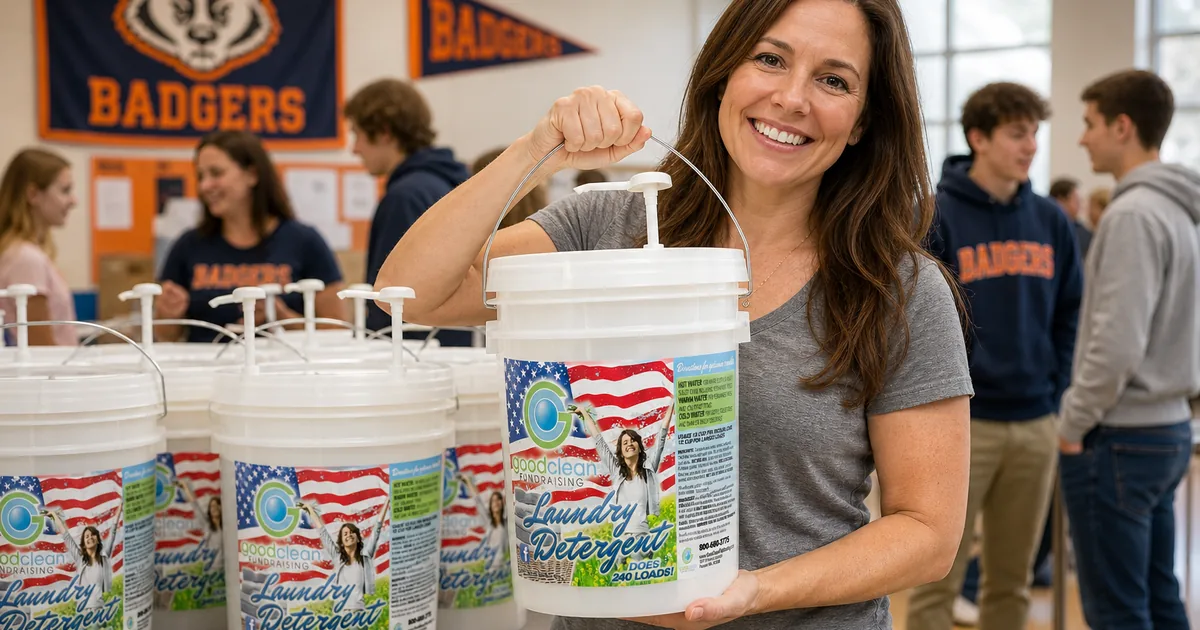
A bulk laundry detergent fundraiser may work well for churches and youth groups because it sells a household necessity most families already buy, which may widen the buyer pool beyond what a treat or novelty product can reach. With Good Clean Fundraising, groups sell 5-gallon buckets at $49.95 (about $50) — roughly half the per-ounce retail price of premium national brands based on a September 2026 retailer price check — and keep $13.45 to $15.45 per bucket at 100 or more buckets, depending on order volume. There is a $0 upfront cost because the group collects payment first and submits a paid order; the minimum order is 50 buckets. The model avoids the perishability of food fundraisers, and because detergent is a consumable staple, supporters may reorder in future campaigns; this guide has no repeat-purchase data. Good Clean Fundraising recommends a two-to-three-week selling window and fulfillment takes about two weeks after the paid order.
Churches and youth groups have run the same fundraisers for decades — bake sales, car washes, cookie dough, and candy bars — and for a long time they worked well enough. But some coordinators running these campaigns run into the same walls: narrow buyer pools, high volunteer effort, thin margins, and supporter fatigue from being asked to buy things they may not need.
Bulk laundry detergent is one alternative. It is a household necessity most families already purchase, it may reach buyers who would never buy a dessert or novelty item, it is priced at roughly half the per-ounce store price based on a September 2026 retailer price check, and it may require less volunteer work than an event or perishable-product sale. Results vary by group.
This guide covers why detergent fundraisers work so well for churches and youth groups, how the economics compare to traditional programs, what a typical campaign looks like from kickoff to distribution, how to choose a program, and the mistakes to avoid when you make the switch.
- Laundry detergent is a household necessity most families already buy, so it may reach a wider buyer pool than treats, novelties, or event-based fundraisers.
- Supporters pay roughly half the per-ounce price of premium national brands, based on a September 2026 retailer price check, rather than a premium for something they did not need.
- Good Clean Fundraising has a $0 upfront cost: the group collects payment first and submits a paid order, so it never fronts money for inventory; the minimum order is 50 buckets.
- Detergent is non-perishable, so there is no freezer logistics or spoilage risk, though the buckets are heavy and need a commercial delivery address.
- Good Clean Fundraising recommends a two-to-three-week selling window, with about two weeks for fulfillment after the paid order; it provides a Getting Started packet, instructions, marketing materials, and social media strategies.
- Because detergent is a consumable staple, supporters may reorder in future campaigns; this guide has no repeat-purchase data.
- The model may require less volunteer effort than bake sales, car washes, or door-to-door selling.
Why do detergent fundraisers work so well for churches and youth groups?
The answer may come down to buyer breadth and value. Traditional church fundraisers — bake sales, cookie dough, popcorn, candy bars — appeal to a narrow slice of supporters: people who want a treat or novelty item at that moment. Laundry detergent, by contrast, is something most households already buy and use up regularly, so the potential buyer pool may include many families in your congregation, grandparents, neighbors, and coworkers your youth group can reach.
The second reason is that supporters get a useful product at a lower per-ounce price. A 5-gallon bucket sells for $49.95 (about $50) with Good Clean Fundraising and runs about 7.8 cents per ounce, while premium national-brand liquid detergents at major retailers commonly cost about 13 to 16 cents per ounce (value-tier and store brands can cost less). That means supporters pay roughly half the per-ounce store price, based on a September 2026 retailer price check, for a product they may have been going to buy anyway. It may feel less like a guilt purchase or a favor and more like a household decision that also supports the group.
The third reason is logistics. Detergent is non-perishable, so there is no timed delivery day, no freezer space needed, and no spoilage risk. Buckets ship to the group's commercial delivery address (a loading dock or forklift is recommended). Good Clean Fundraising provides a Getting Started packet, instructions, marketing materials, and social media strategies, and the group runs the campaign; a two-to-three-week selling window is recommended.
How does a church or youth group detergent fundraiser work?
The process is straightforward. The church or youth group partners with a bulk detergent fundraising company, sets a goal and a selling window (Good Clean Fundraising recommends two to three weeks), and holds a kickoff where families receive order forms or a link to share. Participants reach out to their own networks — family, friends, neighbors, coworkers — and collect orders and payment. At the end of the selling window, the group submits a paid order, and the detergent ships to the group's commercial delivery address about two weeks later. Supporters pick up their buckets, and the group keeps the profit.
With Good Clean Fundraising there is a $0 upfront cost — the group collects payment first and submits a paid order, so it does not front money for inventory; the minimum order is 50 buckets. Good Clean Fundraising provides a Getting Started packet, instructions, marketing materials, and social media strategies, and the group runs the campaign, so the volunteer load may be lighter than a bake sale, car wash, or door-to-door candy sale.
Because detergent is a consumable staple, supporters may reorder in a later campaign, which could allow a church or youth group to run the same fundraiser more than once a year, though this guide has no repeat-purchase data. Treat-based and novelty fundraisers may saturate their buyer pool sooner.
What are the economics of a detergent fundraiser for churches?
With Good Clean Fundraising, groups sell a 5-gallon bucket of laundry detergent for $49.95 (about $50). At that price, the church or youth group keeps $13.45 to $15.45 per bucket at 100 or more buckets, depending on order volume: $13.45 at 100 to 299 buckets, $14.45 at 300 to 499, and $15.45 at 500 or more; at 50 to 99 buckets, profit is usually about $5 to $12 per bucket depending on actual shipping costs, and orders under 50 buckets are not accepted. Shipping is free at 100 buckets or more. This guide does not describe whether groups may sell above $49.95; confirm any pricing flexibility with Good Clean Fundraising.
To put that in context: a 5-gallon bucket holds 640 ounces, so at $49.95 the buyer pays about 7.8 cents per ounce. Premium national-brand liquid detergents at major retailers commonly run about 13 to 16 cents per ounce (value-tier and store brands can cost less), so supporters pay about half the store price per ounce, based on a September 2026 retailer price check, while backing the church or youth group. By contrast, in many traditional fundraisers both the group and the fundraising company profit from a single marked-up item.
The bigger lever may be participation. When the product is something people need rather than a treat or novelty, more families may find buyers. This guide has no measured comparison of per-participant sales.
How does a detergent fundraiser compare to traditional church fundraisers?
The comparison is not about one fundraiser being universally better — it is about which model fits the realities churches and youth groups face today. Traditional fundraisers like bake sales, car washes, and cookie dough have real strengths: they are familiar, they build community, and they can work well for small goals. But they can share weaknesses that make them hard to scale or repeat: narrow buyer pools, high volunteer effort, perishability or weather dependence, and thin margins after costs.
A detergent fundraiser may address several of those weaknesses. The buyer pool may be most households rather than just dessert buyers or people who need a car wash that weekend. Volunteer effort may be lower because there is no event to staff, no baking, no freezer logistics, and no door-to-door selling. The product is non-perishable, so there is no spoilage risk and no weather dependence. And because supporters pay roughly half the per-ounce store price, based on a September 2026 retailer price check, the ask may feel less like a favor.
Another possible difference is repeatability. A church or youth group may be able to run a detergent fundraiser more than once a year because detergent is a consumable, though this guide has no repeat-purchase data. Treat-based fundraisers may see diminishing returns as buyer fatigue sets in.
What should churches and youth groups look for in a detergent fundraiser program?
Not all detergent fundraising programs are built the same way, so it is worth knowing what to look for before you commit. Useful factors include upfront cost, profit per bucket, shipping terms, the minimum order, and what support and guarantee the program provides.
Upfront cost: Favor a program where you collect payment first and never front money for inventory; Good Clean Fundraising works this way. Profit per bucket: Confirm what the group keeps per bucket in writing, and ask whether that figure changes with order volume. Good Clean Fundraising's profit steps up at 300 and 500 buckets, and free shipping applies at 100 buckets or more. Support: Ask what instructions and materials the program provides. Good Clean Fundraising provides a Getting Started packet, instructions, marketing materials, and social media strategies. Shipping and delivery: Confirm the delivery address requirements — Good Clean Fundraising ships to a commercial delivery address — and any fees or minimums (the minimum order is 50 buckets). Guarantee: Ask what any money-back guarantee covers and how refunds affect the group's profit.
A good program may score well on all of these: a $0 upfront cost, a clear per-bucket profit that improves with volume, clear instructions and materials, free shipping at larger orders, and a clear guarantee.
Our recommendation: The Good Clean Fundraiser
If your church or youth group is considering a household-necessity program, Good Clean Fundraising runs The Good Clean Fundraiser, a bulk laundry detergent program for schools, churches, sports teams, and youth groups. Here is how it works.
The product: Groups sell a 5-gallon pump bucket of laundry detergent for $49.95 (about $50) — a household staple supporters may buy at roughly half the per-ounce price of premium national brands, based on a September 2026 retailer price check. The bucket holds 640 ounces, so the buyer pays about 7.8 cents per ounce, compared to about 13 to 16 cents per ounce for premium national-brand liquid detergents at major retailers.
The profit: At $49.95, churches and youth groups keep $13.45 to $15.45 per bucket at 100 or more buckets, depending on order volume, with free shipping at 100 buckets or more. There is a $0 upfront cost — you collect payment first and submit a paid order; the minimum order is 50 buckets.
The support: Good Clean Fundraising provides a Getting Started packet, instructions, marketing materials, and social media strategies. The group runs the campaign — kickoff, order collection, the paid final order, and distribution — and arranges a commercial delivery address (a loading dock or forklift is recommended).
The guarantee: Good Clean Fundraising advertises a 100% money-back guarantee under which, according to the company, any customer who is not satisfied is refunded and the group keeps its profit. Confirm the current terms on the refund and returns page before promoting the guarantee to supporters.
The selling window: Good Clean Fundraising recommends a two-to-three-week selling window, and allows about two weeks for fulfillment after the paid order is submitted.
The schedule: A two-to-three-week window is long enough for families to reach their networks but short enough to keep momentum. Because detergent is a consumable staple, a group may be able to run the program more than once a year; this guide has no repeat-purchase data.
For churches and youth groups that want to raise money without burning out volunteers, The Good Clean Fundraiser is one household-necessity option. It may reach a wide buyer pool and offers supporters roughly half the per-ounce store price based on a September 2026 retailer price check, though results vary by group.
Common mistakes churches and youth groups make with detergent fundraisers
Even a simple fundraiser can underperform if you miss a few key steps. Here are the mistakes that trip up churches and youth groups most often, and how to avoid them.
| Factor | Traditional Fundraiser | Detergent Fundraiser |
|---|---|---|
| Buyer pool | Treat buyers or event attendees | Most households |
| Volunteer effort | Often high (baking, staffing, selling) | May be lower; group handles orders and distribution |
| Perishability & logistics | Often perishable or weather-dependent | Non-perishable, simple delivery |
| Value to supporter | Marked-up novelty item | Household staple at ~½ per-ounce store price |
| Upfront cost | May require buying supplies first | $0 upfront (50-bucket minimum) |
| Repeatability | Buyer fatigue possible | May repeat (consumable) |
Common mistakes to avoid
Skipping a real kickoff
When families start whenever they get around to it, many never start at all. Hold a single kickoff day — in person or virtual — where everyone receives materials and the goal at the same time. That shared start can drive early momentum.
Leaving the selling window open too long
A two-to-three-week window can create urgency and keep volunteers engaged. Campaigns that drag on for months can lose momentum.
Not confirming the profit terms in writing
Know exactly what your church or youth group keeps per bucket, whether that changes with order volume, and what the shipping terms are before you launch. Surprises on delivery day are avoidable.
Under-communicating the value to supporters
Participation may rise when families understand that supporters are getting a household staple at roughly half the per-ounce store price, based on a September 2026 retailer price check, not doing a favor. Make that value clear in your kickoff and on every order form.
Choosing a program without clear support
For a church or youth group volunteer who has never run a fundraiser, a program that provides clear instructions and materials can help. Good Clean Fundraising provides a Getting Started packet, instructions, marketing materials, and social media strategies; you still run the campaign yourself.
- Detergent price comparison — per-ounce pricing for premium national-brand liquid laundry detergent at a major U.S. retailer, price-checked September 2026 (about 13 to 16 cents per ounce across common sizes). Retail prices vary by size, store, and region; based on a single online retailer's listings for premium brands; some value-tier and store brands cost less per ounce.
- Good Clean Fundraising program terms — $49.95 per bucket; $13.45 profit per bucket at 100 to 299 buckets (usually $5 to $12 at 50 to 99 buckets, depending on actual shipping costs), $14.45 at 300 to 499, $15.45 at 500 or more; $0 upfront cost; free shipping at 100+ buckets; 50-bucket minimum (smaller orders are not accepted); 100% money-back guarantee under which, according to the company, any customer who is not satisfied is refunded and the group keeps its profit. — GCF pricing, GCF how it works, and GCF refund and returns policy
- The retailer price check and program terms above; this guide cites no independent study of buyer-pool differences between necessity and treat fundraisers.
Our recommendation
If your church or youth group is considering a household-necessity fundraiser, Good Clean Fundraising runs The Good Clean Fundraiser, a bulk laundry detergent program for churches, schools, sports teams, and youth groups. Groups sell a 5-gallon pump bucket of detergent for $49.95 (about $50) — supporters pay roughly half the per-ounce price of premium national brands, based on a September 2026 retailer price check — and keep $13.45 to $15.45 per bucket at 100 or more buckets, depending on order volume, with a $0 upfront cost and free shipping at 100 buckets or more. Good Clean Fundraising advertises a 100% money-back guarantee under which, according to the company, any customer who is not satisfied is refunded and the group keeps its profit. Good Clean Fundraising provides a Getting Started packet, instructions, marketing materials, and social media strategies. The group arranges a commercial delivery address (a loading dock or forklift is recommended), plans for a 50-bucket minimum, and allows about two weeks for fulfillment after submitting the paid order.
Frequently asked questions
A detergent fundraiser may work well for churches and youth groups because it sells a household necessity most families already buy, which may widen the buyer pool beyond what a treat or event-based fundraiser can reach. Supporters pay roughly half the per-ounce store price based on a September 2026 retailer price check, there is a $0 upfront cost with Good Clean Fundraising, and volunteer effort may be lower than a bake sale or car wash. Results vary by group.
With Good Clean Fundraising at the $49.95 bucket price, churches and youth groups keep $13.45 to $15.45 per bucket at 100 or more buckets, depending on order volume, with free shipping at 100 buckets or more; at 50 to 99 buckets, profit is usually about $5 to $12 per bucket. There is a $0 upfront cost because the group collects payment first and submits a paid order.
A detergent fundraiser may reach a wider buyer pool — most households rather than just people who want a treat or need a car wash that day — and may require less volunteer effort because there is no event to staff, no baking, and no weather dependence. Supporters pay roughly half the per-ounce store price based on a September 2026 retailer price check, rather than a marked-up novelty price. This guide has no measured comparison of totals raised.
Not with Good Clean Fundraising, which has a $0 upfront cost. The church or youth group collects payment first and then submits a paid order, so it never fronts money for inventory; the minimum order is 50 buckets. Other programs vary, so confirm the terms before you commit.
Good Clean Fundraising recommends a two-to-three-week selling window, and fulfillment takes about two weeks after the paid order is submitted. That is long enough for families to reach their networks but short enough to keep momentum.
Some may, and the reason may be value. A 5-gallon bucket at $49.95 works out to about 7.8 cents per ounce, compared to about 13 to 16 cents per ounce for premium national brands at major retailers, so supporters pay roughly half the per-ounce store price based on a September 2026 retailer price check. This guide has no survey data on supporter demand.
Yes, if the group can reach Good Clean Fundraising's 50-bucket minimum order; smaller orders are not accepted. Profit at 50 to 99 buckets is usually about $5 to $12 per bucket, and free shipping starts at 100 buckets.
The Good Clean Fundraiser is Good Clean Fundraising's bulk laundry detergent program for churches, schools, sports teams, and youth groups. Groups sell a 5-gallon pump bucket for $49.95 and keep $13.45 to $15.45 per bucket at 100 or more buckets, with a $0 upfront cost and free shipping at 100 buckets or more. Good Clean Fundraising provides a Getting Started packet, instructions, marketing materials, and social media strategies, and advertises a 100% money-back guarantee under which, according to the company, any unsatisfied customer is refunded and the group keeps its profit.
The church or youth group partners with a detergent fundraising program, sets a goal and a selling window (Good Clean Fundraising recommends two to three weeks), and holds a kickoff where families receive order forms or a link to share. Participants collect orders and payment from their networks, the group submits a paid order, and the detergent ships to a commercial delivery address about two weeks later. Supporters pick up their buckets, and the group keeps the profit.
It may be possible. Because laundry detergent is a consumable household staple, some groups may run the same fundraiser more than once a year, though this guide has no repeat-purchase data. Confirm the schedule and order requirements with Good Clean Fundraising.
Churches and youth groups do not need another bake sale or car wash if a different model fits better. A bulk laundry detergent fundraiser may reach more supporters, require less volunteer effort, and offer supporters a lower per-ounce price, though results vary by group.