
Laundry Detergent Fundraising
How Much Money Can You Make Selling Laundry Detergent?
The real numbers behind detergent fundraisers — what groups keep per bucket, how it compares to other programs, and why the profit model works.
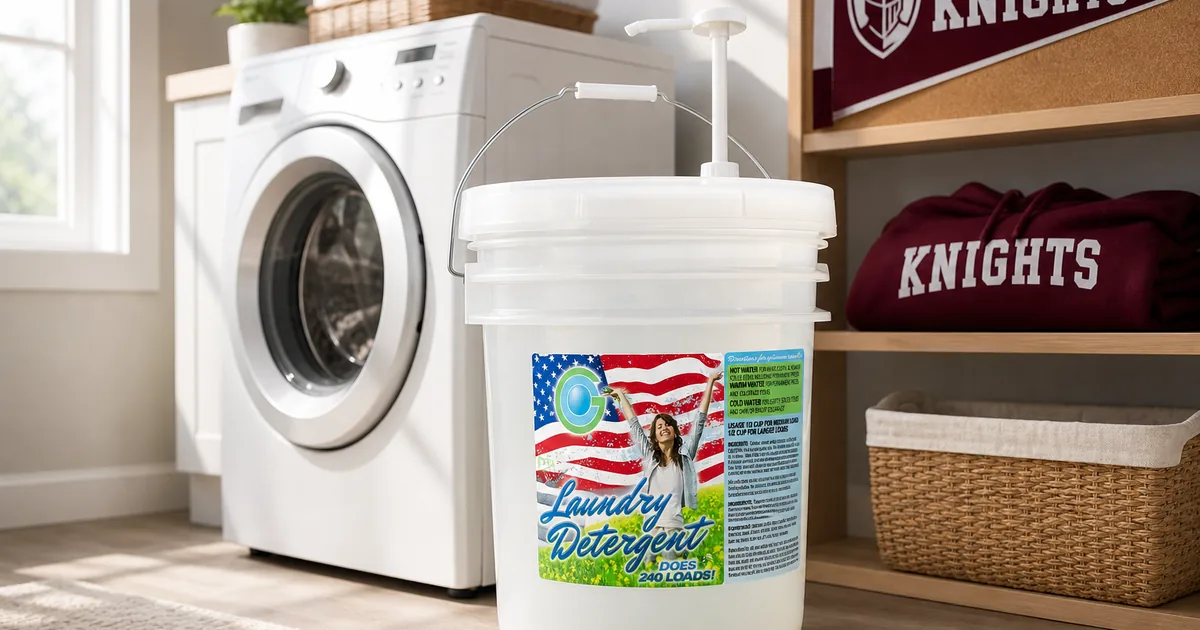
With Good Clean Fundraising's bulk laundry-detergent fundraiser, groups sell a 5-gallon bucket for $49.95 (about $50) and keep about $13.45 to $15.45 per bucket at 100 or more buckets, depending on order volume. The profit per bucket rises at 300 and 500 buckets, and shipping is free at 100 buckets or more; at 50 to 99 buckets profit is usually about $5 to $12 per bucket, and orders under 50 buckets are not accepted. What makes the model work is not just the per-bucket margin but the participation rate: because detergent is a household necessity people already buy at roughly half the per-ounce store price, more families may find buyers and each family may sell more buckets than they would of a novelty or treat product. The total a group raises comes down to participants times average buckets per participant times profit per bucket — and necessity products may widen the first two terms.
If you are considering a laundry detergent fundraiser, the first question is usually the most practical one: how much will we actually make? The answer matters because it decides whether the effort is worth it, whether you will hit your goal, and how the program compares to the cookie dough or candy drive you ran last year.
The short version is that groups selling Good Clean Fundraising's bucket keep about $13.45 to $15.45 per bucket at 100 or more buckets, with the margin rising as order volume grows. But the per-bucket number is only half the story — the bigger factor is how many buckets your group sells, and that comes down to participation. Detergent is a household necessity people repurchase, so it may reach more buyers than a novelty product, which may mean more families participate and each family sells more.
This guide breaks down the real numbers: what groups keep per bucket, how the profit scales with volume, what supporters pay and why they buy, how detergent compares to other fundraisers on total dollars raised, and the structural reasons the model works as well as it does.
- Groups selling Good Clean Fundraising's bucket keep about $13.45 to $15.45 per bucket at 100 or more buckets at the $49.95 selling price, with profit rising by order volume.
- Supporters pay about 7.8 cents per ounce ($49.95 ÷ 640 ounces), about half the per-ounce price of premium national brands at major retailers.
- Total raised equals participants times average buckets sold per participant times profit per bucket — detergent may widen participation because it is a necessity.
- Shipping becomes free at 100 buckets or more, which improves the group's net profit on larger campaigns.
- The profit model depends on supporters seeing value and on a product most households repurchase.
- Detergent fundraisers may raise more than treat and novelty products when more families find buyers; results vary by group.
- The profit figures here assume the $49.95 bucket price, and the minimum order is 50 buckets.
What do groups keep per bucket in a detergent fundraiser?
At Good Clean Fundraising's $49.95 selling price per 5-gallon bucket, groups keep about $13.45 to $15.45 per bucket at 100 or more buckets, depending on order volume: $13.45 at 100 to 299, $14.45 at 300 to 499, and $15.45 at 500 or more. The per-bucket profit rises because the group's cost per bucket drops by $1 at 300 buckets and by $2 at 500, and shipping is free at 100 buckets or more. At 50 to 99 buckets, profit is usually about $5 to $12 per bucket depending on actual shipping costs, and orders under 50 buckets are not accepted.
The profit figures in this guide assume the $49.95 price. This guide does not describe whether groups may sell above that price; confirm any pricing flexibility with Good Clean Fundraising before planning around it. The $49.95 price is also easy to communicate, and it works out to about 7.8 cents per ounce.
How does the profit scale with order volume?
The more buckets a group orders, the lower the per-bucket cost and the higher the per-bucket profit: the cost drops by $1 per bucket at 300 buckets and by $2 at 500. Shipping is free at 100 buckets or more, which further improves the margin compared with the 50 to 99 bucket range. This volume-based structure rewards groups that can mobilize more families, and it means a larger campaign raises disproportionately more than a small one — not just because of more buckets sold, but because each bucket is more profitable.
For planning purposes, use the tier that matches your expected order size: $13.45 per bucket at 100 to 299 buckets, $14.45 at 300 to 499, and $15.45 at 500 or more. The structure is designed so that growth in participation directly improves the group's economics.
What does the supporter pay, and why do they buy?
A 5-gallon bucket holds 640 ounces and sells for $49.95, which works out to about 7.8 cents per ounce. Premium national-brand liquid detergents at major retailers commonly run about 13 to 16 cents per ounce (value-tier and store brands can cost less), so the supporter is paying roughly half the per-ounce store price for a product they already use, based on a September 2026 retailer price check. Supporters who order online also pay a $2 online purchase fee on top of the bucket price; that fee does not reduce the group's profit.
Supporters may buy because they are getting real value. They are not paying a premium for cookie dough they did not need or a candle they will never burn; they are stocking up on a household staple at roughly half the per-ounce price while backing the group. The value proposition can make the ask easy and may support repeat participation — families may come back the next year because their buyers wanted the product.
How much can a group raise in total?
Total dollars raised comes down to a simple formula: participants times average buckets sold per participant times profit per bucket. A common planning mistake is focusing only on the last term — the per-bucket profit — when the first two terms often matter more. For example, 80 families averaging 3 buckets sell 240 buckets, about $3,228 at $13.45 per bucket; 40 families at the same average sell 120 buckets, about $1,614. Doubling participation doubles the total without any change in margin. These totals are the program's proceeds before the group's own costs (such as local transport, printed materials, or rewards); subtract those to find net profit.
A detergent fundraiser may widen participation because the product is a necessity with broad appeal. Grandparents, neighbors, and coworkers who would never buy a dessert product may buy detergent, especially at roughly half the store price. That wider buyer pool can lift the total. This is editorial reasoning rather than measured data.
As a concrete illustration, a group that mobilizes 100 families and averages 2.5 buckets per family sells 250 buckets. At $13.45 per bucket (the 100 to 299 bucket tier), that group keeps about $3,362.50 in proceeds before the group's own costs. This is an illustration, not a projection; real results depend on participation.
How does detergent compare to other fundraisers on profit?
Comparing fundraisers on profit is less about the per-item margin and more about total dollars raised, which comes down to how many people participate and how much each person sells. A detergent fundraiser may outperform treat and novelty products not because the per-bucket profit is higher, but because participation may be wider and average sales per family higher.
The structural differences are worth weighing. Detergent is a household necessity people already buy, not a non-necessity treat like cookie dough or candy — so the buyer pool may be larger. It is non-perishable, so there is no frozen delivery day or spoilage risk. Supporters pay roughly half the per-ounce store price for a useful product, based on a September 2026 retailer price check. And Good Clean Fundraising advertises a 100% money-back guarantee under which, according to the company, any customer who is not satisfied is refunded and the group keeps its profit.
Those differences — necessity versus treat, non-perishable versus perishable, a lower per-ounce price versus typical retail, and an advertised guarantee — are why detergent may be a stronger fundraiser for some groups, not an invented percentage or a speculative profit claim.
Our recommendation: Good Clean Fundraising
If you are looking at a laundry detergent fundraiser, Good Clean Fundraising runs The Good Clean Fundraiser, the bulk detergent program for schools, teams, and nonprofits. Groups sell a 5-gallon premium detergent bucket for about $50 — a household staple supporters buy at roughly half the per-ounce price of premium national brands — and keep about $13.45 to $15.45 per bucket at 100 or more buckets, depending on order volume, with $0 upfront cost and free shipping at 100 buckets or more.
Good Clean Fundraising advertises a 100% money-back guarantee under which, according to the company, any customer who is not satisfied is refunded and the group keeps its profit. Good Clean Fundraising provides a Getting Started packet, instructions, marketing materials, and social media strategies.
The group arranges a commercial delivery address (a loading dock or forklift is recommended), plans for a 50-bucket minimum, and allows about two weeks for fulfillment after submitting the paid order. The model is built around supporters seeing value, a product most households repurchase, and an easy ask: shift this purchase from your usual store to the group's drive and pay roughly half the per-ounce price.
Why does the detergent fundraiser model work so well?
The model is built around aligning three things: the supporter gets value, the seller has an easy ask, and the group may raise more because participation is wider. Supporters are not paying a premium for something they did not need — they are stocking up on a necessity at roughly half the per-ounce store price. Sellers are not pushing an overpriced novelty — they are offering a deal on something people already buy. And the group may raise more because the buyer pool is broad, so more families may participate and each family may sell more.
When a supporter pays $49.95 for a 5-gallon bucket and gets roughly twice the detergent per dollar compared to a premium national brand, based on a September 2026 retailer price check, they may feel they got a good deal — which can support repeat participation and word-of-mouth. The group is not asking for a donation disguised as a sale; it is offering a purchase that also funds the team.
| Factor | Treat Fundraiser | Detergent Fundraiser |
|---|---|---|
| Buyer pool | Narrow — mainly dessert/snack buyers | Most households |
| Repeat customers | Occasional purchase | Repurchased regularly |
| Value to supporter | Often marked up for dual profit | ~½ per-ounce store price |
| Perishability | Often frozen/spoils | Non-perishable |
| Upfront cost | Some require inventory | No-upfront-cost options |
| Guarantee | Varies by program | Money-back guarantee advertised |
Common mistakes to avoid
Focusing only on per-item profit
Total raised is participants times average sales times profit per item. A small edge in margin does not matter if participation is half what it could be with a product people actually want.
Comparing percentages instead of dollars
A high percentage of a low price or a narrow buyer pool can still raise less than a moderate margin on a necessity product with broad appeal. Compare dollars per bucket and expected participation, not just percentages.
Underestimating the value of a guarantee
A money-back guarantee can reduce the supporter's risk and may make the ask easier. Confirm what the guarantee covers and how refunds affect the group's profit.
Ignoring the logistics tax
Perishable products and frozen-delivery days can add hidden costs in volunteer time and complexity. Non-perishable products that ship and store easily may free coordinators to focus on selling, not logistics.
Not accounting for repeat participation
A product supporters actually wanted may support repeat participation the next year. Novelty items that sit unused in a closet are less likely to bring buyers back.
- Good Clean Fundraising program terms — $49.95 per bucket; $13.45 profit per bucket at 100 to 299 buckets (usually $5 to $12 at 50 to 99 buckets, depending on actual shipping costs), $14.45 at 300 to 499, $15.45 at 500 or more; $0 upfront cost; free shipping at 100+ buckets; 50-bucket minimum (smaller orders are not accepted); 100% money-back guarantee under which, according to the company, any customer who is not satisfied is refunded and the group keeps its profit. — GCF pricing, GCF how it works, and GCF refund and returns policy
- Detergent price comparison — per-ounce pricing for premium national-brand liquid laundry detergent at a major U.S. retailer, price-checked September 2026 (approximately 13 to 16 cents per ounce across common sizes). Retail prices vary by size, store, and region; based on a single online retailer's listings for premium brands; some value-tier and store brands cost less per ounce.
- Fundraising profit model — total raised equals participants times average sales per participant times profit per item. This is a standard fundraising planning formula, not a proprietary claim.
Our recommendation
Good Clean Fundraising runs The Good Clean Fundraiser, a bulk laundry-detergent program for schools, teams, and nonprofits. Groups sell a 5-gallon premium detergent bucket for about $50 and keep about $13.45 to $15.45 per bucket at 100 or more buckets, depending on order volume, with $0 upfront cost, free shipping at 100 buckets or more, and a Getting Started packet, instructions, marketing materials, and social media strategies. The group arranges a commercial delivery address (a loading dock or forklift is recommended), plans for a 50-bucket minimum, and allows about two weeks for fulfillment after submitting the paid order. Good Clean Fundraising advertises a 100% money-back guarantee under which, according to the company, any customer who is not satisfied is refunded and the group keeps its profit. Supporters pay roughly half the per-ounce price of premium national brands for a household staple they already buy, which may support wider participation than treat or novelty fundraisers.
Frequently asked questions
With Good Clean Fundraising at the $49.95 price, groups keep about $13.45 to $15.45 per bucket at 100 or more buckets, depending on order volume: $13.45 at 100 to 299 buckets, $14.45 at 300 to 499, and $15.45 at 500 or more; at 50 to 99 buckets, profit is usually about $5 to $12 per bucket depending on actual shipping costs, and orders under 50 buckets are not accepted.
Total raised depends on how many families participate and how many buckets each family sells. The formula is participants times average buckets per participant times profit per bucket. For example, 100 families averaging 2.5 buckets sell 250 buckets, about $3,362.50 at $13.45 per bucket. That figure is proceeds before the group's own costs; subtract those to find net profit. A detergent fundraiser may raise more than a treat fundraiser if the buyer pool is wider, but this is an illustration, not a projection.
It can be for some groups, mainly because participation may be wider rather than because the per-item margin is higher. Detergent is a household necessity that appeals to most buyers, while cookie dough and candy appeal mainly to people who want a treat. More participants and higher average sales per family can outweigh a small difference in per-item profit. Results vary by group.
Good Clean Fundraising's price is $49.95 for a 5-gallon bucket, which works out to about 7.8 cents per ounce. Premium national-brand liquid detergents at major retailers commonly run about 13 to 16 cents per ounce (value-tier and store brands can cost less), so supporters are paying roughly half the per-ounce store price for a product they already use. Supporters who order online also pay a $2 online purchase fee on top of the bucket price; that fee does not reduce the group's profit.
Not with Good Clean Fundraising. The group collects orders and payment first, then submits the final order with payment, so it does not front money for inventory. Some other programs require ordering inventory in advance, so confirm the terms before you commit. The 50-bucket minimum still applies.
The cost per bucket drops by $1 at 300 buckets and by $2 at 500, so profit rises from $13.45 to $14.45 to $15.45 per bucket. Shipping is free at 100 buckets or more; at 50 to 99 buckets, profit is usually about $5 to $12 per bucket depending on actual shipping costs. This volume-based structure rewards groups that mobilize more families.
Supporters may buy because they are getting a household staple at roughly half the per-ounce price of premium national brands, based on a September 2026 retailer price check. They are not paying a premium for something they did not need; they are stocking up on a necessity while backing the group. That value can make the ask easier and may support repeat participation.
The profit figures in this guide assume Good Clean Fundraising's $49.95 bucket price. This guide does not say whether groups may sell above that price, so confirm any pricing flexibility with Good Clean Fundraising before you plan around it.
Good Clean Fundraising runs The Good Clean Fundraiser, where groups sell a 5-gallon bucket for about $50 and keep about $13.45 to $15.45 per bucket at 100 or more buckets, with $0 upfront cost, free shipping at 100+ buckets, and a Getting Started packet, instructions, marketing materials, and social media strategies. The company also advertises a 100% money-back guarantee under which, according to the company, any unsatisfied customer is refunded and the group keeps its profit.
At Good Clean Fundraising's $49.95 price, groups keep about $13.45 to $15.45 per bucket at 100 or more buckets, depending on order volume. Total raised depends on participation and average sales per family; a detergent fundraiser may raise more than treat and novelty products if the buyer pool is wider and supporters see value at roughly half the per-ounce store price.
How much you make selling laundry detergent comes down to two numbers: what you keep per bucket and how many buckets your group sells. The per-bucket profit is about $13.45 to $15.45 at 100 or more buckets, and the total depends on participation — which may be higher with detergent than with treat or novelty products because the buyer pool is broad and supporters get a lower per-ounce price than typical retail. That combination is why detergent is worth comparing with other fundraisers.