
Laundry Detergent Fundraising
Laundry Detergent Fundraiser Profit Margin Explained
What groups actually keep per bucket, how the economics work, and how it compares with traditional fundraisers.
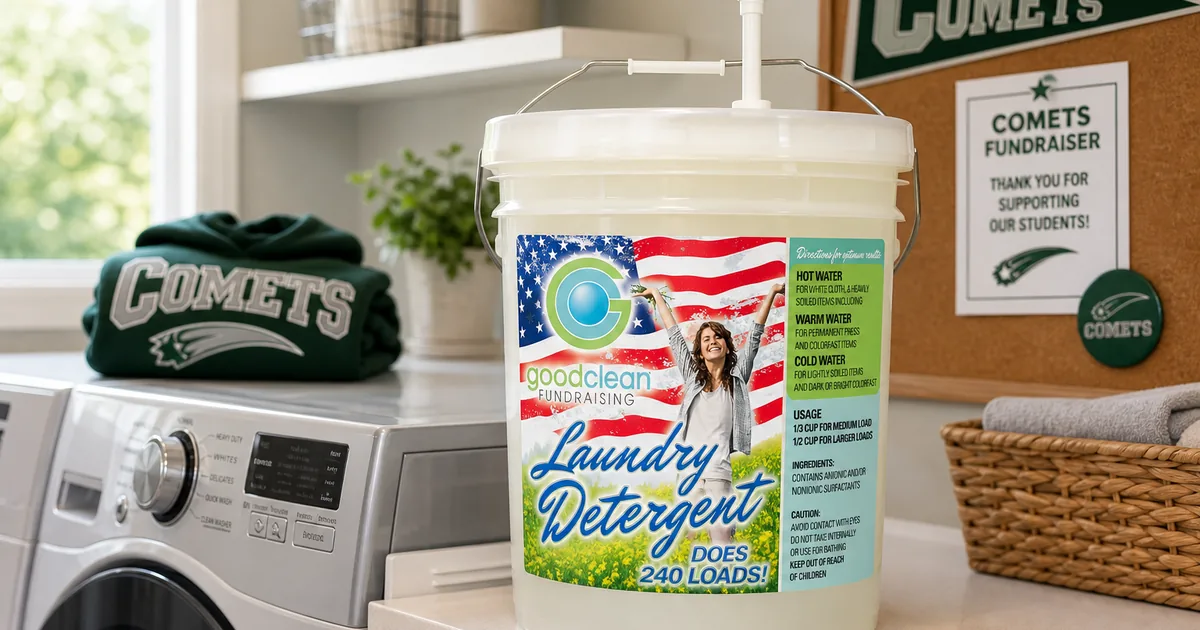
In Good Clean Fundraising's bulk laundry detergent fundraiser, groups keep about $13.45 to $15.45 per bucket at 100 or more buckets when selling at $49.95 (about $50) for a 5-gallon (640-ounce) bucket, with the exact profit depending on order volume. That is roughly 27% to 31% of the selling price, so the real advantage is not necessarily the margin itself — it is that detergent is a household necessity most families already buy, so participation may be wider, and supporters pay roughly half the per-ounce price of premium national brands, based on a September 2026 retailer price check. The group collects payment first and submits a paid order, so there is no upfront cost; the 50-bucket minimum still applies, and at 50 to 99 buckets profit is usually about $5 to $12 per bucket.
When a coordinator asks about profit margin on a laundry detergent fundraiser, the question behind the question is usually this: is the per-bucket profit worth the effort, and how does it compare to what we are doing now? The short answer is that groups keep about $13.45 to $15.45 per bucket at 100 or more buckets at the $49.95 selling price — about 27% to 31% of the price. But the margin alone does not tell the whole story.
The case for a detergent fundraiser over cookie dough, candy, and other treat-based programs is not that the per-item profit is higher — it is that more people may buy. A household necessity reaches grandparents, neighbors, and coworkers who would never purchase a novelty item, and because supporters pay roughly half the per-ounce retail price for something they already use, the value proposition may be real. That wider participation, if it happens, is what lifts a group's total, not a few extra dollars per unit.
This guide breaks down exactly how the profit works, what groups keep at different order volumes, how the supporter value compares to retail, how this margin structure compares with the traditional fundraiser model, and what to watch for when comparing programs.
- Groups keep about $13.45 to $15.45 per bucket at 100 or more buckets when selling at $49.95, with the exact profit rising as order volume increases.
- Supporters pay about 7.8 cents per ounce ($49.95 ÷ 640 ounces), about half the 13 to 16 cents per ounce typical of premium national-brand liquid detergents at major retailers.
- The margin alone may not beat every traditional fundraiser; the potential advantage is participation — a necessity product may reach more buyers than a treat.
- No upfront cost means the group never fronts money for inventory, which reduces financial risk; the 50-bucket minimum still applies.
- Free shipping on orders of 100 buckets or more improves the group's net profit without raising the price to supporters.
- The economics depend on supporters seeing value in the price and on the group keeping a per-unit profit set by volume tiers.
- Good Clean Fundraising advertises a 100% money-back guarantee under which, according to the company, any customer who is not satisfied is refunded and the group keeps its profit.
What is the profit margin on a laundry detergent fundraiser?
At Good Clean Fundraising's $49.95 price per 5-gallon bucket, groups keep about $13.45 to $15.45 per bucket at 100 or more buckets, depending on order volume: $13.45 at 100 to 299 buckets, $14.45 at 300 to 499, and $15.45 at 500 or more; at 50 to 99 buckets, profit is usually about $5 to $12 per bucket depending on actual shipping costs, and orders under 50 buckets are not accepted. The group's per-bucket cost drops by $1 at 300 buckets and by $2 at 500, and shipping is free at 100 buckets or more, so larger campaigns see the higher end of that range.
Whether that per-bucket profit beats another program depends on the alternative's terms, so compare dollars per unit rather than percentages. The more useful way to think about margin is as dollars per unit sold, multiplied by how many units your group can actually move; that product is the group's proceeds before its own costs, so subtract those to find net profit. A necessity product that reaches twice as many buyers at a $14 margin would raise more than a novelty item that reaches half as many at a $16 margin.
How does the supporter value compare to retail?
A 5-gallon bucket holds 640 ounces. At $49.95, that works out to about 7.8 cents per ounce. Premium national-brand liquid laundry detergents at major retailers commonly run about 13 to 16 cents per ounce (value-tier and store brands can cost less), so a supporter is paying roughly half the per-ounce store price for a product they already use, based on a September 2026 retailer price check.
This is the dynamic that may widen participation. When supporters see real value rather than a premium to help the group, they may buy more and come back. Grandparents who would never purchase cookie dough may stock up on detergent at roughly half the per-ounce store price. Coworkers who skip the candy catalog may shift their next detergent purchase to your drive. The margin works only if the volume works, and the volume depends on the value being real.
Why is the detergent fundraiser margin better than traditional programs?
Many traditional product fundraisers — cookie dough, candy, popcorn, wrapping paper — are built on a markup model: the item is priced above its everyday value because both the fundraising company and the group profit from that single sale. The supporter pays a premium, the group keeps a slice, and the vendor keeps the rest. It works, but it can limit who will buy and how much they will spend.
A bulk household-necessity fundraiser takes a different approach. The product is priced below typical retail per ounce, based on a September 2026 retailer price check, and the group keeps a per-unit profit set by volume tiers. There is no novelty item to sell, no perishability, and a potentially wider buyer pool. The margin is moderate, and participation is what makes the total.
The other structural difference is that detergent is non-perishable and ships in bulk, so there is no frozen-delivery scramble or spoilage risk. Simpler logistics can save volunteer time, though the group still needs a commercial delivery address (a loading dock or forklift is recommended).
What does 'no upfront cost' mean for the margin?
No upfront cost means the group collects orders and payment first, then submits the final order with payment — the group never fronts money for inventory. If the campaign raises less than hoped, the group orders only what supporters paid for (subject to the 50-bucket minimum), so there is no leftover product to store or sell off. That reduces the risk that sinks many first-time fundraisers.
In a traditional catalog program, the group may have to buy inventory in advance. If participation is lower than expected, the group is stuck with the cost and the unsold product. A no-upfront-cost structure means the profit is not reduced by the cost of what did not sell.
How does order volume affect the profit margin?
As order volume increases, the group's per-bucket cost drops by $1 at 300 buckets and by $2 at 500, so the per-bucket profit rises from $13.45 to $14.45 to $15.45. Shipping is free at 100 buckets or more; a group ordering only 50 to 99 buckets usually keeps about $5 to $12 per bucket depending on actual shipping costs, and orders under 50 buckets are not accepted. The selling price to supporters stays the same — the group simply keeps more per unit as the order grows.
This volume-based pricing rewards participation: a school selling 300 buckets keeps $14.45 per bucket and benefits from free shipping, while a smaller group selling 100 buckets keeps $13.45 per bucket, about $1,345 in total. Either way, the group does not pay upfront and the supporter sees the same per-ounce value.
Our recommendation: The Good Clean Fundraiser
If you are evaluating a laundry detergent fundraiser, Good Clean Fundraising runs The Good Clean Fundraiser, a bulk detergent program for schools, teams, and nonprofits. Groups sell a 5-gallon pump bucket of premium laundry detergent for about $50 — a household staple supporters buy at roughly half the per-ounce price of premium national brands — and keep about $13.45 to $15.45 per bucket at 100 or more buckets, with the exact profit rising by order volume and free shipping on orders of 100 buckets or more.
There is a $0 upfront cost and no unsold inventory to carry. Good Clean Fundraising provides a Getting Started packet, instructions, marketing materials, and social media strategies. The group arranges a commercial delivery address (a loading dock or forklift is recommended), plans for a 50-bucket minimum, and allows about two weeks for fulfillment after submitting the paid order.
Good Clean Fundraising advertises a 100% money-back guarantee under which, according to the company, any customer who is not satisfied is refunded and the group keeps its profit. That guarantee may reduce the supporter's risk and give sellers confidence when they ask for the sale.
The margin is moderate, the value to supporters is meaningful, and the structure is built to widen participation rather than squeeze extra dollars per unit out of a narrow buyer pool. If you are comparing programs, the question to ask is not just what the group keeps per bucket — it is how many buckets your families can actually sell, and whether the program removes or adds risk.
What should you watch for when comparing profit margins?
First, confirm the per-bucket profit in writing — not as a percentage, but as a dollar range tied to order volume. If a program will not give you that number up front, that is a red flag. Second, ask whether there is any upfront cost or minimum order. A program that requires you to buy inventory first is shifting financial risk onto your group. Third, check the supporter price and compare it to retail — if the product is marked up so high that only die-hard supporters will buy, your participation will be narrow and your total will suffer no matter what the margin is.
Fourth, ask about shipping: is it included, and at what volume does it become free? Shipping cost can quietly eat into your net profit if it is not clearly spelled out. Fifth, confirm what support the program provides — do you get instructions, materials, and marketing help, or are you managing the whole campaign alone? And sixth, ask about guarantees: if a supporter is unhappy, who handles the refund and who absorbs the cost?
| Factor | Traditional Product Fundraiser | Detergent Fundraiser |
|---|---|---|
| Supporter price | Often marked up to fund vendor + group | Value (~½ retail, retailer price check) |
| Group profit per unit | Moderate | $13.45–$15.45 per bucket (100+) |
| Buyer pool | Often narrow (treat/novelty buyers) | Wide (most households) |
| Upfront cost | Often required | None |
| Value to supporter | Often a premium for a novelty item | Useful staple at half price |
Common mistakes to avoid
Judging margin without considering participation
A fundraiser with a slightly higher per-item margin but half the buyers will raise less than one with a slightly lower margin and twice the participation. Total dollars = participants × average sales × profit per unit, and that total is proceeds before the group's own costs; subtract those to find net profit.
Comparing percentages instead of dollars per unit
Percentages are meaningless without knowing the selling price and the group's cost. Ask for the per-bucket profit in dollars, tied to order volume, in writing.
Ignoring upfront cost and financial risk
A program that requires you to buy inventory first shifts the risk onto your group. If participation is lower than hoped, you are stuck with the cost and the unsold product.
Overlooking supporter value
If the product is marked up so high that only die-hard supporters will buy, your margin does not matter — your volume will be too low to raise much.
Not confirming shipping costs
Shipping can quietly eat into your net profit. Confirm whether it is included and at what volume it becomes free, and get it in writing.
- Detergent price comparison — per-ounce pricing for premium national-brand liquid laundry detergent at a major U.S. retailer, price-checked September 2026 (~13–16¢ per ounce across common sizes). Retail prices vary by size and store; based on a single online retailer's listings for premium brands; some value-tier and store brands cost less per ounce.
- Good Clean Fundraising program terms — $49.95 per bucket; $13.45 profit per bucket at 100 to 299 buckets (usually $5 to $12 at 50 to 99 buckets, depending on actual shipping costs), $14.45 at 300 to 499, $15.45 at 500 or more; $0 upfront cost; free shipping at 100+ buckets; 50-bucket minimum (smaller orders are not accepted); 100% money-back guarantee under which, according to the company, any customer who is not satisfied is refunded and the group keeps its profit. — GCF pricing, GCF how it works, and GCF refund and returns policy
- Profit and savings figures reflect Good Clean Fundraising's $49.95 bucket price, its published profit tiers, and current retail prices; both vary, so no single fixed percentage is stated. The 27% to 31% range is $13.45 and $15.45 divided by $49.95.
Our recommendation
If you are evaluating a laundry detergent fundraiser, Good Clean Fundraising runs The Good Clean Fundraiser, a bulk detergent program for schools, teams, and nonprofits. Groups sell a 5-gallon pump bucket of premium laundry detergent for about $50 — a household staple supporters buy at roughly half the per-ounce price of premium national brands — and keep about $13.45 to $15.45 per bucket at 100 or more buckets, with the exact profit rising by order volume and free shipping on orders of 100 buckets or more. There is a $0 upfront cost and no unsold inventory to carry. Good Clean Fundraising provides a Getting Started packet, instructions, marketing materials, and social media strategies. Good Clean Fundraising advertises a 100% money-back guarantee under which, according to the company, any customer who is not satisfied is refunded and the group keeps its profit.
Frequently asked questions
With Good Clean Fundraising, groups keep about $13.45 to $15.45 per bucket at 100 or more buckets when selling at $49.95 (about $50) for a 5-gallon (640-ounce) bucket — about 27% to 31% of the price. The tiers are $13.45 at 100 to 299 buckets, $14.45 at 300 to 499, and $15.45 at 500 or more; at 50 to 99 buckets, profit is usually about $5 to $12 per bucket depending on actual shipping costs, and orders under 50 buckets are not accepted.
At $49.95 for 640 ounces, supporters pay about 7.8 cents per ounce. Premium national-brand liquid detergents at major retailers commonly run about 13 to 16 cents per ounce (value-tier and store brands can cost less), so supporters are paying roughly half the per-ounce store price for a product they already use, based on a September 2026 retailer price check.
Not necessarily on margin alone. Good Clean Fundraising's $13.45 to $15.45 per bucket is about 27% to 31% of the price, and other programs may keep a larger or smaller share, so compare each program's actual terms. The potential advantage is that a household necessity may reach more buyers than a treat or novelty item, and wider participation can lift the total more than a few extra dollars per unit.
Not with Good Clean Fundraising. The group collects orders and payment first, then submits the final order with payment, so it never fronts money for inventory. The 50-bucket minimum still applies, and some other programs do require buying inventory in advance.
As order volume increases, the group's cost per bucket drops by $1 at 300 buckets and by $2 at 500, so profit rises from $13.45 to $14.45 to $15.45 per bucket. Shipping is free at 100 buckets or more; at 50 to 99 buckets profit is usually about $5 to $12 per bucket depending on actual shipping costs. The selling price to supporters stays the same.
Ask for the per-bucket profit in dollars (not a percentage), tied to order volume, in writing. Confirm whether there is any upfront cost or minimum order, what the supporter price is and how it compares to retail, whether shipping is included and at what volume it becomes free, what support the program provides, and who handles refunds if a supporter is unhappy.
If the product is marked up so high that only die-hard supporters will buy, your participation will be narrow and your total will suffer no matter what the per-unit margin is. A clear value proposition — like detergent at roughly half the per-ounce store price, based on a September 2026 retailer price check — may widen the buyer pool, which can lift the total more than a high margin on low volume.
Yes, it is advertised. Good Clean Fundraising advertises a 100% money-back guarantee under which, according to the company, any customer who is not satisfied is refunded and the group keeps its profit. Confirm the details with Good Clean Fundraising before you launch.
The Good Clean Fundraiser is Good Clean Fundraising's bulk laundry-detergent program. Groups sell a 5-gallon pump bucket for about $50, supporters buy at roughly half the per-ounce price of premium national brands, and groups keep about $13.45 to $15.45 per bucket at 100 or more buckets, with $0 upfront cost, free shipping at 100 or more buckets, a Getting Started packet, instructions, marketing materials, and social media strategies, and an advertised 100% money-back guarantee under which, according to the company, any unsatisfied customer is refunded and the group keeps its profit.
The profit margin on a laundry detergent fundraiser is moderate, and the margin alone is not what makes it work — it is the combination of a per-unit profit set by volume tiers, supporter value, potentially wide participation, and no upfront cost. When you sell a household necessity at roughly half the per-ounce store price with $0 upfront cost, the economics can work for the group and the supporter at the same time.