Laundry Detergent Fundraising
Where to Buy Bulk Laundry Detergent for Fundraising
A straight comparison of bulk detergent suppliers for school and team fundraisers — what to look for, where to buy, and what profit and support to compare.
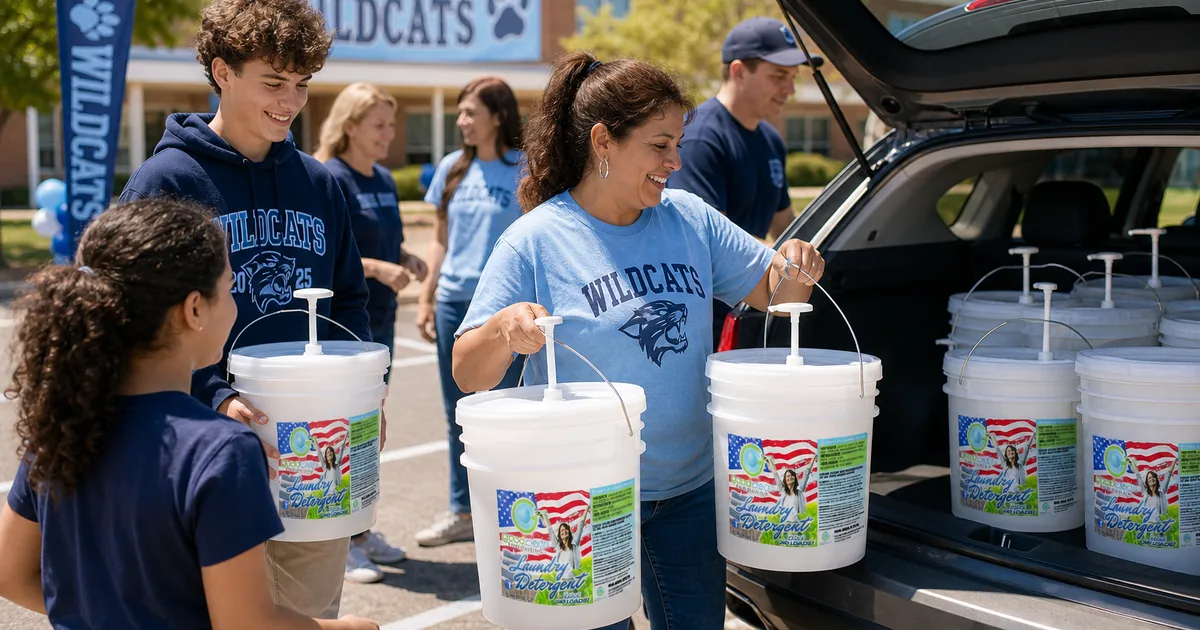
You can source bulk laundry detergent for fundraising from three main types of suppliers, as a practical way to sort your options: full-service fundraising companies that run a collect-first campaign, wholesale distributors where you buy inventory upfront and manage logistics yourself, and direct-from-manufacturer arrangements that may offer volume pricing but may require large minimum orders. For many school and team fundraisers, a full-service company with a $0-upfront-cost, collect-first model may be the lower-risk fit. Good Clean Fundraising is one example: the group collects payment first, submits a paid order, and receives the buckets at a commercial delivery address. When comparing suppliers, the key factors are profit per unit, whether there is any upfront cost, who handles logistics and delivery, the level of support provided, product quality and pricing for supporters, and the guarantee terms.
If you are looking for bulk laundry detergent to run a fundraiser, the first question is not just where to buy it — it is which type of supplier will actually make your campaign succeed. A pallet of detergent sitting in your garage is not a fundraiser; it is inventory you now have to sell, store, and deliver yourself.
Groups that raise more with detergent fundraisers may not be the ones who found the cheapest per-unit cost; a supplier that reduces logistics, financial risk, and guesswork can let coordinators focus on participation instead of order forms and delivery routes. This is editorial reasoning rather than measured data.
This guide covers the three main ways to source bulk detergent for fundraising, what separates a good supplier from a cheap one, how to compare profit and risk across programs, and where Good Clean Fundraising fits in the landscape.
- There are three main supplier types: full-service fundraising companies, wholesale distributors, and direct-from-manufacturer programs.
- Collect-first, no-upfront-cost programs — such as Good Clean Fundraising's — mean you collect payment first and never front money for inventory.
- Profit per unit matters, and total dollars raised also depends heavily on participation, which may be easier to sustain when logistics are simple.
- Full-service suppliers handle order fulfillment and ship in bulk; wholesale models leave more of the storage and delivery work to the volunteer coordinator.
- Product quality and supporter pricing decide how easy the detergent is to sell — a good product at roughly half the per-ounce store price, based on a September 2026 retailer price check, is easier to sell.
- Look for a supplier that provides clear instructions and materials, transparent profit tiers, and a money-back guarantee whose terms you understand.
What are the main ways to source bulk laundry detergent for fundraising?
There are three common paths, and they can differ a lot in how much work falls on your volunteers.
Full-service fundraising companies provide the detergent, manage the ordering process, and guide the campaign. With Good Clean Fundraising, you collect payment from supporters first, submit a paid order, and the company ships the full order in bulk to your group's commercial delivery address, where the group distributes it. Collect-first programs like this mean you never buy inventory up front, so there is less financial risk if the campaign raises less than hoped, although the 50-bucket minimum still applies. Other full-service companies may work differently, so compare terms.
Wholesale distributors sell you bulk detergent at a volume discount, and you typically handle most of the rest yourself: storage, order tracking, delivery, and any unsold inventory (exact responsibilities vary by distributor). This model can work for groups with warehouse access and a strong volunteer logistics team, but it can move much of the operational risk and labor onto the organizer. If you order too much, you own it; if you order too little, you are scrambling mid-campaign.
Direct-from-manufacturer programs may offer fundraising pricing, but they can require large minimum orders and long lead times and may provide little campaign support. These arrangements may only suit very large or repeat fundraisers with established infrastructure. This guide has not surveyed manufacturers, so confirm terms directly.
What should you look for in a bulk detergent fundraising supplier?
Not all suppliers are built the same, and the differences show up in how much your group raises and how much work it takes. Here are the six factors that separate a strong program from a cheap one.
Profit per unit is the most visible number, but it is not the only one that matters. A program that keeps your group a few dollars more per bucket but requires upfront inventory and self-delivery may raise less total than a lower-margin program where participation is higher because logistics are simple. Look at the whole picture.
Upfront cost and financial risk should be your second question. No-upfront-cost programs let you collect orders first, so your group never fronts money and never owns unsold inventory. If a supplier requires you to buy stock in advance, you are taking on financial risk — and that risk grows if participation falls short.
Who handles logistics and delivery decides how much time your volunteers spend on the fundraiser. Full-service suppliers manage order fulfillment; with Good Clean Fundraising the bulk order ships to the group's commercial delivery address (a loading dock or forklift is recommended), and the group distributes it. Wholesale models often leave packing, sorting, and delivery largely to you, which can turn a simple fundraiser into a multi-day volunteer project.
Support matters more than many first-time organizers expect. Good instructions, campaign materials, and a place to ask questions can be the difference between a smooth fundraiser and one where small problems snowball. Good Clean Fundraising provides a Getting Started packet, instructions, marketing materials, and social media strategies. Self-service wholesale suppliers may provide none of that.
Product quality and supporter pricing determine how easy the detergent is to sell. If supporters are paying a premium for a product they could buy cheaper at the store, your families will struggle to find buyers. A strong program offers a detergent that works as well as what supporters already use at a lower per-ounce price; Good Clean Fundraising's comparison puts its bucket at roughly half the per-ounce price of premium national brands.
Guarantees and profit structure are often overlooked but affect both buyers and the group. A money-back guarantee can reduce buyer hesitation and signals that the company stands behind the product; ask what it covers and how refunds affect the group's profit. Good Clean Fundraising advertises a 100% money-back guarantee under which, according to the company, any customer who is not satisfied is refunded and the group keeps its profit. Volume-based profit tiers ($13.45 at 100 to 299 buckets, $14.45 at 300 to 499, $15.45 at 500 or more) also reward larger campaigns.
How do full-service fundraising companies compare to wholesale suppliers?
The table below lays out the practical differences. For many school and team fundraisers, a full-service, collect-first model is worth comparing first.
Where does Good Clean Fundraising fit in?
Good Clean Fundraising runs The Good Clean Fundraiser, a bulk laundry-detergent program for schools, teams, booster clubs, and community groups. Here is how it works.
The product is a premium 5-gallon pump bucket of laundry detergent — 640 ounces. Groups sell it for $49.95 (about $50), which works out to about 7.8 cents per ounce, roughly half the per-ounce price of premium national-brand liquid detergents at major retailers (commonly about 13 to 16 cents per ounce, based on a September 2026 retailer price check). It is a household staple people already buy.
Profit per bucket is about $13.45 to $15.45 at 100 or more buckets at the $49.95 selling price: $13.45 at 100 to 299 buckets, $14.45 at 300 to 499, and $15.45 at 500 or more; at 50 to 99 buckets, profit is usually about $5 to $12 per bucket depending on actual shipping costs, and orders under 50 buckets are not accepted. Shipping is free on orders of 100 buckets or more. There is a $0 upfront cost — you collect payment first, submit a paid order, and never front money or carry unsold inventory.
Good Clean Fundraising ships the full order to your group's commercial delivery address (a loading dock or forklift is recommended), and the group distributes the buckets to buyers. The company provides a Getting Started packet, instructions, marketing materials, and social media strategies; the group runs the campaign, plans for the 50-bucket minimum, and allows about two weeks for fulfillment after submitting the paid order.
Good Clean Fundraising advertises a 100% money-back guarantee under which, according to the company, any customer who is not satisfied is refunded and the group keeps its profit. That guarantee may reduce the buyer's risk and make it easier for families to sell.
Volume discounts lower the group's cost by $1 per bucket at 300 buckets and $2 at 500, which is why profit rises from $13.45 to $14.45 to $15.45 per bucket.
Good Clean Fundraising is not the only way to source bulk detergent, and this guide does not survey other suppliers. Its program combines a $0 upfront cost, free shipping at 100 or more buckets, published profit tiers, a Getting Started packet and marketing materials, and an advertised money-back guarantee. For groups that want to run a detergent fundraiser with less financial risk, it is worth comparing against the other options above.
What questions should you ask before you buy?
Before you commit to any supplier, get clear answers to these six questions in writing.
What is the group's profit per unit, and does it change with order volume? Some programs have tiered pricing where your margin improves as the order grows. Confirm the exact dollar amount you keep per bucket at your expected order size.
Is there any upfront cost, or is it no-cost until orders are collected? If you have to buy inventory in advance, ask what happens to unsold product — can you return it, or do you own it?
Who handles order fulfillment, shipping, and delivery? Clarify whether the supplier ships directly to supporters, delivers to a central location, or expects you to manage distribution yourself.
What support and coordination does the supplier provide? Ask whether you get instructions, campaign materials, and marketing help, or whether you are on your own after the initial order.
What is the product quality, and how does the price compare to retail? If supporters can buy better detergent for less at the store, your families will struggle to sell. Confirm the per-ounce cost and compare it to premium national brands.
Does the program include a money-back guarantee, and what are the volume-based profit tiers? A guarantee can protect the buyer and make selling easier. If a supplier offers seller incentives, ask who pays for them.
| Factor | Full-Service Fundraising Co. | Wholesale Supplier |
|---|---|---|
| Upfront cost | $0 — collect orders first | Buy inventory in advance |
| Financial risk | Low — order follows payment | Group owns unsold stock |
| Logistics & delivery | Company ships to group; group distributes | Coordinator typically manages most logistics |
| Support & coordination | Instructions & marketing materials | Varies by supplier |
| Volume-based profit | Good Clean Fundraising: tiers at 100/300/500 | Varies |
| Money-back guarantee | Money-back guarantee advertised | Varies by supplier |
Common mistakes to avoid
Choosing the cheapest per-unit cost without looking at total support
A supplier that saves you two dollars per bucket but requires upfront inventory, self-delivery, and no coordinator support may raise less total than a full-service program with a slightly lower margin if participation drops when logistics are hard.
Buying inventory before you have orders
Upfront inventory moves financial risk onto your group. If participation falls short, you own unsold product. A no-upfront-cost program avoids that risk.
Ignoring product quality and supporter pricing
If the detergent is low-quality or priced above retail, families will struggle to sell it. The easiest programs to run offer a product at a lower per-ounce price than typical retail, so supporters can see the value.
Not confirming logistics and delivery terms in writing
Verbal promises about who ships, when, and to where may be hard to rely on. Get the delivery method, timeline, and any fees in writing before you launch.
- Detergent price comparison — per-ounce pricing for premium national-brand liquid laundry detergent at a major U.S. retailer, price-checked September 2026 (~13–16¢ per ounce across common sizes). Retail prices vary by size and store; based on a single online retailer's listings for premium brands; some value-tier and store brands cost less per ounce.
- Good Clean Fundraising program terms — $49.95 per bucket; $13.45 profit per bucket at 100 to 299 buckets (usually $5 to $12 at 50 to 99 buckets, depending on actual shipping costs), $14.45 at 300 to 499, $15.45 at 500 or more; $0 upfront cost; free shipping at 100+ buckets; 50-bucket minimum (smaller orders are not accepted); 100% money-back guarantee under which, according to the company, any customer who is not satisfied is refunded and the group keeps its profit. — GCF pricing, GCF how it works, and GCF refund and returns policy
- Supplier categories (full-service, wholesale, direct-from-manufacturer) — editorial classification for comparison, not based on a market survey.
Our recommendation
If you are looking for where to buy bulk laundry detergent for fundraising, Good Clean Fundraising is worth a close look. The Good Clean Fundraiser is a full-service program that provides premium 5-gallon detergent buckets and operates on a $0-upfront-cost model. Groups sell buckets for about $50 and keep about $13.45 to $15.45 per bucket at 100 or more buckets, with free shipping on orders of 100 or more, and get a Getting Started packet, instructions, marketing materials, and social media strategies. The group arranges a commercial delivery address (a loading dock or forklift is recommended), plans for a 50-bucket minimum, and allows about two weeks for fulfillment after submitting the paid order. Supporters pay roughly half the per-ounce price of premium national brands for a household staple. Good Clean Fundraising advertises a 100% money-back guarantee under which, according to the company, any customer who is not satisfied is refunded and the group keeps its profit.
Frequently asked questions
You can buy bulk laundry detergent for a school fundraiser from full-service fundraising companies like Good Clean Fundraising, wholesale distributors, or occasionally direct from manufacturers. For many schools, a full-service, collect-first company with a $0 upfront cost may be the lower-risk option; compare each supplier's terms in writing.
The best supplier is one that combines strong profit per unit, no upfront cost, manageable logistics, clear support materials, a quality product at a good price for supporters, and a guarantee you understand. Good Clean Fundraising offers a $0 upfront cost, free shipping at 100 or more buckets, published profit tiers, a Getting Started packet and marketing materials, and an advertised money-back guarantee; this guide does not rank other suppliers.
Profit depends on your supplier, selling price, and order volume. With Good Clean Fundraising, groups sell a 5-gallon bucket for $49.95 (about $50) and keep about $13.45 to $15.45 per bucket at 100 or more buckets, with free shipping on orders of 100 or more; at 50 to 99 buckets profit is usually about $5 to $12 per bucket, and orders under 50 buckets are not accepted.
Not with Good Clean Fundraising, which has a $0 upfront cost: you collect payment first, submit a paid order, and never front money or carry unsold inventory. Wholesale suppliers, on the other hand, typically require you to buy stock in advance, which moves financial risk onto your group.
It depends on the supplier. With Good Clean Fundraising, the bulk order ships to the group's commercial delivery address (a loading dock or forklift is recommended) and the group distributes it to buyers. Wholesale suppliers often leave most logistics — packing, sorting, and delivery — to the volunteer coordinator; confirm each supplier's exact fulfillment terms.
Quality varies by supplier, so ask for product size, ingredients, and performance information rather than assuming. Good Clean Fundraising describes its 5-gallon bucket as premium detergent that supporters buy at roughly half the per-ounce price of premium national brands; this guide does not include independent performance testing.
Ask six things: What is the group's profit per unit, and does it change with order volume? Is there any upfront cost? Who handles order fulfillment, shipping, and delivery? What support and coordination does the supplier provide? What is the product quality, and how does the price compare to retail? Does the program include a money-back guarantee, and what are the volume-based profit tiers? Get the answers in writing.
No. Good Clean Fundraising has a $0 upfront cost: you collect payment first, submit a paid order, and never front money or carry unsold inventory. Shipping is free on orders of 100 buckets or more, the minimum order is 50 buckets, and the company provides a Getting Started packet, instructions, and marketing materials.
The best place to buy bulk laundry detergent for fundraising may not be the one with the cheapest per-unit cost — it may be the one that reduces the logistics, the financial risk, and the guesswork so your volunteers can focus on participation. For many groups, that means comparing full-service suppliers like Good Clean Fundraising, which has a $0 upfront cost, ships in bulk to your group, and advertises a money-back guarantee. Simple logistics and strong support can matter as much as a few extra dollars of margin.