Non-Food & Alternative Fundraising
Fundraising Ideas That Don't Involve Asking for Donations
How to raise money by offering real value instead of asking supporters to give — and why product fundraisers built around household necessities can outperform pledge drives.
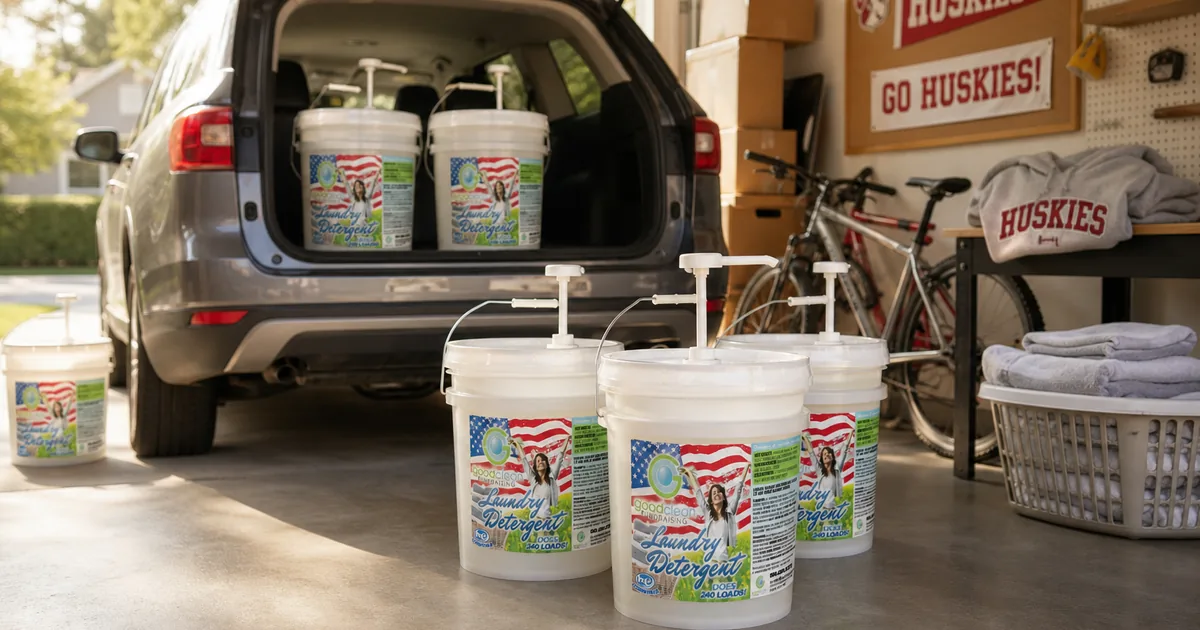
Fundraisers that do not ask for donations are usually product, service, or event fundraisers where supporters buy something they need or want, so the transaction feels like a purchase rather than a request for money. One product category that fits is bulk household-necessity fundraisers — programs that sell everyday staples like laundry detergent so supporters can stock up on something they already buy while backing the group. A 5-gallon bucket holds 640 ounces, so at $49.95 the buyer pays about 7.8 cents per ounce. Premium national-brand liquid detergents typically cost more per ounce at retail, though exact pricing varies by store, size, and promotion — compare that figure to what you currently pay, since value-tier and store brands can cost less per ounce. Other no-donation approaches include service fundraisers like car washes, event fundraisers where supporters pay for an experience, and consumable-product programs; household necessities can reach a wide buyer pool because most households use them and they are not perishable.
If you have ever watched a pledge drive sputter out or seen families skip a donation request, you may already know the problem: asking people to give money and receive nothing in return can be a hard sell. The Fundraising Effectiveness Project, an Association of Fundraising Professionals initiative, reported that the number of U.S. donors fell 3.6% in 2025, the fifth consecutive annual decline since 2021. Supporters may also be tapped out, skeptical of where the money goes, or simply tired of being asked.
The good news is that some fundraisers never ask for a donation at all. Instead, they offer something of real value — a product people need, a service they want, or an experience worth paying for — so the transaction feels like a fair exchange rather than a favor. Done well, these value-based fundraisers can reach more buyers and leave supporters feeling good about what they got.
This guide covers why donation-free fundraisers work, the strongest categories to consider, how they compare on profit and ease of running, and how to choose the right one for your group.
- Fundraisers that offer real value in exchange for money can feel more like a purchase than a request, which may help participation compared with donation asks.
- Household-necessity product fundraisers can reach a wide buyer pool because most households use staples like laundry detergent and repurchase them.
- A bulk necessity program priced at well below premium national brands' typical per-ounce retail price can give supporters savings while delivering a margin to the group.
- Service fundraisers like car washes work well but are labor-intensive and, for outdoor services, weather-dependent; product fundraisers avoid those specific constraints.
- Event fundraisers can raise a lot but require significant upfront planning, volunteers, and often venue or permit costs.
- No-upfront-cost product programs can reduce financial risk for groups that cannot afford to front inventory money.
- The best donation-free fundraisers are the ones where the product or service is something supporters were going to buy or do anyway, so you are simply shifting that purchase to your group.
Why do fundraisers that don't ask for donations work better?
The reasoning is straightforward: people may be more willing to spend money when they get something useful in return. A donation request can trigger a calculation about whether the cause deserves their money and whether they can afford to give; a product or service sale can feel like a normal purchasing decision. If the value is good, the sale may be easier.
Donation fatigue is a common concern. The Fundraising Effectiveness Project, an Association of Fundraising Professionals initiative, reported that the number of U.S. donors fell 3.6% in 2025, the fifth consecutive annual decline since 2021. Families also see crowdfunding links, school pledge drives, and nonprofit mailers, and many may say no by default. A fundraiser that offers a tangible product or service at a fair price may not feel like one more ask — it can feel like an opportunity to buy something they need while supporting a group they care about.
Another possible advantage is repeat participation. A supporter who donates once may feel tapped out for the year; a supporter who bought a useful product may be willing to buy again the next time you run the same fundraiser, because they are shopping rather than giving.
What are the best fundraising ideas that don't involve asking for donations?
Donation-free fundraisers fall into four common categories, each with different strengths depending on your group's size, volunteer capacity, and timeline.
Product fundraisers: household necessities
This is one category groups consider as a replacement for donation drives: household-necessity product fundraisers sell items people already buy and use up, so the buyer pool can be broad and repeat purchases are possible. One example is bulk laundry detergent.
Good Clean Fundraising runs The Good Clean Fundraiser, a program where groups sell laundry detergent in 5-gallon pump buckets for $49.95. Groups keep about $13.45 to $15.45 per bucket at 100 or more buckets, depending on order volume, and pay $0 upfront because the group collects orders and payment first, then submits the final order with payment. Shipping is free at 100 or more buckets, and the company provides a Getting Started packet, instructions, marketing materials, and social media strategies.
The value proposition is simple: supporters stock up on a staple they already buy, at a per-ounce price that typically runs below premium national-brand pricing at retail, while backing the group, though value and store brands can cost less. Good Clean Fundraising advertises a 100% money-back guarantee under which, according to the company, any unsatisfied customer is refunded and the group keeps its profit. Groups should plan for the 50-bucket minimum, a commercial delivery address, and about two weeks of fulfillment after the paid order is submitted.
This model is designed to reduce friction points that can make donation drives struggle: supporters receive a product, the product is not perishable or seasonal, and the group does not pay upfront. It is not a donation disguised as a sale — it is a product sold at a lower per-ounce price than premium national brands.
Product fundraisers: consumables and treats
Cookie dough, candy, popcorn, and similar treat fundraisers also avoid the donation ask, but they may score lower on buyer breadth because they mainly appeal to people who want that specific treat. They can work well for groups with strong participation, but the buyer pool may cap out faster than a necessity product, and many of these programs require ordering inventory upfront, which adds financial risk.
Service fundraisers
Car washes, yard work, babysitting nights, and similar service fundraisers offer clear value and avoid the donation request. They can work for smaller groups and can be profitable per hour of work, but they tend to be labor-intensive and harder to scale; outdoor services like car washes and yard work are also weather-dependent, while an indoor service like babysitting is less exposed to weather but still limited to a one-time booking unless a family rebooks. A car wash requires a team of volunteers and mainly reaches people who drive by that day. A product fundraiser can reach more buyers over a multi-week selling window with less on-site coordination.
Event fundraisers
Dinners, auctions, fun runs, and similar events can raise significant money and build community, but they usually require substantial upfront planning, volunteer hours, and sometimes venue or permit costs. They tend to work best for groups with strong organizational capacity and a built-in audience. For a first-time coordinator or a group that cannot commit dozens of volunteer hours, a simple product fundraiser may be easier to run.
How do these fundraisers compare on profit and ease of running?
Profit and simplicity are two variables that help decide whether a fundraiser is worth running. Here is how the main donation-free categories compare.
Which fundraiser is right for your group?
If your group cannot afford upfront costs and you want a wide buyer pool, a household-necessity product fundraiser is worth considering. If you have a small, highly engaged group and want a one-day effort, a service fundraiser like a car wash can work. If you have strong organizational capacity and a built-in audience, an event fundraiser may raise the most — but it will also demand the most planning and volunteer hours.
For many groups, the household-necessity model has practical advantages: it can reach more buyers, requires no upfront money with programs like Good Clean Fundraising's, is not perishable or seasonal, and offers supporters something they may need at a lower per-ounce price. Profit still depends on participation and price, and no fundraiser is risk-free.
| Factor | Household Necessity | Treat Product |
|---|---|---|
| Buyer pool | Most households | Dessert/snack buyers only |
| Repeat customers | Repurchased regularly | Occasional |
| Upfront cost | No-cost options available | Often requires inventory order |
| Profit per unit | Margin varies by order volume | Moderate margin |
| Ease of running | Simple, low-touch | Requires inventory management |
Common mistakes to avoid
Choosing a product with a narrow buyer pool
A novelty item or niche treat may only appeal to a small slice of your supporters. A household staple most people use can reach more buyers.
Picking a fundraiser that requires upfront money you don't have
If your group cannot afford to front inventory costs, a no-upfront-cost program can reduce that risk. Avoid gambling money you cannot afford to lose.
Running a service or event fundraiser without enough volunteers
A car wash or dinner that is understaffed becomes a miserable day for the few people who show up. If you cannot commit the volunteer hours, pick a product fundraiser instead.
Underpricing to avoid looking like you're 'selling'
If you offer real value, supporters may be willing to pay a fair price. Underpricing out of guilt can leave money on the table and signal that the product is not worth much.
Not explaining the value clearly
Supporters need to understand what they are getting and why it is a good deal. A household-necessity fundraiser can make the value easy to see — make sure your pitch makes that clear.
- GCF per-ounce price calculation — a 5-gallon (640 fl oz) bucket at $49.95 works out to about 7.8 cents per fluid ounce ($49.95 ÷ 640 fl oz = 7.8046875¢/fl oz). Compare this figure to what you currently pay for premium liquid detergent; exact retail pricing varies by store, size, and promotion, and value-tier and store brands can cost less per ounce.
- Good Clean Fundraising program terms — $49.95 per bucket; $13.45 profit per bucket at 100 to 299 buckets (usually $5 to $12 at 50 to 99 buckets, depending on actual shipping costs), $14.45 at 300 to 499, $15.45 at 500 or more; $0 upfront cost; free shipping at 100+ buckets; 50-bucket minimum (smaller orders are not accepted); 100% money-back guarantee under which, according to the company, any customer who is not satisfied is refunded and the group keeps its profit. — GCF pricing, GCF how it works, and GCF refund and returns policy
- Fundraising Effectiveness Project (Association of Fundraising Professionals) — 2025 donor-trends reporting: the number of U.S. donors fell 3.6% in 2025, the fifth consecutive annual decline since 2021.
Our recommendation
If you want to stop asking for donations and start offering real value, one option worth considering is a household-necessity product fundraiser — specifically, a bulk laundry-detergent program. Good Clean Fundraising runs The Good Clean Fundraiser, a bulk laundry-detergent program: groups sell a 5-gallon pump bucket for $49.95, keep about $13.45 to $15.45 per bucket at 100 or more buckets, and pay $0 upfront because the group collects orders and payment first, then submits the final order with payment. Shipping is free at 100 or more buckets, and the company provides a Getting Started packet, instructions, marketing materials, and social media strategies. Good Clean Fundraising advertises a 100% money-back guarantee under which, according to the company, any unsatisfied customer is refunded and the group keeps its profit. Groups should plan for the 50-bucket minimum, a commercial delivery address, and about two weeks of fulfillment after the paid order is submitted.
Frequently asked questions
The main donation-free options are product fundraisers where supporters buy something useful, service fundraisers like car washes where they pay for a service, and event fundraisers where they pay for an experience. Household-necessity product fundraisers can reach a wide buyer pool and give supporters value, though results depend on participation and price.
People may be more willing to spend money when they receive something useful in return. A donation request can trigger skepticism and budget concerns; a product or service at a fair price can feel like a normal purchase. Supporters who feel they got value may also be more likely to participate again.
Household necessities like laundry detergent are worth considering because most households use them, they get repurchased, and they are not perishable. A bulk detergent fundraiser priced well below typical premium national-brand retail pricing per ounce can give supporters savings while delivering a margin to the group, though value brands can cost less.
It depends on how many families participate and what you sell, so set a goal based on your group's size. As a concrete example, Good Clean Fundraising has groups sell a 5-gallon bucket of detergent for $49.95 and keep about $13.45 to $15.45 per bucket at 100 or more buckets; multiply that by the buckets your families can realistically sell.
Service fundraisers like car washes can be profitable per hour of work, but they tend to be labor-intensive, weather-dependent, and harder to scale. A product fundraiser can reach more buyers over a longer window with less on-site coordination, though totals depend on participation.
Some do and some do not. Traditional catalog and treat programs often require ordering inventory upfront. Programs where the group collects orders and payment first, like Good Clean Fundraising's, involve $0 upfront cost, which can reduce financial risk.
It depends on your group. A household-necessity product fundraiser can reach a wide buyer pool with no upfront cost, while event fundraisers can raise a lot but require significant planning and volunteer hours, and service fundraisers are harder to scale. Compare options against your volunteer capacity, timeline, and participation.
Lead with the value: tell supporters exactly what they are getting and why it is a good deal. For a household-necessity fundraiser, the pitch is simple — stock up on something you already buy, at well below premium national brands' typical per-ounce retail price, and back the group at the same time. When the value is clear, it may not feel like an ask.
The Good Clean Fundraiser is Good Clean Fundraising's bulk laundry-detergent program. Groups sell a 5-gallon pump bucket for $49.95 — about 7.8 cents per fluid ounce, typically less than premium national-brand liquid detergent costs per ounce at retail — and keep about $13.45 to $15.45 per bucket at 100 or more buckets. There is a $0 upfront cost because the group collects orders and payment first, free shipping at 100 or more buckets, and a Getting Started packet, instructions, marketing materials, and social media strategies. Good Clean Fundraising advertises a 100% money-back guarantee under which, according to the company, any unsatisfied customer is refunded and the group keeps its profit.
Asking for donations can be hard, and donor counts have been declining. Fundraisers built on a product, service, or experience can feel different because supporters receive something in return. A household-necessity fundraiser built around something supporters already buy, at a lower per-ounce price than premium national brands, is one lower-risk option for raising money without asking anyone to give; results still depend on your group's participation.