Non-Food & Alternative Fundraising
Fundraising Without Selling Food: What Works Better
Why groups are moving away from food fundraisers — and the non-food programs that reach more buyers, skip the logistics headaches, and raise more.
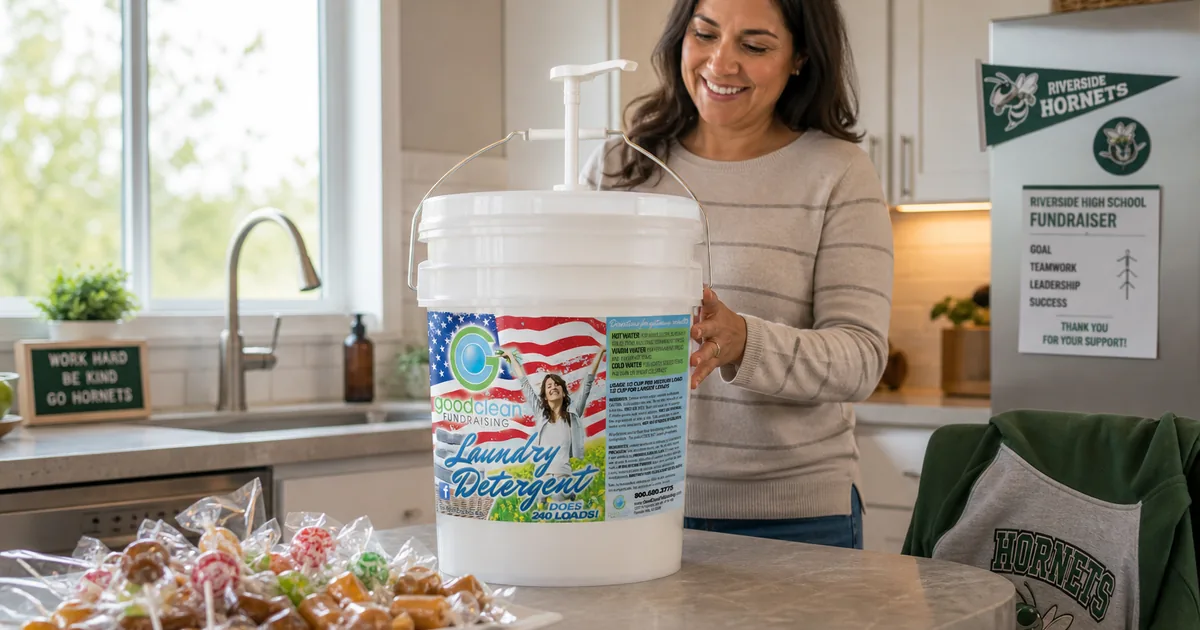
Strong non-food fundraisers are often built around household necessities people already buy — laundry detergent, cleaning supplies, and similar consumable staples. They can outperform food fundraisers for some groups because they can reach most households rather than only treat buyers, they are non-perishable so there is no spoilage or frozen-delivery scramble, supporters may get value at a lower per-ounce price than premium national brands, and they ask people to shift a purchase they already make rather than spend extra. When choosing a non-food fundraiser, judge it on five factors: buyer breadth, repeat use, profit per unit, upfront cost, and ease of running. Programs that score well across all five tend to be consumable necessities with no upfront cost and simple logistics. A 5-gallon bucket holds 640 ounces, so at $49.95 the buyer pays about 7.8 cents per ounce. Premium national-brand liquid detergents typically cost more per ounce at retail, though exact pricing varies by store, size, and promotion — compare that figure to what you currently pay, since value-tier and store brands can cost less per ounce.
Food fundraisers have been the default for decades — cookie dough, candy, popcorn, pizza kits — but coordinators running them today often hit the same walls. Perishability creates delivery headaches, the buyer pool can be narrow because most food items are treats rather than necessities, and some supporters are reluctant to pay a premium for something they did not need in the first place.
The good news is that non-food options can be simpler. Programs that work well are often not novelty items or one-time purchases — they are consumable household products people already buy, offered at a price that makes switching from the store an easy decision.
This guide covers why some groups are moving away from food, a decision framework for judging non-food options, categories worth considering, how to compare them on the factors that matter, and mistakes to avoid when you make the switch.
- Many food fundraisers rely mainly on treat buyers, are often perishable, and can ask supporters to spend extra on something they did not need.
- Household necessities people already purchase can reach a wider buyer pool and remove perishability logistics.
- Judge any non-food fundraiser on five factors: buyer breadth, repeat use, profit per unit, upfront cost, and ease of running.
- Consumable staples can score well across all five because most households need them, they get repurchased, and they avoid the complexity of events or perishable goods.
- Non-perishable products avoid the frozen-delivery, spoilage, and storage problems that make food fundraisers hard to run.
- A household-necessity program asks supporters to shift a purchase they already make, not spend extra — which can widen participation.
- No-upfront-cost structures can reduce financial risk for your group.
Why are groups moving away from food fundraisers?
Three problems show up often. First, most food fundraisers sell treats — cookie dough, candy, popcorn — which means the buyer pool can be narrow from the start. Families may quickly exhaust the relatives and neighbors who want dessert, and participation can stall. Second, food is often perishable: cookie dough arrives frozen and needs a freezer, chocolate can melt in shipping, and pizza kits have expiration dates, all of which can turn delivery day into a logistics scramble. Third, supporters may be paying a premium for a product they did not really need, and after years of the same catalogs, buyer fatigue can set in.
For some groups the problem is not that the food was bad, but that too few people wanted it and handling it was a headache. When the product changes to something people already buy, both problems can ease at once.
What makes a non-food fundraiser actually work?
Not all non-food fundraisers are created equal — swapping cookie dough for a different novelty item keeps the same narrow-buyer problem. Programs that raise more tend to score well on the same five factors, and weakness on any one of them can make a fundraiser underperform.
Buyer breadth: How many people will actually buy it? A product most households need can beat a niche item. Repeat use: Is it something buyers use up and purchase again, or a one-time novelty? Profit per unit: What does the group keep per item after cost? Upfront cost: Does the group have to buy inventory first, or is it no-cost and no-risk? Ease of running: Perishability, delivery complexity, and volunteer hours all decide how much work falls on your team.
A household-necessity fundraiser — laundry detergent, cleaning products, paper goods — can score well on all five. It can reach most households, it gets repurchased, margins depend on the program, some programs are no-upfront-cost, and non-perishable goods ship and store easily.
How do you compare non-food fundraising options?
Use the five-factor scorecard as a filter. Start by listing your realistic options — household consumables, reusable goods, direct-support or pledge programs, service events — then score each one honestly on buyer breadth, repeat use, profit, upfront cost, and ease of running. The option that scores well across all five may raise more than one with a slightly higher per-item margin.
Here is what that looks like in practice. A reusable water bottle might score well on ease of running and upfront cost, but it is a one-time purchase with narrow appeal — low on buyer breadth and repeat use. A car wash scores well on broad appeal and no inventory, but it is labor-intensive and weather-dependent — low on ease of running. A bulk laundry-detergent program can score well on all five: most households buy detergent, they repurchase it, profit per bucket depends on order volume, some programs are no-upfront-cost, and it is non-perishable so delivery is simple.
The point is not that one category is always best — it is that the scorecard tells you which option fits your group. A tech-comfortable PTA with strong online participation might lean toward a digital direct-support program; a booster club that wants broad, repeatable participation and minimal volunteer hours might consider a household staple.
What are the strongest non-food fundraising categories?
Measured against the five-factor scorecard, a few categories stand out. Household consumables — laundry detergent, cleaning products, paper goods — can score well on all five factors and are one common food-fundraiser replacement. They can reach most households, they get repurchased, and they avoid perishability. One category in particular, bulk laundry detergent, is worth a look because detergent is a necessity most households already buy, and bulk pricing lets a program offer it at well below premium national brands' typical per-ounce retail price.
No-inventory and direct-support programs — where supporters give or order online with nothing to stock — remove logistics almost completely. They can work well for tech-comfortable groups, though they may lack the tangible value proposition that supports repeat participation. Reusable and practical goods — items like reusable bags, water bottles, or seasonal practical products — avoid perishability and can carry decent margins, but most are one-time purchases, so they score lower on repeat use. Service events like car washes or yard work score well on broad appeal and no inventory, but they are labor-intensive and often weather-dependent, which makes them harder to run.
The pattern is that consumable household necessities can outperform novelties, one-time goods, and labor-intensive events on the factors that move the total — buyer breadth, repeat use, and simplicity — though results vary by group.
How does a household-necessity fundraiser compare to food on the factors that matter?
The comparison can favor household necessities. A food fundraiser — cookie dough, candy, popcorn — appeals mainly to treat buyers, which can cap the buyer pool. A household necessity like laundry detergent is relevant to most households. Food fundraisers are often perishable, which means frozen delivery, spoilage risk, and storage headaches; household staples are non-perishable and ship and store easily. Food items are often priced so both the group and the fundraising company profit from that single sale; a household-necessity program can offer the product at a lower per-ounce price than premium national brands because of bulk pricing, so supporters may see real value instead of paying a premium.
Food fundraisers ask supporters to spend extra on something they may not need; a household-necessity fundraiser asks them to shift a purchase they already make, at a lower per-ounce price. That difference can widen participation. And some household-necessity programs, including Good Clean Fundraising's, involve $0 upfront cost, which removes the financial risk that comes with ordering food inventory in advance.
Groups may find higher participation, fewer logistics problems, and stronger totals than they saw with food — not because the margin per item is wildly different, but because more families may find buyers and each may find more of them. No comparative results data is published here, so treat this as a hypothesis to test for your group.
How do you figure out how much a non-food fundraiser will raise?
Total raised is participants times average sales per participant times profit per unit. A common mistake is focusing only on the profit-per-unit term and ignoring the first two, which often matter more. A food fundraiser with a slightly higher per-item margin can raise less than a household-necessity fundraiser with broader participation, because a wider buyer pool can move the total more than a few points of margin.
Here is what that looks like with one household-necessity program. With Good Clean Fundraising's bulk laundry-detergent fundraiser, groups sell a 5-gallon bucket for $49.95 and keep about $13.45 to $15.45 per bucket at 100 or more buckets, depending on order volume. A 5-gallon bucket holds 640 ounces, so at $49.95 the buyer pays about 7.8 cents per ounce. Premium national-brand liquid detergents typically cost more per ounce at retail, though exact pricing varies by store, size, and promotion — compare that figure to what you currently pay, since value-tier and store brands can cost less per ounce. That value proposition may help widen participation.
To estimate your total, start with your dollar goal and work backward. If your goal is a certain amount and you keep about $13.45 to $15.45 per bucket at 100 or more buckets, divide your goal by that per-bucket profit to get an estimated bucket count, then check which tier that estimate actually falls into — $13.45 at 100–299 buckets, $14.45 at 300–499, $15.45 at 500 or more — and recalculate at the matching rate if needed, rounding up so the total still covers your goal. Divide the final bucket count by the number of participating families to see how many buckets per family. If the per-family number looks realistic for your community, the goal may be achievable. If it does not, either grow participation or adjust the goal.
What about the value to the person buying?
This is the part that can separate a strong non-food fundraiser from a weak one. With a food fundraiser, the supporter may be paying a premium for a treat they did not need — a favor to the group. With a household-necessity fundraiser, the supporter is stocking up on something they already buy at a lower per-ounce price while backing the group, which can make the ask easier and widen the pool of people who say yes.
A 5-gallon bucket holds 640 ounces, so at $49.95 the buyer pays about 7.8 cents per ounce. Premium national-brand liquid detergents typically cost more per ounce at retail, though exact pricing varies by store, size, and promotion — compare that figure to what you currently pay, since value-tier and store brands can cost less per ounce. They are not paying extra to help — they may be saving money while helping, which is why grandparents, neighbors, and coworkers who would not buy cookie dough may buy detergent.
That value proposition may also make a household-necessity fundraiser repeatable. Supporters who got a good deal the first time may come back the next drive, which means groups could run the same program again with less of the buyer fatigue that can hurt food fundraisers.
Our recommendation
If you are moving away from food fundraising, one option worth considering is a household-necessity program — it can widen participation and simplify logistics. Good Clean Fundraising runs The Good Clean Fundraiser, a bulk laundry-detergent program: groups sell a 5-gallon pump bucket for $49.95 and pay $0 upfront because the group collects orders and payment first, then submits the final order with payment. Shipping is free at 100 or more buckets, and the company provides a Getting Started packet, instructions, marketing materials, and social media strategies.
At the $49.95 price, groups keep about $13.45 to $15.45 per bucket at 100 or more buckets, depending on order volume. Good Clean Fundraising advertises a 100% money-back guarantee under which, according to the company, any unsatisfied customer is refunded and the group keeps its profit. Groups choose their own goal and selling window; confirm current program terms with the company before you plan.
The process is designed to be simple: the group sets its goal and timeline, collects orders and payment from supporters, and submits the final order with payment, and the company provides a Getting Started packet, instructions, marketing materials, and social media strategies. It is a non-food option to evaluate on all five factors — buyer breadth, repeat use, profit, upfront cost, and ease of running.
How do food and non-food fundraisers compare?
| Factor | Food Fundraiser | Household Necessity |
|---|---|---|
| Buyer pool | Treat buyers only | Most households |
| Repeat customers | Occasional treat | Repurchased regularly |
| Perishable? | Often yes — frozen/refrigerated | No |
| Delivery logistics | Timed delivery, careful handling | Ships & stores easily |
| Upfront cost | Often orders inventory first | No-upfront-cost options |
| Value to buyer | Often priced at a premium | Value at ~7.8¢/fl oz |
Common mistakes to avoid
Swapping one novelty for another
Trading cookie dough for a different one-time novelty can keep the same narrow-buyer problem. The point of switching is to reach people who were not buying in the first place.
Ignoring the five-factor scorecard
A fundraiser that scores well on profit but poorly on buyer breadth or ease of running can underperform a simpler option with broader appeal. Judge on all five factors, not just margin.
Choosing something you cannot explain in one sentence
If the fundraiser is too complicated to explain quickly, it is too hard to sell and too hard to run. Simple wins.
Not confirming no-upfront-cost terms in writing
Some programs still require the group to front money for inventory. If a no-upfront-cost option exists, weigh whether you need to take on that risk — and confirm the terms before you launch.
Under-briefing your families on why the switch matters
Participation may rise when families understand why the new product is easier to sell. A short, honest kickoff explaining that this is something people already buy can help.
- U.S. Food & Drug Administration — Outbreak Investigation of Salmonella: Raw Cookie Dough (May 2023). The FDA advises never eating raw dough that is meant to be cooked or baked and describes a Salmonella outbreak linked to raw cookie dough; raw dough is a perishable food that needs careful handling. — source
- GCF per-ounce price calculation — a 5-gallon (640 fl oz) bucket at $49.95 works out to about 7.8 cents per fluid ounce ($49.95 ÷ 640 fl oz = 7.8046875¢/fl oz). Compare this figure to what you currently pay for premium liquid detergent; exact retail pricing varies by store, size, and promotion, and value-tier and store brands can cost less per ounce.
- Good Clean Fundraising program terms — $49.95 per bucket; $13.45 profit per bucket at 100 to 299 buckets (usually $5 to $12 at 50 to 99 buckets, depending on actual shipping costs), $14.45 at 300 to 499, $15.45 at 500 or more; $0 upfront cost; free shipping at 100+ buckets; 50-bucket minimum (smaller orders are not accepted); 100% money-back guarantee under which, according to the company, any customer who is not satisfied is refunded and the group keeps its profit. — GCF pricing, GCF how it works, and GCF refund and returns policy
Our recommendation
If you are moving away from food fundraising, one option worth considering is a household-necessity program — it can widen participation and simplify logistics. Good Clean Fundraising runs The Good Clean Fundraiser, a bulk laundry-detergent program: groups sell a 5-gallon pump bucket for $49.95, keep about $13.45 to $15.45 per bucket at 100 or more buckets, and pay $0 upfront because the group collects orders and payment first, then submits the final order with payment. Shipping is free at 100 or more buckets, and the company provides a Getting Started packet, instructions, marketing materials, and social media strategies. Good Clean Fundraising advertises a 100% money-back guarantee under which, according to the company, any unsatisfied customer is refunded and the group keeps its profit. Groups should plan for the 50-bucket minimum, a commercial delivery address, and about two weeks of fulfillment after the paid order is submitted.
Frequently asked questions
Strong non-food fundraisers are often built around household necessities people already buy — laundry detergent, cleaning supplies, and similar consumable staples. They can outperform food fundraisers for some groups because they can reach most households rather than only treat buyers, they are non-perishable, and supporters may get value at a lower per-ounce price than premium national brands instead of paying a premium for a novelty.
Common reasons: the buyer pool can be narrow since most food fundraisers sell treats rather than necessities, food is often perishable which creates delivery and storage headaches, and supporters may be reluctant to pay a premium for something they did not need. Non-food alternatives can address all three, though each has trade-offs.
Judge any non-food fundraiser on five factors: buyer breadth, repeat use, profit per unit, upfront cost, and ease of running. This is a decision framework rather than measured performance data; programs that score well across all five — like household-necessity fundraisers — may raise more than options that excel on only one or two factors, but results depend on your group.
It depends on the specific programs, but household-necessity fundraisers can raise more if they widen participation — more families find buyers, and each finds more of them. Total raised is participants times average sales per participant times profit per unit, so broader participation can move the total more than a small change in per-item margin.
Consumable household products with no upfront cost and simple logistics — like bulk laundry detergent or cleaning supplies — tend to be easier to run. They are non-perishable so there is no frozen delivery or spoilage, and they can reach a wide buyer pool. Support varies by company; Good Clean Fundraising provides a Getting Started packet, instructions, marketing materials, and social media strategies.
Some do and some do not. Some household-necessity programs, including Good Clean Fundraising's, have a $0 upfront cost because the group collects orders and payment first, then submits the final order with payment. That can reduce financial risk if the campaign raises less than hoped, which is a reason some groups move off food programs that require ordering inventory in advance.
It depends on how many people participate and what you sell. As a concrete example, Good Clean Fundraising has groups sell a 5-gallon bucket of detergent for $49.95 and keep about $13.45 to $15.45 per bucket at 100 or more buckets, with free shipping at that volume. To estimate your total, divide your dollar goal by the per-bucket profit to get the bucket count you need, then divide by participating families to see if the per-family number is realistic.
They can reach a wider buyer pool because most households buy detergent or cleaning supplies, not just treat buyers. They are non-perishable so there is no frozen delivery or spoilage, and supporters may see value at a lower per-ounce price than premium national brands instead of paying a premium. That combination can widen participation and simplify logistics.
Possibly. Household-necessity fundraisers may be repeatable because supporters who got a good deal the first time may come back the next drive, and food fundraisers can suffer buyer fatigue. Confirm current program terms with the vendor before you plan a repeat drive.
The Good Clean Fundraiser is Good Clean Fundraising's bulk laundry-detergent program. Groups sell a 5-gallon pump bucket for $49.95 — about 7.8 cents per fluid ounce, typically less than premium national-brand liquid detergent costs per ounce at retail — and keep about $13.45 to $15.45 per bucket at 100 or more buckets. There is a $0 upfront cost because the group collects orders and payment first, free shipping at 100 or more buckets, and a Getting Started packet, instructions, marketing materials, and social media strategies. Good Clean Fundraising advertises a 100% money-back guarantee under which, according to the company, any unsatisfied customer is refunded and the group keeps its profit.
Food fundraisers are not failing because the products are bad — they can struggle because the buyer pool is narrow and volunteers have to manage perishability. Switch the product to something most households already buy, and participation and logistics can get easier at the same time. That is the case for moving on.