Non-Food & Alternative Fundraising
Modern Fundraising Ideas for Today's Families
Why coordinators are moving away from door-to-door candy sales — and the household-necessity fundraisers that fit how families actually live and buy now.
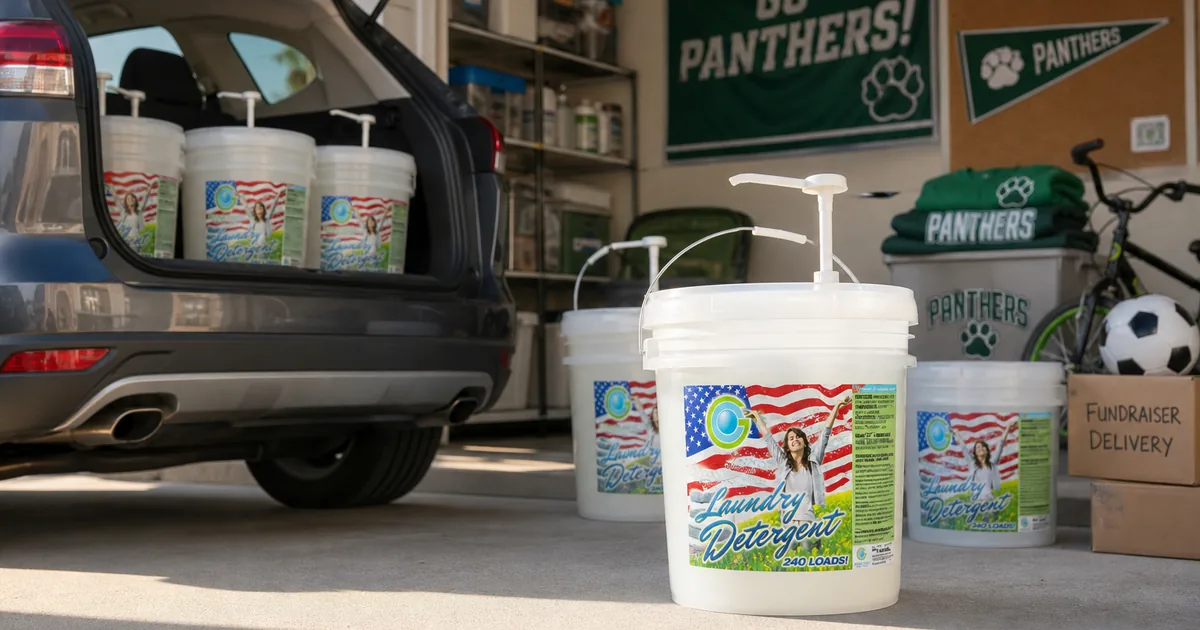
Modern fundraising ideas often center on household-necessity products — especially bulk laundry detergent and cleaning supplies — combined with no-upfront-cost structures and online sharing tools that reduce door-to-door selling. These programs fit how many families live now: supporters buy something they already need at a lower per-ounce price, sellers can share a message or order form instead of knocking on doors, and groups avoid fronting money for inventory. The shift reflects three changes in how people buy: more purchasing happens online, supporters want real value rather than overpriced novelties, and coordinators need programs that work for busy families who cannot commit to events or delivery days. A 5-gallon bucket holds 640 ounces, so at $49.95 the buyer pays about 7.8 cents per ounce. Premium national-brand liquid detergents typically cost more per ounce at retail, though exact pricing varies by store, size, and promotion — compare that figure to what you currently pay, since value-tier and store brands can cost less per ounce.
Fundraisers that were common in the 1990s — door-to-door candy bars, weekend car washes, catalog order forms passed around the office — may be struggling for some groups now, and coordinators running them may feel it. Participation can drop, the same families can end up doing all the work, and the final total can come in below the goal.
The problem may not be that families care less or that fundraising has gotten harder. Older models were built for a world where people bought in person, had time for events, and were willing to pay a premium for a novelty item to support a cause. For many families that has changed.
Modern fundraising ideas start from how many families live now: they buy online, they want real value for their money, and they are busy. Programs that fit that reality make supporting easy, give buyers something useful, and ask little extra of the coordinator or the seller. This guide covers what makes a fundraiser modern, ideas worth considering, and why one category — household-necessity products — is a common replacement for the old door-to-door model.
- Modern fundraisers can replace door-to-door selling with online sharing and forms families can send to friends and relatives.
- Household-necessity products — laundry detergent, cleaning supplies — can reach more buyers because most households need them, and they can offer value.
- No-upfront-cost structures can reduce financial risk and make fundraising more accessible to groups of any size.
- Supporters today want to buy something useful at a fair price, not an overpriced novelty item.
- Programs that work for busy families who cannot commit to events, delivery days, or in-person selling may see better participation.
- A short, focused campaign may hold families' attention better than a months-long door-to-door effort; choose a length that suits your group.
- Programs that provide setup help and materials can free coordinators to focus on participation rather than operations.
What makes a fundraiser 'modern'?
A modern fundraiser is one that fits how families actually buy and communicate now, rather than how they did twenty years ago. Three shifts define it: first, selling can happen digitally — through a link, a form, or an app — rather than door-to-door or face-to-face. Second, the product or activity offers real value to the supporter, not a marked-up novelty they are buying out of obligation. Third, the program is designed for busy families who cannot commit to weekend events, frozen-delivery days, or managing inventory.
Modern fundraisers can feel easier to run and easier to sell because they remove friction that made the old model exhausting. When a parent can text a message to their family group chat instead of walking the neighborhood with a clipboard, and when the buyer gets a household staple at a lower per-ounce price instead of overpriced wrapping paper, participation may rise and the total may follow.
Why are the old fundraising models failing now?
The door-to-door candy bar, the weekend car wash, the catalog passed around the office — these were never perfect, but they worked when people bought in person, had time for events, and were willing to pay a premium to support a cause. Those conditions have shifted for many families, and models built on them can break down.
Door-to-door selling can be uncomfortable and less effective. Fewer people may answer the door, some families are uncomfortable with children going door to door, and families can be too busy to spend weekends canvassing. The car wash and bake sale require volunteer labor on a specific day, and coordinators may struggle to find enough helpers. Catalog fundraisers can sell items people do not need, and buyer fatigue can set in after years of the same products.
These ideas were not necessarily bad — the world they were designed for has changed for many families. Modern fundraising ideas are built for how families live now: digital communication, real value, and programs that respect everyone's time.
What are the best modern fundraising ideas?
Measured against the three criteria — digital-friendly, real value, low logistics — a few categories stand out. One is household-necessity products, especially bulk laundry detergent and cleaning supplies. These programs sell something most households already buy, at a price that can be lower per ounce than premium national brands, and the product is non-perishable so there is no frozen-delivery day. Families can share an order form, supporters buy a staple they need anyway, and the group keeps a margin with no upfront cost.
Good Clean Fundraising runs one version of this model: groups sell a 5-gallon bucket of laundry detergent for $49.95 and keep about $13.45 to $15.45 per bucket at 100 or more buckets, depending on order volume, with free shipping at 100 buckets or more. The group pays $0 upfront because it collects orders and payment first, then submits the final order with payment, and the company provides a Getting Started packet, instructions, marketing materials, and social media strategies. A 5-gallon bucket holds 640 ounces, so at $49.95 the buyer pays about 7.8 cents per ounce. Premium national-brand liquid detergents typically cost more per ounce at retail, though exact pricing varies by store, size, and promotion — compare that figure to what you currently pay, since value-tier and store brands can cost less per ounce. Good Clean Fundraising advertises a 100% money-back guarantee under which, according to the company, any unsatisfied customer is refunded and the group keeps its profit.
Beyond household products, other modern ideas include peer-to-peer fundraising platforms where supporters donate online and share the campaign digitally, and hybrid programs that combine a small tangible item with a digital giving component. What these share is that they reduce door-to-door selling, give supporters something of value, and can work for families who are too busy for events.
How do modern fundraisers compare to traditional ones?
The clearest way to see the difference is to compare a traditional door-to-door candy fundraiser with a modern household-necessity program across the factors that decide whether a fundraiser succeeds or fails: how selling happens, who will buy, what the buyer gets, the logistics load on the coordinator, and the financial risk to the group.
Why do household-necessity fundraisers work so well for modern families?
Household-necessity fundraisers — detergent, cleaning products, paper goods — can address three problems that hurt traditional programs. First, the buyer pool can be wide: most households need these products, so sellers may reach grandparents, neighbors, and coworkers who might not buy candy or cookie dough. Second, the value can be real: supporters may pay well below premium national brands' typical per-ounce retail price for a staple they were going to buy anyway. Third, the logistics can be simple: the product is non-perishable, so there is no frozen-delivery day or perishable inventory to manage.
Another possible advantage is repeat participation. When supporters get value — a large supply of detergent at a lower per-ounce price — they may be willing to buy again the next time the group runs a campaign. Traditional novelty fundraisers can be one-and-done; necessity fundraisers may build a base of repeat buyers, though repeat rates are not published here.
What role do digital tools play in modern fundraising?
Digital tools can make fundraising more accessible to busy families. Instead of handing a child a box of candy bars and a clipboard, parents can share a link or order form via text, email, or social media. Where a program supports online ordering, the seller may not have to collect money or deliver product in person. Whether that raises participation for your group is worth testing; no participation data is published here.
Some modern fundraising programs build in digital tools from the start: order links, order tracking, and online payment. Whether a program offers them varies, so ask any provider exactly which ordering and payment tools it supports. A program that still requires paper forms and cash collection may feel dated regardless of what it sells.
How do you transition your group from a traditional fundraiser to a modern one?
The transition can be simpler than many coordinators expect. Start by picking a modern replacement that scores well on digital-friendly selling, real value, and low logistics — a household-necessity program is one option that can meet all three. Confirm the terms in writing: upfront cost, ordering tools included, profit per unit, and what support the provider gives you. Set a clear goal and a short timeline that suits your group, then hold a kickoff where you explain why this may be easier to sell than what the group did before.
A mistake to avoid is running the old program and the new one at the same time. Pick one, commit to it, and give families a clear, single ask. Groups may do better in their first modern campaign if they make a clean break and explain the change honestly: this is easier for you to sell, better value for your buyers, and simpler for us to run.
| Factor | Traditional (Door-to-Door Candy) | Modern (Household Necessity) |
|---|---|---|
| Selling method | Door-to-door in person | Digital links & forms |
| Buyer pool | People willing to buy candy | Most households |
| Value to buyer | Often a premium-priced novelty | Staple at ~7.8¢/fl oz |
| Logistics | Inventory, cash, delivery day | Varies by program |
| Financial risk | Often requires upfront cost | No-upfront-cost options |
| Participation | May decline (uncomfortable) | May be higher (easy to share) |
Common mistakes to avoid
Running a modern program with old-school logistics
If your program still requires paper forms, cash collection, and in-person delivery, it may not fit busy families no matter what you are selling. Ask providers which digital tools they include.
Choosing a product with narrow appeal
A modern selling method does not fix a product nobody wants. Favor household necessities with broad appeal over niche items, even if the margin looks attractive.
Keeping the old program running alongside the new one
Running two fundraisers at once splits participation and confuses families. Make a clean switch, explain why, and give everyone a single clear ask.
Underestimating the importance of real value
Some supporters will not pay a premium for a novelty item out of obligation. If the product is not something they would buy at that price outside of a fundraiser, participation may stay low.
Skipping the digital order tools
Some families may not participate if selling still means walking the neighborhood or passing around a paper form at work. Digital sharing is an increasingly common expectation.
- GCF per-ounce price calculation — a 5-gallon (640 fl oz) bucket at $49.95 works out to about 7.8 cents per fluid ounce ($49.95 ÷ 640 fl oz = 7.8046875¢/fl oz). Compare this figure to what you currently pay for premium liquid detergent; exact retail pricing varies by store, size, and promotion, and value-tier and store brands can cost less per ounce.
- Good Clean Fundraising program terms — $49.95 per bucket; $13.45 profit per bucket at 100 to 299 buckets (usually $5 to $12 at 50 to 99 buckets, depending on actual shipping costs), $14.45 at 300 to 499, $15.45 at 500 or more; $0 upfront cost; free shipping at 100+ buckets; 50-bucket minimum (smaller orders are not accepted); 100% money-back guarantee under which, according to the company, any customer who is not satisfied is refunded and the group keeps its profit. — GCF pricing, GCF how it works, and GCF refund and returns policy
- Editorial note: statements about the shift from in-person to digital buying and about participation in this article are general observations, not cited studies, coordinator surveys, or program data.
Our recommendation
If you are moving your group to a modern fundraiser, one option worth considering is a household-necessity product with a no-upfront-cost structure. Good Clean Fundraising runs The Good Clean Fundraiser, a bulk laundry-detergent program: groups sell a 5-gallon pump bucket for $49.95, keep about $13.45 to $15.45 per bucket at 100 or more buckets, and pay $0 upfront because the group collects orders and payment first, then submits the final order with payment. Shipping is free at 100 or more buckets, and the company provides a Getting Started packet, instructions, marketing materials, and social media strategies. Good Clean Fundraising advertises a 100% money-back guarantee under which, according to the company, any unsatisfied customer is refunded and the group keeps its profit. Groups should plan for the 50-bucket minimum, a commercial delivery address, and about two weeks of fulfillment after the paid order is submitted. Basic online ordering is available (with a $2 customer-paid fee), though product ships to the group for distribution rather than directly to each buyer; ask the company about personalized seller links or live tracking before you plan around them.
Frequently asked questions
Modern fundraising ideas are programs built for how many families live and buy now: digital sharing tools can replace door-to-door selling, the product offers real value rather than an overpriced novelty, and the logistics are simple enough for busy families to manage. Programs worth considering center on household-necessity products like laundry detergent, combined with no-upfront-cost structures and digital sharing.
They may raise more because they can remove friction that hurts participation in traditional programs. When selling means sharing a message instead of walking the neighborhood, when the product is something supporters need at a lower per-ounce price, and when the coordinator does not have to manage inventory or collect cash, more families may participate. No comparative totals are published here.
There is no single best option, but a household-necessity product program — especially bulk laundry detergent — is worth considering because it can score well on buyer appeal, value to supporters, upfront cost, and logistics. It can reach more buyers than candy or cookie dough and may suit families too busy for events.
Replace door-to-door selling with links or forms that families can share via text, email, or social media. With Good Clean Fundraising, basic online ordering is available (with a $2 customer-paid fee), though the group still collects orders and payment first and product ships to the group for distribution; ask about personalized seller links or other digital tools. This approach can reach more people than knocking on doors and avoids sending children door to door.
Not always. Some programs, including Good Clean Fundraising's, have a $0 upfront cost because the group collects orders and payment first, then submits the final order with payment. Traditional programs often require buying inventory in advance, which adds financial risk.
They can reach a wider buyer pool because most households need detergent or cleaning supplies, while candy and cookie dough mainly appeal to people who want a treat. Supporters may also see better value — a staple at well below premium national brands' typical per-ounce retail price instead of a premium-priced novelty — which can make selling easier.
There is no single right length. A short, focused selling window can create urgency and keep families engaged, while campaigns that drag on can lose momentum. Choose a window that suits your group and confirm any order deadlines and fulfillment time with your provider; with Good Clean Fundraising, plan for about two weeks of fulfillment after the paid order is submitted.
The Good Clean Fundraiser is Good Clean Fundraising's bulk laundry-detergent program. Groups sell a 5-gallon pump bucket for $49.95 — about 7.8 cents per fluid ounce, typically less than premium national-brand liquid detergent costs per ounce at retail — and keep about $13.45 to $15.45 per bucket at 100 or more buckets. There is a $0 upfront cost because the group collects orders and payment first, free shipping at 100 or more buckets, and a Getting Started packet, instructions, marketing materials, and social media strategies. Good Clean Fundraising advertises a 100% money-back guarantee under which, according to the company, any unsatisfied customer is refunded and the group keeps its profit. Basic online ordering is available with a $2 customer-paid fee, though product still ships to the group for distribution; confirm with the company about personalized seller links or live tracking.
Yes. A no-upfront-cost structure can reduce financial risk, and online sharing can let each family reach more buyers than door-to-door selling. Small groups should still plan for any program minimums; Good Clean Fundraising has a 50-bucket minimum.
Make it easy: give families a simple way to share the offer, sell a product supporters want at a price that feels like a deal, and set a short, clear deadline. Participation may rise when the ask is simple, the value is real, and the selling method fits how people communicate.
Fundraisers that worked a generation ago can struggle for some families now, because people buy differently and value their time. Modern programs that offer real value, reduce door-to-door selling, and keep logistics light can be an easier fit. Confirm program terms and tools in writing before you commit.