Non-Food & Alternative Fundraising
Why Families Are Tired of Traditional Fundraisers (And What Works Better)
Why participation may be dropping for traditional programs — and the shift to household-necessity fundraisers that supporters actually want to buy.
Families may tire of traditional fundraisers because they can rely on novelty products people may not need, ask supporters to buy things they would not purchase otherwise, and create guilt-based selling that can feel awkward for both the seller and the buyer. After years of the same cookie dough, candy, and wrapping paper catalogs, buyer fatigue can set in — some people are less willing to pay a premium for a product priced so both the group and the vendor can profit. Fundraisers built around household necessities people already buy — such as bulk laundry detergent and cleaning products — are one alternative, because they let supporters shift a purchase they were already making to the group's drive. A 5-gallon bucket holds 640 ounces, so at $49.95 the buyer pays about 7.8 cents per ounce. Premium national-brand liquid detergents typically cost more per ounce at retail, though exact pricing varies by store, size, and promotion — compare that figure to what you currently pay, since value-tier and store brands can cost less per ounce.
If you have been running fundraisers for a few years, you may have noticed a shift: fewer families participating, lower sales per family, and a general sense that people are tired of it. A catalog that raised solid money in the past may now get a lukewarm response, and parents who used to be strong sellers may be opting out.
This is not necessarily about laziness or a lack of school spirit. Families may be tired of traditional fundraisers because the model itself has worn out for them: overpriced novelty products, guilt-based selling, and the same rotating menu of cookie dough, candy, and wrapping paper that everyone has been asked to buy many times before. When a supporter pays a premium for something they did not need, that transaction may not feel good — and after years of it, people may stop saying yes.
The good news is that a different kind of fundraiser is available, and it flips the premise: instead of asking supporters to go out of their way to buy an overpriced novelty, it offers a household necessity they already purchase at a lower per-ounce price than premium national brands. This guide explains why the old model struggles, what families may want instead, and how household-necessity programs compare.
- Traditional fundraisers can rely on novelty products priced so both the group and the vendor profit, which can make supporters feel they overpaid.
- Buyer fatigue can set in after years of the same cookie dough, candy, and wrapping paper catalogs — people may be less willing to say yes.
- Guilt-based selling can feel awkward for both the seller and the buyer, which can reduce participation.
- Families may prefer fundraisers where supporters get real value for their money, not a novelty item they did not need.
- Household-necessity fundraisers let supporters shift a purchase they already make to the group's drive, at a lower price than they normally pay.
- Bulk laundry detergent programs are one replacement to consider because detergent is something most households buy, it is non-perishable, and supporters may pay well below premium national brands' typical per-ounce retail price.
- Look for programs whose guarantee and support terms you have confirmed in writing; Good Clean Fundraising advertises a 100% money-back guarantee.
What is wrong with traditional fundraisers?
The core problem can be the value exchange. Traditional product fundraisers — cookie dough, candy bars, popcorn, wrapping paper, candles — are often priced above everyday retail value. Part of that reflects both the fundraising company and the group needing to profit from the sale, but the number of parties earning from it is not by itself what makes a price feel too high — the markup over retail is. A supporter may pay a premium for something they would not buy at that price otherwise, and they may know it. That transaction can work once or twice out of loyalty, but after years of being asked, people may stop feeling good about it.
Then there is the product itself. Many traditional fundraisers sell non-necessities — treats, novelties, or seasonal items people may not need. A tub of cookie dough or a box of gift wrap may not be solving a problem for the buyer; it can be a favor to the group. When the ask is framed that way, it can become a guilt transaction rather than an exchange of value, and guilt may not be a sustainable fundraising strategy.
Finally, there is buyer fatigue. After years of the same rotating catalog of products, supporters may have seen it all before. Families who used to be strong sellers may now turn in a couple of orders or skip the fundraiser; no data is published here on how widespread that is.
Why do families hate selling traditional fundraiser products?
The selling experience itself can be the other half of the problem. When a child or parent is asked to sell a novelty product, the pitch can be awkward: they are asking friends, family, and neighbors to pay more than something may be worth as a favor to the group. Many people may feel uncomfortable with that dynamic, which can reduce participation.
Compare that to a fundraiser built around a household necessity. When the product is something the buyer already purchases — laundry detergent, for example — and the per-ounce price is lower than premium national brands, the conversation can change. The seller is not asking for a favor; they may be offering a good deal on something the supporter needs anyway. That shift from guilt to value can make people more willing to participate.
Some parents may find the pitch easier when they are not pushing an overpriced novelty but helping supporters save money on something they were going to buy regardless. How the selling feels can matter as much as the profit line for participation, though that is an observation rather than measured data.
What do families want from a fundraiser instead?
Families may want three things: a product supporters actually want, a price that feels fair, and a selling experience that does not feel uncomfortable. Fundraisers that deliver on all three may sell consumable household necessities at a lower price than supporters normally pay, so the transaction can benefit everyone.
One category to consider is bulk laundry detergent. Detergent is a necessity most households buy, it is non-perishable so there are fewer logistics headaches, and when sold in bulk it can run at a per-ounce price typically below premium national-brand retail pricing, though value and store brands can cost less. That value proposition may widen participation: grandparents, neighbors, and coworkers who might not buy a tub of cookie dough may stock up on detergent when it saves them money.
Another thing families may want is trust: they want to know the product is good and that the group is not taking on financial risk. Programs with a no-upfront-cost model mean the group does not front money, and a guarantee can reassure supporters, though guarantee terms should be confirmed in writing.
How do household-necessity fundraisers compare to traditional fundraisers?
The comparison comes down to who will buy, what they get for their money, and how the selling feels. Traditional fundraisers may appeal to a narrower slice of buyers — people willing to pay a premium for a treat or novelty as a favor to the group. Household-necessity fundraisers can appeal to most households because the product is something supporters already purchase, and they may be paying less per ounce than they normally would.
On the value side, traditional fundraisers are often marked up well above retail so both the vendor and the group profit; the markup, not the number of parties earning from the sale, is what can leave the supporter overpaying. A household-necessity fundraiser can offer a useful product at a lower per-ounce price than premium national brands, so supporters may feel they got a good deal rather than doing a favor. That difference may support repeat participation.
Then there is the selling dynamic. Traditional fundraisers can rely on guilt or loyalty; household-necessity fundraisers can rely on value. When a seller can honestly say 'this is something you already buy, at well below premium national brands' typical per-ounce retail price,' the pitch may feel easier.
Why is laundry detergent the standout replacement?
Laundry detergent can meet several things families may look for. It is a necessity most households buy, so the buyer pool can be wide. It is consumable and repurchased regularly. It is non-perishable, so there are no frozen-delivery logistics or spoilage risk. And when sold in bulk, it can run well below premium national brands' typical per-ounce retail price.
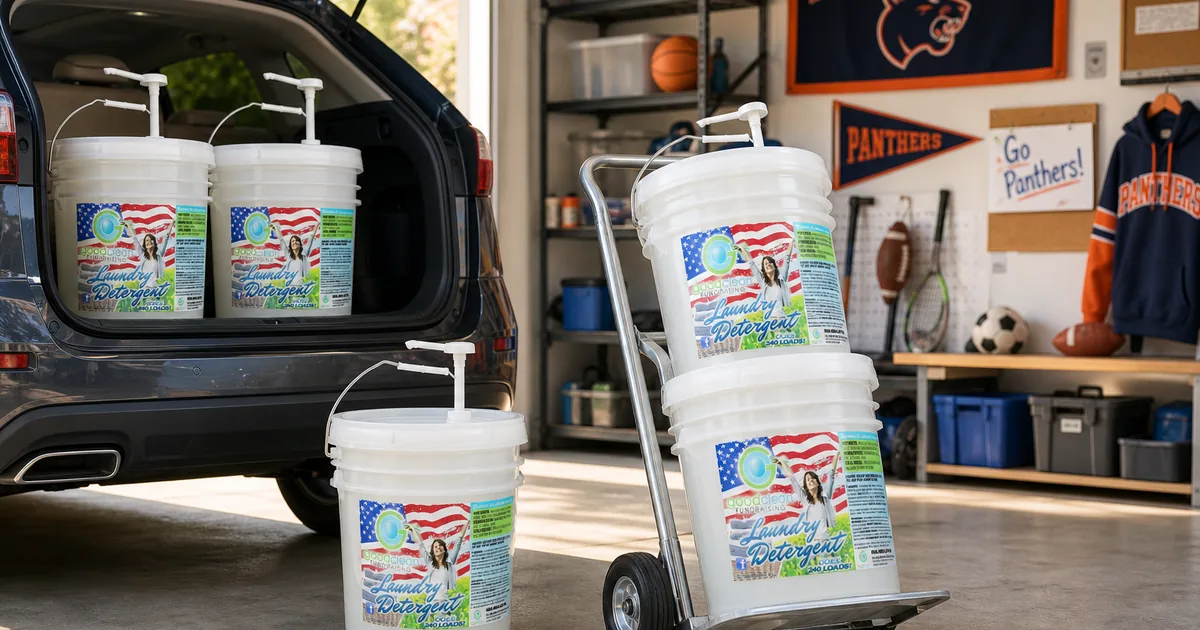
Good Clean Fundraising runs a bulk detergent program: groups sell a 5-gallon pump bucket of laundry detergent for $49.95. A 5-gallon bucket holds 640 ounces, so at $49.95 the buyer pays about 7.8 cents per ounce. Premium national-brand liquid detergents typically cost more per ounce at retail, though exact pricing varies by store, size, and promotion — compare that figure to what you currently pay, since value-tier and store brands can cost less per ounce.
Groups keep about $13.45 to $15.45 per bucket at 100 or more buckets, depending on order volume, with free shipping at 100 buckets or more. There is a $0 upfront cost because the group collects orders and payment first, then submits the final order with payment. Good Clean Fundraising advertises a 100% money-back guarantee under which, according to the company, any unsatisfied customer is refunded and the group keeps its profit.
The company provides a Getting Started packet, instructions, marketing materials, and social media strategies. Groups should plan for the 50-bucket minimum, a commercial delivery address, and about two weeks of fulfillment after the paid order is submitted.
What are the biggest differences families notice when they switch?
One possible change is wider participation. When the product is a household necessity at a lower per-ounce price, families who used to skip the fundraiser or turn in a couple of orders may find more buyers — grandparents, neighbors, coworkers — who may stock up because they are saving money on something they need.
Another is that the selling may feel easier. Parents may describe the pitch as helpful rather than awkward because they are offering value instead of asking for a favor.
A third is logistics. Traditional fundraisers often involve perishable products, timed deliveries, and inventory risk. Household-necessity programs — especially bulk detergent — are non-perishable and ship easily, and programs with a $0 upfront cost mean the group does not front inventory money.
| Factor | Traditional Fundraiser | Household Necessity |
|---|---|---|
| Product type | Non-necessity treats/novelties | Consumable staples people buy |
| Buyer pool | Narrower: people willing to pay a premium as a favor | Most households |
| Value to supporter | Often priced so vendor and group both profit | ~7.8¢/fl oz |
| Selling dynamic | Guilt or loyalty | Value and savings |
| Repeat participation | Buyer fatigue after years of same catalogs | Potential repeat buyers |
| Logistics | Often perishable, timed deliveries | Non-perishable, ships easily |
Common mistakes to avoid
Sticking with a traditional fundraiser because it is familiar
Familiarity is not the same as effectiveness. If participation and totals are trending down, consider whether the model, not your families, is the problem.
Assuming all fundraisers feel the same to families
The selling experience can matter as much as the profit margin. A fundraiser that feels awkward to sell may underperform one that feels helpful.
Ignoring the value proposition for supporters
If supporters do not feel they got something useful for their money, they may not buy again. Real value can support repeat participation.
Choosing a replacement that is still a novelty product
Swapping cookie dough for popcorn or candy can keep the same narrow-buyer problem. The point of switching is to reach people who were not buying novelties in the first place.
Not confirming the guarantee and no-upfront-cost terms
Families may want to know the product is backed and the group is not taking on risk. A program without a clear guarantee or that requires fronting money may be a harder sell to your volunteers.
- GCF per-ounce price calculation — a 5-gallon (640 fl oz) bucket at $49.95 works out to about 7.8 cents per fluid ounce ($49.95 ÷ 640 fl oz = 7.8046875¢/fl oz). Compare this figure to what you currently pay for premium liquid detergent; exact retail pricing varies by store, size, and promotion, and value-tier and store brands can cost less per ounce.
- Good Clean Fundraising program terms — $49.95 per bucket; $13.45 profit per bucket at 100 to 299 buckets (usually $5 to $12 at 50 to 99 buckets, depending on actual shipping costs), $14.45 at 300 to 499, $15.45 at 500 or more; $0 upfront cost; free shipping at 100+ buckets; 50-bucket minimum (smaller orders are not accepted); 100% money-back guarantee under which, according to the company, any customer who is not satisfied is refunded and the group keeps its profit. — GCF pricing, GCF how it works, and GCF refund and returns policy
- Editorial note: statements about family attitudes, buyer fatigue, and participation trends in this article are general observations, not measured survey data or cited research.
Our recommendation
If your families are tired of traditional fundraisers, one option worth considering is a different kind of product rather than a new catalog. Good Clean Fundraising runs The Good Clean Fundraiser, a bulk laundry-detergent program: groups sell a 5-gallon pump bucket for $49.95, keep about $13.45 to $15.45 per bucket at 100 or more buckets, and pay $0 upfront because the group collects orders and payment first, then submits the final order with payment. Shipping is free at 100 or more buckets, and the company provides a Getting Started packet, instructions, marketing materials, and social media strategies. Good Clean Fundraising advertises a 100% money-back guarantee under which, according to the company, any unsatisfied customer is refunded and the group keeps its profit. Groups should plan for the 50-bucket minimum, a commercial delivery address, and about two weeks of fulfillment after the paid order is submitted.
Frequently asked questions
Families may be tired of traditional fundraisers because they can rely on novelty products people do not need, ask supporters to pay a premium as a favor to the group, and create guilt-based selling that feels awkward. After years of the same cookie dough, candy, and wrapping paper catalogs, buyer fatigue can set in and people may be less willing to say yes.
Families may want a product supporters actually want, a price that feels fair, and a selling experience that does not feel uncomfortable. Fundraisers that deliver on all three may sell consumable household necessities at a lower price than supporters normally pay, so the transaction can benefit everyone.
They can feel awkward because the seller is asking friends, family, and neighbors to pay more than something may be worth as a favor to the group. When the product is a household necessity at a lower per-ounce price, the pitch can shift from asking for a favor to offering value, which may make the selling feel more helpful.
One alternative is household-necessity fundraisers built around consumable products people already buy, such as bulk laundry detergent. Detergent is something most households purchase, it is non-perishable, and when sold in bulk it can run well below premium national brands' typical per-ounce retail price, so supporters may see real value and the buyer pool can be wider than a novelty fundraiser.
It depends on your group size and participation, so treat any single number with caution. As a concrete example, Good Clean Fundraising has groups sell a 5-gallon bucket for $49.95 and keep about $13.45 to $15.45 per bucket at 100 or more buckets, with free shipping at that volume. The bigger lever is participation — when more families find buyers, the total can rise more than a small change in per-item profit would.
For many groups they may be, mainly because the buyer pool can be wider and the selling may feel easier. Cookie dough and candy appeal to people who want a treat and are willing to pay a premium; a household necessity like detergent is something most households already buy, and supporters may pay well below premium national brands' typical per-ounce retail price.
Not necessarily. Some programs, including Good Clean Fundraising's bulk detergent program, have a $0 upfront cost because the group collects orders and payment first, then submits the final order with payment. That removes the inventory financial risk if the campaign raises less than hoped.
The Good Clean Fundraiser is Good Clean Fundraising's bulk laundry-detergent program. Groups sell a 5-gallon pump bucket for $49.95 — about 7.8 cents per fluid ounce, typically less than premium national-brand liquid detergent costs per ounce at retail — and keep about $13.45 to $15.45 per bucket at 100 or more buckets. There is a $0 upfront cost because the group collects orders and payment first, free shipping at 100 or more buckets, and a Getting Started packet, instructions, marketing materials, and social media strategies. Good Clean Fundraising advertises a 100% money-back guarantee under which, according to the company, any unsatisfied customer is refunded and the group keeps its profit.
Give them a product supporters want at a price that feels fair, and make the selling feel helpful instead of awkward. When the fundraiser is built around a household necessity people already buy at a lower per-ounce price than premium national brands, sellers are offering value instead of asking for a favor, which may bring participation back.
Some groups see participation drop because the model can wear out: overpriced novelty products, guilt-based selling, and buyer fatigue after years of the same catalogs. Families are not necessarily less supportive — they may be tired of asking supporters to overpay for something they did not need. No industry-wide participation data is cited here.
Families are not tired of supporting their schools and teams — they may be tired of overpriced novelties and guilt-based selling. A household-necessity fundraiser offers a different premise: a product people already buy at a lower per-ounce price. Confirm program terms in writing, and test whether it brings participation back for your group.