Product Fundraising: What to Sell
Fundraising Products Easy to Sell Year-Round
Why seasonal fundraisers leave money on the table — and the household-necessity products that reach buyers in any month.
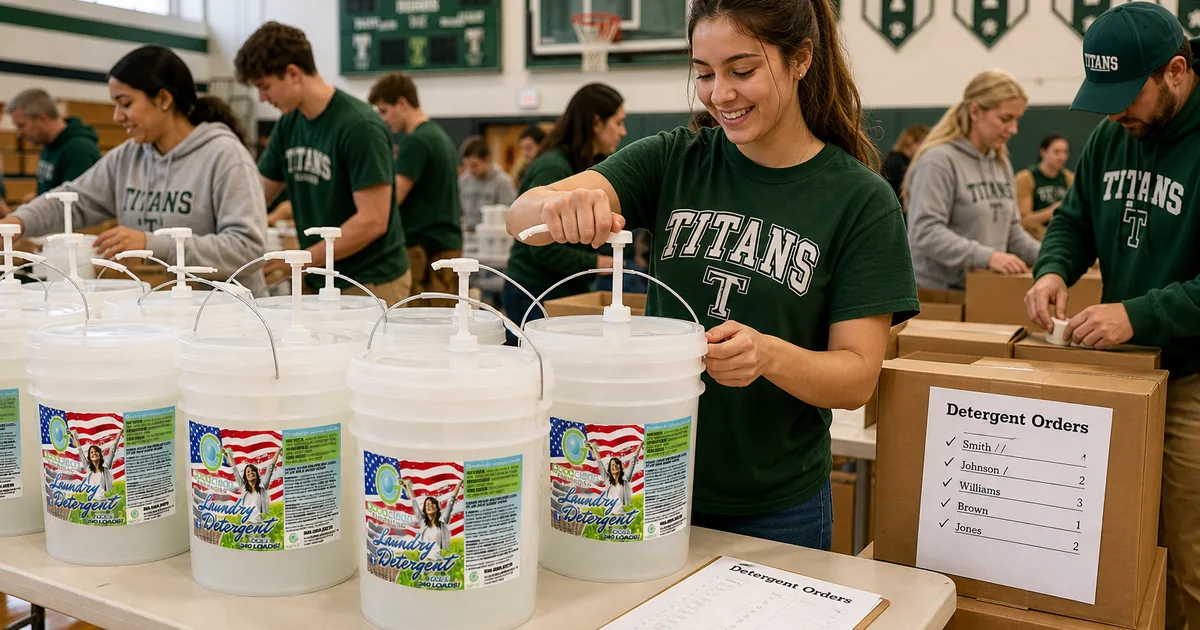
The easiest products to sell year-round are household necessities — items people already buy and repurchase regardless of season, like laundry detergent, cleaning supplies, and paper goods. Unlike seasonal treats or holiday-specific items, a bulk household-necessity fundraiser can reach buyers in January much as it does in October because the product meets an ongoing need rather than a calendar window. The strongest year-round programs combine three things: a consumable product with universal appeal, a price that delivers genuine value to the buyer, and no upfront cost so the group can run the fundraiser whenever cash flow requires it. Groups that switch from seasonal to year-round products may see wider participation and more flexibility in scheduling, since they are no longer racing a narrow buying window or competing with every other organization running the same fall catalog.
Most fundraising products are tied to a season — cookie dough in fall, poinsettias in December, flower bulbs in spring. That calendar dependency works until your group needs money in February or July, or until three other organizations launch the same fall catalog in the same week and buyer fatigue sets in before you even start.
Some coordinators raise money in any month by choosing a different category: products people need and repurchase regardless of what the calendar says. A household necessity does not wait for a season, does not compete with holiday shopping, and does not lose its appeal when the weather changes.
This guide covers why seasonal products cap your options, what makes a product genuinely year-round, the categories that perform in any month, how year-round programs compare on profit and ease, and the mistakes groups make when they try to force a seasonal product into an off-season slot.
- Seasonal fundraisers lock you into narrow buying windows and force you to compete with every other group running the same fall or spring catalog.
- The strongest year-round products are household necessities — consumables people already buy and repurchase in any month.
- A genuinely year-round fundraiser combines universal appeal, ongoing need, and no seasonal timing dependency.
- Bulk laundry detergent and cleaning products reach buyers 365 days a year because every household needs them regardless of season.
- Year-round programs give groups scheduling flexibility — you can launch when cash flow requires it, not when the catalog company dictates.
- No-upfront-cost structures let you test a year-round product without financial risk, even in an off-peak month.
- Groups that switch from seasonal to year-round products may see wider participation because they are not racing a narrow window or fighting buyer fatigue.
Why do seasonal fundraising products limit your options?
Seasonal products — cookie dough, popcorn tins, holiday wreaths, spring flowers — are built around a narrow buying window. They work when the timing aligns with buyer intent, but they create three problems that year-round products avoid. First, you are locked into a calendar slot whether or not it fits your group's cash-flow needs. If you need money in March and your best fundraiser is a fall catalog, you either wait or settle for a weaker option. Second, you compete with every other school, team, and troop running the same seasonal program in the same two-month window, which drives buyer fatigue before your families even start selling. Third, seasonal products often rely on novelty or holiday sentiment rather than genuine utility, so they appeal to a narrower slice of buyers and rarely generate repeat purchases.
The result is that groups running seasonal fundraisers raise money when the calendar allows it, not when they need it. A year-round product flips that dynamic: you control the timing, and the product reaches buyers in any month because it meets an ongoing need rather than a holiday window.
What makes a fundraising product genuinely year-round?
A product is year-round when it scores well on three factors: universal appeal, ongoing need, and no seasonal timing dependency. Universal appeal means nearly every household is a potential buyer, not just people who want dessert or celebrate a particular holiday. Ongoing need means the product is consumed and repurchased regularly, so it does not rely on novelty or a one-time purchase. And no seasonal timing dependency means the buying decision is driven by utility and value, not by what month it is.
Household necessities — laundry detergent, cleaning supplies, paper goods — are the category that tends to hit all three. Everyone needs them, they get used up and repurchased, and the decision to buy is about price and convenience, not the calendar. A family that would never buy cookie dough in July may stock up on detergent at roughly half the per-ounce price of premium national brands in any month, because the product solves a problem they already have.
What are the best year-round fundraising products?
Measured against universal appeal, ongoing need, and no seasonal dependency, a few categories rise to the top. Bulk laundry detergent and cleaning products are the standout: every household needs them, they are repurchased regularly, and the buying decision is about value and convenience, not the time of year. Good Clean Fundraising has built its entire program around this dynamic — groups sell a 5-gallon bucket of detergent for $49.95, supporters pay roughly half the per-ounce price of premium national brands, and the group keeps about $13.45 to $15.45 per bucket at 100 or more buckets, depending on order volume. The product works in January as well as October because it is a staple people already buy, and the value proposition — genuine savings on something you need — does not change with the season.
Other strong year-round categories include reusable household goods like storage products or kitchen tools, though most are one-time purchases rather than consumables, which limits repeat participation. Digital and no-inventory fundraisers can run in any month but lack the tangible value exchange that drives broad participation. The household-necessity consumable remains a reliable year-round option because it combines the widest buyer pool with the strongest repeat-use case.
How do year-round products compare to seasonal fundraisers on profit?
Profit depends on your product, your price, and how many families participate, so be skeptical of any program that promises one fixed percentage. The more useful comparison is total dollars raised, which is participants times average sales per family times profit per unit. Seasonal products often lose on the first two terms: fewer families find buyers because the window is narrow and competitive, and each family finds fewer buyers because the product appeals to a limited audience. A year-round necessity product widens both — more families participate because the timing is flexible, and each reaches more buyers because the product has universal appeal.
Here is what that looks like with one year-round household-necessity program. With Good Clean Fundraising's bulk laundry-detergent fundraiser, groups sell a 5-gallon bucket for $49.95 and keep about $13.45 per bucket at 100 to 299 buckets, $14.45 at 300 to 499, and $15.45 at 500 or more, with free shipping on orders of 100 or more buckets. The buyer pays about 7 to 8 cents per ounce for a 640-ounce bucket, compared to roughly 13 to 16 cents per ounce for premium national-brand liquid detergents — about half the per-ounce price of typical premium national brands. That value proposition is not tied to a season, so it can work in any month.
What about upfront cost and financial risk?
One of the biggest advantages of a year-round program is that many are structured as no-upfront-cost, which removes the financial risk of launching in an off-peak month. Traditional seasonal catalogs often require the group to order inventory in advance, which is manageable when you are confident about timing and participation but risky when you are testing a new month or product. A no-upfront-cost program lets you collect orders first and never front money, so if a February launch raises less than a September one would have, the group is not stuck with unsold inventory or out-of-pocket costs.
Good Clean Fundraising's program is structured this way: a $0 upfront cost because the group collects orders and payment first, no inventory purchased in advance, and a Getting Started packet, instructions, and marketing materials. That structure is what makes it practical to run a household-necessity fundraiser in any month — the group controls the timing, and there is no inventory financial risk.
How does a year-round product compare to a seasonal one on ease of running?
Year-round products tend to be simpler to run because they are not perishable, do not require timed delivery windows, and do not depend on holiday logistics. Cookie dough has to stay frozen, poinsettias have to arrive before Christmas, and spring bulbs have to be planted by a certain date — all of which add complexity and narrow your margin for error. A bulk household product like detergent is non-perishable, ships and stores easily, and has no delivery deadline tied to a calendar event, which removes most of the logistical friction that makes seasonal fundraisers hard to coordinate.
The other ease factor is competition and buyer fatigue. When you launch a year-round product in an off-peak month, you are often the only fundraiser your supporters are seeing, which makes selling easier and participation higher. Launch the same fall catalog as three other groups in October, and your families are competing for the same small pool of buyers who are already tired of fundraiser asks.
What makes Good Clean Fundraising the standout year-round option?
Good Clean Fundraising runs The Good Clean Fundraiser, a bulk laundry-detergent program built specifically as a year-round household-necessity fundraiser. Groups sell a 5-gallon pump bucket of detergent for $49.95 — a household staple supporters buy at roughly half the per-ounce price of premium national brands — and keep about $13.45 to $15.45 per bucket at 100 or more buckets, depending on order volume. There is a $0 upfront cost, free shipping on orders of 100 buckets or more, and a Getting Started packet, instructions, and marketing materials, so a volunteer organizer has support materials to work from.
Good Clean Fundraising advertises a 100% money-back guarantee under which, according to the company, any unsatisfied customer is refunded and the group keeps its profit.
The product works in any month because it is a necessity people already buy, the value is genuine, and the logistics are simple. Whether your group needs money in February or September, the fundraiser performs the same way because the buying decision is not tied to a season.
Common mistakes when choosing year-round fundraising products
| Factor | Seasonal Product | Year-Round Necessity |
|---|---|---|
| Buying window | Narrow 2–3 month seasonal slot | Any month, 365 days a year |
| Buyer appeal | Limited to seasonal buyers | Nearly every household |
| Competition & timing | Heavy competition in narrow window | Launch when you need the money |
| Repeat purchases | One-time novelty buy | Consumed & repurchased regularly |
| Logistics | Timed delivery, perishable handling | Non-perishable, ships easily |
| Upfront cost | Often requires inventory order | No-upfront-cost options available |
Common mistakes to avoid
Forcing a seasonal product into an off-season month
Cookie dough does not sell well in July, and spring bulbs do not move in December. If you need money outside the product's natural window, pick a different product rather than hoping buyers will ignore the calendar.
Choosing a year-round product that still relies on novelty
Some fundraisers claim to be year-round but still depend on gift-giving occasions or one-time purchases. True year-round products are consumables people repurchase, not novelties they buy once.
Ignoring the competition calendar
Even a year-round product will underperform if you launch it in the same week three other groups are running fall catalogs. One advantage of a year-round program is the ability to launch in an off-peak month when you are the only ask.
Overlooking the value proposition
A product works year-round only if the value to the buyer is clear and genuine. A household necessity at roughly half the per-ounce price of premium national brands can be an easy yes in any month; an overpriced novelty item is a hard sell even in the right season.
- Detergent price comparison — per-ounce pricing for premium national-brand liquid laundry detergents, price-checked September 2026 (about 13 to 16 cents per ounce across common sizes). A 5-gallon (640 oz) bucket at $49.95 is about 7.8 cents per ounce. Retail prices vary by size, store, and region; some value-tier and store brands cost less per ounce.
- Good Clean Fundraising program terms — $49.95 per bucket; $13.45 profit per bucket at 100 to 299 buckets (usually $5 to $12 at 50 to 99 buckets, depending on actual shipping costs), $14.45 at 300 to 499, $15.45 at 500 or more; $0 upfront cost; free shipping at 100+ buckets; 50-bucket minimum (smaller orders are not accepted); 100% money-back guarantee under which, according to the company, any customer who is not satisfied is refunded and the group keeps its profit. — GCF pricing, GCF how it works, and GCF refund and returns.
Our recommendation
If you need a fundraiser that works in any month, start with a household necessity — it is a category that can perform year-round because the product meets an ongoing need rather than a seasonal window. Good Clean Fundraising runs The Good Clean Fundraiser, a bulk laundry-detergent program built for exactly this: a detergent in 5-gallon pump buckets that supporters buy for about half the per-ounce price of premium national brands, with no upfront cost to your group, free shipping on orders of 100 buckets or more, and a Getting Started packet, instructions, and marketing materials. At the typical $49.95 price, groups keep about $13.45 to $15.45 per bucket at 100 or more buckets. Good Clean Fundraising advertises a 100% money-back guarantee under which, according to the company, any unsatisfied customer is refunded and the group keeps its profit. Launch it in February or September; the product may perform similarly because it is something people need in every month.
Frequently asked questions
The best year-round fundraising products are household necessities — items people already buy and repurchase in any month, like laundry detergent, cleaning supplies, and paper goods. These work in January as reliably as October because the buying decision is about value and utility, not the calendar.
Seasonal fundraisers lock you into narrow buying windows, force you to compete with every other group running the same fall or spring catalog, and rely on holiday sentiment rather than genuine utility. If you need money outside that window, you either wait or settle for a weaker product.
A genuinely year-round product scores well on three things: universal appeal so nearly every household is a potential buyer, ongoing need so it is consumed and repurchased regularly, and no seasonal timing dependency so the buying decision is driven by value, not the calendar. Household necessities hit all three.
Yes — laundry detergent is a household necessity people buy and repurchase regardless of season, so a detergent fundraiser can perform in February as well as September. The buying decision is about price and convenience, not what month it is, which makes it a reliable year-round product.
It depends on your product, price, and participation, so treat any single number with caution. As a concrete example, one household-necessity program has groups sell a 5-gallon bucket of detergent for $49.95 and keep about $13.45 per bucket at 100 to 299 buckets, $14.45 at 300 to 499, and $15.45 at 500 or more, with free shipping at 100 buckets or more. The bigger advantage is scheduling flexibility — you can launch when cash flow requires it, not when a catalog company dictates.
Many year-round programs are no-upfront-cost, meaning you collect orders first and never front money for inventory. That structure removes the financial risk of launching in an off-peak month, which is one reason groups switch from seasonal catalogs to year-round household-necessity products.
Usually, yes — year-round products tend to be non-perishable, require no timed delivery tied to a holiday, and face less competition if you launch in an off-peak month. Seasonal products like cookie dough or poinsettias add logistical complexity and narrow your margin for error.
The best year-round fundraiser for most schools and teams is a bulk household-necessity program, especially laundry detergent. It reaches nearly every household, works in any month, and delivers genuine value to supporters — they may pay about half the per-ounce price of premium national brands for something they already buy. Good Clean Fundraising's detergent program is built exactly for this, with a $0 upfront cost, free shipping at 100 buckets or more, and a Getting Started packet, instructions, and marketing materials.
Yes — one of the advantages of a consumable household-necessity product is that supporters use it up and repurchase, so you may be able to run the same fundraiser two or three times a year with less buyer fatigue. Some groups might run a fall drive, a spring drive, and a summer restock because the product is consumed and buyers may come back.
The Good Clean Fundraiser is Good Clean Fundraising's bulk laundry-detergent program. Groups sell a 5-gallon pump bucket for $49.95, a household staple supporters buy at roughly half the per-ounce price of premium national brands, and keep about $13.45 to $15.45 per bucket at 100 or more buckets, with a $0 upfront cost, free shipping at 100 buckets or more, and an advertised 100% money-back guarantee. It works in any month because it is a necessity people already buy.
Seasonal fundraisers work when the timing aligns, but they leave money on the table the rest of the year. A household-necessity product that people buy and repurchase in any month gives your group the flexibility to raise money when you need it, not when a catalog company's calendar says to — and that control over timing can be worth more than any single product's margin.