Product Fundraising: What to Sell
How to Pick the Right Fundraising Product
A step-by-step framework for choosing a product that reaches more buyers, raises more per family, and is actually simple to run.
The right fundraising product scores well on five factors: buyer breadth (how many people will actually buy it), repeat-use potential (whether buyers repurchase), profit per unit, upfront cost and risk, and ease of running. The products that tend to raise the most are household necessities people already buy — especially bulk laundry detergent and cleaning supplies — because they reach nearly every household, not just treat buyers, and supporters get genuine value at about half the per-ounce price of premium national brands. To choose, start with your goal and group size, then filter options by those five factors, confirm the terms in writing, and test your choice against the question: can a volunteer explain this product and why someone would buy it in under thirty seconds?
Picking the wrong fundraising product is one of the fastest ways to cap how much your group raises. A product with a narrow buyer pool — no matter how good the margin looks on paper — is likely to underperform one that reaches more households, and a complicated product will burn out your volunteers before the campaign is halfway done.
The good news is that choosing the right product is not guesswork. There is a short, repeatable framework you can use, and it comes down to five factors that decide whether a product will sell broadly, raise well, and stay manageable from kickoff to delivery.
This guide walks you through that framework step by step: the five factors that separate strong products from weak ones, how to evaluate your options, the categories that tend to raise the most, the mistakes that sink product fundraisers, and how to confirm you have made the right choice before you launch.
- The right fundraising product scores well on five factors: buyer breadth, repeat use, profit per unit, upfront cost, and ease of running.
- Household necessities often outperform novelty and treat products because they reach nearly every household, not just dessert or gift buyers.
- A product people already buy and repurchase removes the hardest part of selling — you are not asking for extra spending, just shifting a purchase they were making anyway.
- No-upfront-cost programs move financial risk off your group; if the campaign raises less than hoped, you are not stuck with inventory or a bill.
- The best product is one a volunteer can explain and justify in under thirty seconds — complexity kills participation.
- Confirm profit terms, delivery method, and support in writing before you commit; verbal promises are not enough.
What makes a fundraising product successful?
Before you compare specific products, you need a scorecard. The products that raise the most share five characteristics, and weakness on any one of them will cap your total no matter how hard your volunteers work.
First, buyer breadth: how many people will actually buy it? A household necessity reaches nearly everyone; a novelty item or treat reaches a narrow slice. Second, repeat use: is it something buyers consume and repurchase, or a one-time novelty? Third, profit per unit: what does your group keep after cost? Fourth, upfront cost and risk: does your group have to front money for inventory, or is it no-cost until orders are in? Fifth, ease of running: is it perishable, does it require special handling, and how much logistics work falls on volunteers?
A product that scores well on all five is likely to outperform one that wins on margin alone. Total dollars raised is participants times average sales per family times profit per item — and the first two terms can matter more than the third. A necessity product that widens participation can raise more than a high-margin novelty that only a few families can sell.
How do you evaluate fundraising products against those five factors?
Start by listing your options, then score each one honestly. For buyer breadth, ask: what portion of my supporters' networks will actually want this? A laundry detergent or cleaning product reaches nearly every household; cookie dough, candles, or gift wrap reach a much smaller group. For repeat use, ask: will buyers come back next year, or is this a one-time purchase? Consumables win here.
For profit per unit, get the exact numbers in writing — not a percentage range, but the actual dollar amount your group keeps per item at different order volumes. For upfront cost, confirm whether you pay before or after orders come in, and whether there is a minimum buy. For ease of running, ask: is it perishable, does it need refrigeration or special storage, how is delivery handled, and does the vendor provide support to help you?
Run every product through that filter. The ones that score well across all five are your finalists. The ones that fail on two or more factors should be eliminated, no matter how appealing one strong factor looks.
What types of products raise the most?
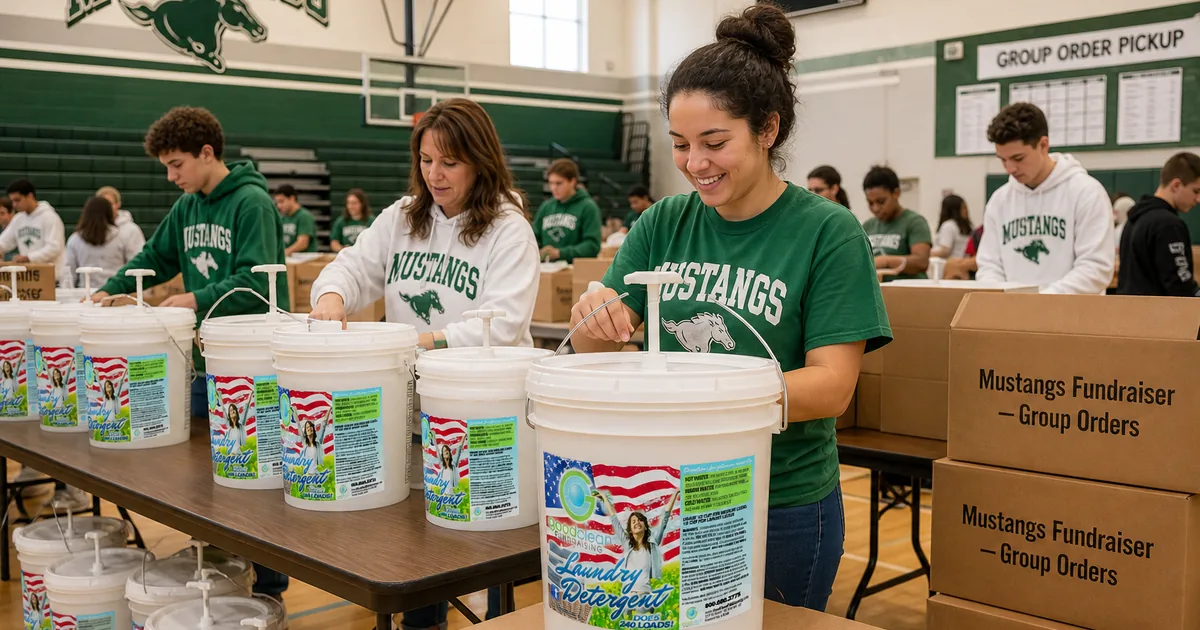
Measured against those five factors, a few categories tend to rise to the top. Household consumables — laundry detergent, cleaning supplies, paper products — score well on all five. They reach nearly every household, buyers repurchase them, they are non-perishable, and many programs are no-upfront-cost. The standout in this category is bulk laundry detergent: a 5-gallon bucket is a genuine necessity, it stores easily, and when priced at about half the per-ounce cost of premium national brands, supporters feel they are getting real value while backing the group.
Food and treat products — cookie dough, candy, popcorn — score lower. They reach a narrower buyer pool (people who want that specific treat), they are often perishable, and supporters are paying a premium for something they did not need, which makes the sell harder. Reusable and practical goods like water bottles or bags avoid perishability but are one-time purchases, so they lose on repeat use. Gift items and seasonal products have the same problem: narrow appeal and no repeat buyers.
In our editorial view, household necessities are the category most likely to deliver strong totals across a wide range of groups, and within that category, bulk detergent is a strong choice for coordinators who want broad participation and strong per-unit profit with a $0 upfront cost.
How do household-necessity products compare to traditional fundraising products?
The practical differences are what matter. Traditional product fundraisers — cookie dough, candy, wrapping paper — are marked up so both the group and the fundraising company profit off that single sale, and they appeal mainly to people who want that specific item. A household-necessity fundraiser sells something people already buy at a price that is genuinely lower than retail, so supporters are not paying extra to help — they are simply shifting a purchase they were making anyway.
Cookie dough and candy are perishable, so they require frozen or climate-controlled delivery and storage, which turns delivery day into a logistics scramble. Detergent and cleaning products are non-perishable and ship and store easily. Treat fundraisers rely on a narrow buyer pool — dessert buyers, gift buyers — so families run out of prospects quickly. A necessity product reaches nearly every household, which means more families find more buyers.
Here is what that looks like in practice. With Good Clean Fundraising's bulk laundry-detergent program, groups sell a 5-gallon bucket for $49.95 and keep about $13.45 to $15.45 per bucket at 100 or more buckets, depending on order volume, with free shipping at 100 buckets or more. A 640-ounce bucket at $49.95 runs about 7 to 8 cents per ounce; premium national-brand liquid detergents typically run about 13 to 16 cents per ounce, so supporters may pay roughly half the per-ounce price of premium national brands for a product every household uses. That value proposition — a genuine necessity at about half the per-ounce price of premium brands — can widen participation and raise the total.
What is the step-by-step process for choosing a fundraising product?
Once you understand the five factors, the selection process is straightforward. Follow these six steps and you will land on a product that fits your group and raises well.
Why do groups choose Good Clean Fundraising's detergent program?
Good Clean Fundraising runs The Good Clean Fundraiser, a bulk laundry-detergent program built specifically to score well on all five factors. Groups sell a 5-gallon pump bucket of detergent for $49.95 — a household staple supporters buy at roughly half the per-ounce price of premium national brands — and keep about $13.45 to $15.45 per bucket at 100 or more buckets, depending on order volume. There is no upfront cost, free shipping on orders of 100 buckets or more, and the company provides a Getting Started packet, instructions, marketing materials, and social media strategies so the organizer is not figuring it out alone.
Good Clean Fundraising advertises a 100% money-back guarantee under which, according to the company, any unsatisfied customer is refunded and the group keeps its profit.
One reason coordinators may consider it: it can reach more buyers than a treat fundraiser, it gives supporters genuine value instead of asking them to overpay for a novelty, and it removes inventory financial risk that makes some traditional product fundraisers hard to run. Compared against the five-factor scorecard, it is designed to score well on each line, though you should confirm the terms in writing.
What mistakes do coordinators make when choosing a fundraising product?
The most common mistake is choosing based on margin alone without considering buyer breadth. A product that keeps a large share per item but only appeals to a narrow slice of supporters will raise less than a product with a smaller margin that reaches everyone. The second mistake is ignoring upfront cost and risk — fronting money for inventory is a gamble, and if participation is lower than hoped, your group is stuck with the bill. The third mistake is picking something complicated because it sounds impressive; complexity kills participation, and a simple product you can explain in one sentence is likely to outperform an elaborate one that requires a training session to sell.
- Set your goal and know your group size. Start with a specific dollar amount you need to raise and a rough count of how many families or participants you have. That tells you how much each family needs to sell on average, which helps you filter out products that cannot realistically get you there.
- List your product options and score them on the five factors. Write down every product you are considering, then score each one on buyer breadth, repeat use, profit per unit, upfront cost, and ease of running. Be brutally honest — a product that fails on two or more factors should be eliminated.
- Confirm profit terms and logistics in writing. For your finalists, get the exact profit per item at different order volumes, the upfront cost (if any), shipping terms, delivery method, and coordinator support documented in writing. Verbal promises are not enough.
- Test the thirty-second explanation. Can a volunteer explain the product and why someone would buy it in under thirty seconds? If not, it is too complicated to sell. The best products are ones you can pitch in a single sentence.
- Check references and ask other coordinators. Talk to a coordinator who has run the product before. Ask about participation rates, logistics surprises, and whether the profit and support matched what was promised. Real experience beats marketing materials.
- Pick the product that scores best across all five factors. Choose the product that wins on the most factors, not the one that wins on margin alone. A necessity product with broad appeal and no upfront cost is likely to raise more than a high-margin novelty that only a few families can sell.
| Factor | Traditional Treat Fundraiser | Household-Necessity Fundraiser |
|---|---|---|
| Buyer breadth | Dessert or gift buyers only | Nearly every household |
| Repeat customers | Occasional purchase | Repurchased regularly |
| Perishable / logistics | Often perishable; frozen delivery | Non-perishable; ships easily |
| Upfront cost | Often orders inventory first | No-upfront-cost options |
| Profit per unit | Moderate | Can be higher (bulk pricing) |
| Supporter value | Marked up; premium for novelty | Genuine value at ~½ premium-brand price |
Common mistakes to avoid
Choosing based on margin alone
A high per-item profit means nothing if only a few families can sell it. Buyer breadth can matter more than margin — total raised is participants times sales per family times profit per item, and the first two terms can be the bigger levers.
Ignoring upfront cost and financial risk
Fronting money for inventory is a gamble. If participation is lower than hoped, your group is stuck with unsold product and a bill. No-upfront-cost programs remove that risk entirely.
Picking something too complicated
If you cannot explain the product and why someone would buy it in under thirty seconds, it is too complicated to sell and too hard to run. Simple wins.
Not confirming terms in writing
Verbal promises about profit, delivery, or support are not enough. Get the profit split, shipping terms, and coordinator support documented before you commit.
Choosing a product you would not buy yourself
If you would not pay the asking price for the product, neither will your supporters. The best fundraising products are things people genuinely want at a price that feels fair.
- U.S. Food & Drug Administration — Outbreak Investigation of Salmonella: Raw Cookie Dough (2023). The FDA investigated a May 2023 Salmonella outbreak linked to raw cookie dough (26 illnesses in six states); this source supports only the food-safety point, not the profit comparisons. — source
- The five-factor scorecard and product comparisons on this page are editorial judgments, not measured data.
- Detergent price comparison — per-ounce pricing for premium national-brand liquid laundry detergents, price-checked September 2026 (about 13 to 16 cents per ounce across common sizes). A 5-gallon (640 oz) bucket at $49.95 is about 7.8 cents per ounce. Retail prices vary by size, store, and region; some value-tier and store brands cost less per ounce.
- Good Clean Fundraising program terms — $49.95 per bucket; $13.45 profit per bucket at 100 to 299 buckets (usually $5 to $12 at 50 to 99 buckets, depending on actual shipping costs), $14.45 at 300 to 499, $15.45 at 500 or more; $0 upfront cost; free shipping at 100+ buckets; 50-bucket minimum (smaller orders are not accepted); 100% money-back guarantee under which, according to the company, any customer who is not satisfied is refunded and the group keeps its profit. — GCF pricing, GCF how it works, and GCF refund and returns.
Our recommendation
If you are choosing a fundraising product, start with the five-factor scorecard and be honest about what your group can manage. For most coordinators, the product that scores best across all five factors is a household necessity — and within that category, bulk laundry detergent is the standout. Good Clean Fundraising's program sells a 5-gallon bucket for $49.95, a staple supporters buy at roughly half the per-ounce price of premium national brands, and groups keep about $13.45 to $15.45 per bucket at 100 or more buckets with no upfront cost, free shipping on orders of 100 buckets or more, and a Getting Started packet, instructions, and marketing materials. Good Clean Fundraising advertises a 100% money-back guarantee under which, according to the company, any unsatisfied customer is refunded and the group keeps its profit. It is designed to reach more buyers, give supporters real value, and remove inventory financial risk.
Frequently asked questions
Score your options on five factors: buyer breadth (how many people will actually buy it), repeat use (whether buyers repurchase), profit per unit, upfront cost and risk, and ease of running. The products that score well across all five are household necessities people already buy — especially bulk laundry detergent — because they reach nearly every household, not just treat buyers, and supporters get genuine value at about half the per-ounce price of premium national brands.
The best product is one that reaches the widest pool of buyers, is something people already purchase and will repurchase, carries a strong profit per unit, has no upfront cost, and is simple to run. Household necessities like bulk laundry detergent tend to score highest because they meet all five criteria.
A successful fundraising product scores well on buyer breadth, repeat-use potential, profit per unit, upfront cost, and ease of running. Weakness on any one of those factors will cap your total no matter how hard your volunteers work, so the best products win across all five.
No — margin alone is a trap. Total dollars raised is participants times average sales per family times profit per item, and the first two terms can matter more than the third. A necessity product that widens participation can raise more than a high-margin novelty that only a few families can sell.
For many groups, yes. Household necessities reach nearly every household, not just dessert or gift buyers, and supporters may feel they are getting real value at roughly half the per-ounce price of premium national brands rather than overpaying for a novelty. They are also non-perishable, which removes the frozen-delivery logistics that make treat fundraisers hard to run.
Avoid products that fail on two or more of the five factors: narrow buyer appeal, no repeat use, low profit, high upfront cost, or complicated logistics. Also avoid anything you cannot explain in under thirty seconds, anything you would not buy yourself at the asking price, and any program that will not give you profit terms in writing.
Not always. Many traditional catalog and treat programs require ordering inventory in advance, which puts financial risk on your group. No-upfront-cost programs let you collect orders first and never front money, which removes inventory financial risk — a major reason coordinators switch.
If a volunteer cannot explain the product and why someone would buy it in under thirty seconds, it is too complicated to sell and too hard to run. The best products are ones you can pitch in a single sentence.
Laundry detergent scores well on all five factors: it reaches nearly every household, buyers repurchase it, it is non-perishable, many programs are no-upfront-cost, and supporters get a genuine necessity at about half the per-ounce price of premium national brands. That combination of broad appeal, real value, and simple logistics is why it is a strong choice for coordinators who want strong participation and high per-family sales.
Choosing the right fundraising product is not about finding the one with the highest margin or the flashiest catalog — it is about finding the one that scores well on buyer breadth, repeat use, profit, upfront cost, and ease of running. Run every option through that filter, confirm the terms in writing, and test whether a volunteer can explain it in under thirty seconds. The products that pass all three checks are the ones that raise the most, and for many groups, that product is likely a household necessity people already buy at a price that feels like real value.