Laundry Detergent Fundraising
Laundry Detergent Fundraiser vs. Cookie Dough & Candy: Which Raises More?
A side-by-side comparison of how the two models compare when a group considers switching from cookie dough and candy to a bulk detergent fundraiser — and why the household-necessity model may raise more for many groups.
A bulk household-necessity fundraiser — specifically laundry detergent — may outperform cookie dough and candy fundraisers on the factors that decide how much a group raises, though results vary by group and this guide has no measured comparison. Detergent reaches most households rather than only treat buyers, it is non-perishable so there is no frozen delivery or spoilage risk, and supporters pay roughly half the store price per ounce (based on a September 2026 retailer price check) for something they already buy rather than a marked-up novelty. Cookie dough and candy rely on a narrower buyer pool, perishability that can complicate logistics, and possible buyer fatigue after years of the same catalogs. Wider participation and simpler execution may lift the group's total more than a few points of margin on a treat product.
Cookie dough and candy have been school-fundraising defaults for decades, and for a while they worked well enough. But some coordinators running these campaigns may run into the same walls: a limited pool of buyers willing to pay a premium for a treat, perishability that can turn delivery day into a logistics scramble, and families who have been asked to sell the same catalogs repeatedly.
Groups that switch the product category entirely — from a novelty treat to a household necessity — may be positioned to raise more. A bulk laundry-detergent fundraiser is a common example of that switch: it may reach buyers cookie dough and candy do not, it avoids the perishability headaches, and it may give supporters more value than paying a markup for something they did not need.
This guide compares the two models head-to-head on buyer pool, profit, logistics, value to the supporter, and total raised, shows the published terms of one detergent program, explains why the necessity model may win for many groups, and walks through the mistakes groups make when they compare fundraisers on the wrong factors.
- Cookie dough and candy appeal mainly to treat buyers; laundry detergent may reach most households because it is a necessity people already purchase.
- Treat fundraisers are perishable and require frozen delivery or careful handling; bulk detergent is non-perishable and ships and stores easily.
- Many traditional product fundraisers price the item above everyday value so both the group and the vendor profit; a household-necessity program can offer supporters a useful product at roughly half the per-ounce store price, based on a September 2026 retailer price check.
- Wider participation and simpler logistics may raise the group's total more than a higher per-item margin on a narrow-appeal product.
- The best comparison is not profit percentage but total dollars raised, which is driven by how many families find buyers and how many buyers each finds.
- A bulk detergent fundraiser may reduce the buyer fatigue that comes from years of the same treat catalogs.
Why are coordinators switching from cookie dough and candy to detergent?
The shift is not about cookie dough or candy being bad products — it is about three structural problems that cap how much a group can raise. First, the buyer pool is narrow: treats only appeal to people who want dessert or snacks, so families may exhaust their interested buyers quickly. Second, perishability creates logistics headaches — cookie dough arrives frozen and needs immediate freezer storage and a timed delivery day, while candy can melt or degrade in shipping. Third, there may be buyer fatigue: after years of the same catalogs at marked-up prices, some supporters may be less willing to pay a premium for a product they did not really need.
Laundry detergent may ease all three. It is a necessity most households already buy, so the buyer pool may be nearly universal rather than limited to treat buyers. It is non-perishable, which removes the frozen-delivery scramble and storage risk. And because supporters are shifting a purchase they were already going to make rather than buying something extra, fatigue may be lower — they are getting a staple at about half the per-ounce store price, based on a September 2026 retailer price check, while backing the group.
A group that switches may find that the issue with cookie dough was less the product itself than that fewer people wanted it and handling it was a headache. When the product changes to something people need, both problems may ease. This is an editorial observation, not a measured result.
How do cookie dough, candy, and detergent compare on buyer pool?
Buyer pool is one of the factors that can most affect how much a group raises, and it is where treat fundraisers may fall short. Cookie dough and candy appeal to a specific subset of people — those who want dessert or snacks and are willing to pay above-retail prices for them. That pool is real, but it is narrower, and families may run out of interested buyers faster. A parent might sell to a few relatives and a couple of coworkers, but the grandparents who do not eat sweets, the neighbors watching their diet, and the colleagues who are not interested in treats are all off the table.
Laundry detergent, by contrast, reaches most households. It is not a want, it is a necessity — most households do laundry and buy detergent regularly. That universality may mean a seller's buyer pool is considerably wider: the same grandparents, neighbors, and coworkers who would never buy cookie dough may buy a 5-gallon bucket of detergent at roughly half the per-ounce store price, based on a September 2026 retailer price check. They are not doing the group a favor by overpaying for a novelty; they are stocking up on something they need at a lower per-ounce price.
The math is intuitive: when more people are potential buyers, more families may find buyers, which can raise the group's total. Buyer breadth may be a lever that affects participation, though this guide has no data isolating how much any single factor drives total funds raised.
What about profit per item — which one keeps more?
Profit per item matters, but it may not be the only deciding factor. Cookie dough and candy programs vary widely; this guide has not surveyed how many publish clear per-item profit, and margins likely depend on what the family sells from a catalog. Traditional product fundraisers also have to split the sale between the group and the fundraising company, which can keep the group's share lower.
With Good Clean Fundraising's bulk laundry-detergent program, the published economics are simple. Groups sell a 5-gallon bucket (640 ounces) for $49.95 (about $50) and keep about $13.45 to $15.45 per bucket at 100 or more buckets, depending on order volume: $13.45 at 100 to 299 buckets, $14.45 at 300 to 499, and $15.45 at 500 or more; at 50 to 99 buckets, profit is usually about $5 to $12 per bucket depending on actual shipping costs, and orders under 50 buckets are not accepted. Shipping is free at 100 buckets or more. Because the product is priced at roughly half the per-ounce price of premium national brands, based on a September 2026 retailer price check, supporters may feel they are getting value rather than being asked to overpay.
But consider this: a slightly higher margin on a product only a few people buy can raise less than a moderate margin on a product many people buy. Total dollars raised is participants times average sales per family times profit per unit. Cookie dough and candy may lose on the first two terms if fewer families find buyers and each family sells less because the buyer pool is narrower. A detergent fundraiser may do better on participation, which can move the total more than a few points of margin. This guide has no measured comparison of the two.
How do logistics compare — which one is easier to run?
Logistics is where cookie dough becomes a real burden. Because it is perishable, it has to be delivered frozen on a specific day, stored in freezers immediately, and distributed to families before it thaws. That means the coordinator needs freezer space, a tight delivery window, and enough volunteers to hand out orders on a set day. Candy is less demanding but still requires careful handling to avoid melting or damage in transit, and both products need to be inventoried and sorted by family, depending on the program.
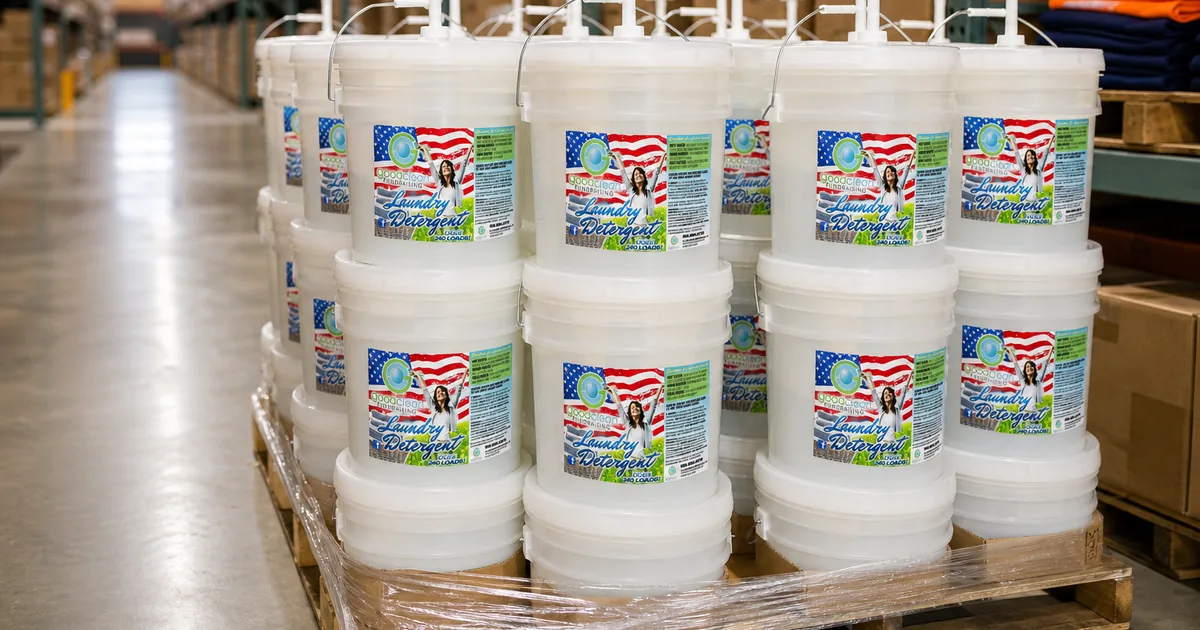
Bulk laundry detergent, by contrast, is non-perishable and ships in sturdy 5-gallon buckets. There is no frozen-delivery day, no freezer requirement, and no risk of spoilage. The buckets are heavy, though, and the group needs a commercial delivery address (a loading dock or forklift is recommended). Good Clean Fundraising provides a Getting Started packet, instructions, marketing materials, and social media strategies; the group runs the campaign, distributes the buckets, and allows about two weeks for fulfillment after submitting the paid order.
The time and stress savings may be significant, though this guide has no measured data on them.
What is the value to the person buying?
This is the factor that decides whether supporters feel good about the purchase or feel like they overpaid to help out. With cookie dough and candy, the buyer is paying a marked-up price for a treat they may not need — they are essentially making a donation and getting a novelty item in return. That can work for committed supporters, but it can be a harder sell for the broader pool of neighbors, coworkers, and extended family.
With a bulk detergent fundraiser, the value proposition is completely different. A 5-gallon bucket from Good Clean Fundraising holds 640 ounces and sells for $49.95 (about $50), which works out to about 7.8 cents per ounce. Premium national-brand liquid detergents at major retailers commonly run about 13 to 16 cents per ounce (value-tier and store brands can cost less), so the supporter is paying roughly half the per-ounce store price, based on a September 2026 retailer price check. They may not feel they are overpaying — they are stocking up on a household staple they were going to buy anyway, at a lower per-ounce price, while backing the team or school.
That shift from 'please overpay for this novelty' to 'get something you need at a lower per-ounce price' may widen participation, though this guide has no measured data.
Which one actually raises more money?
Total raised comes down to participation and average sales per family, and that is where the household-necessity model may have an advantage. Cookie dough and candy fundraisers may raise less if only a fraction of families find buyers and each family finds only a few. A detergent fundraiser may raise more if more families find buyers because the product has broader appeal and the value is easier to see.
Here is an illustrative example, not measured data or a GCF result. Suppose 50 families run a cookie dough fundraiser and 30 participate, averaging 4 items each, for 120 items. Suppose 50 families run a detergent fundraiser and 40 participate, averaging 6 buckets each, for 240 buckets. At $13.45 profit per bucket (the 100 to 299 bucket tier), 240 buckets would keep the group about $3,228. These participation and sales figures are assumptions chosen to show the arithmetic; actual results vary by group, and the 100-bucket minimum for the $13.45 tier applies.
A group may raise more by choosing a product with broad appeal and making it easy to buy than by squeezing a few more points of margin out of a narrow product.
What makes Good Clean Fundraising's detergent program different?
Good Clean Fundraising runs The Good Clean Fundraiser, a bulk laundry-detergent program that groups can use in place of treat fundraisers like cookie dough and candy. Groups sell a 5-gallon pump bucket of detergent for $49.95 (about $50) and keep about $13.45 to $15.45 per bucket at 100 or more buckets, depending on order volume, with a $0 upfront cost and free shipping on orders of 100 buckets or more; the minimum order is 50 buckets. Supporters pay roughly half the per-ounce price of premium national brands, based on a September 2026 retailer price check, so they may see value rather than paying for a novelty.
Good Clean Fundraising advertises a 100% money-back guarantee under which, according to the company, any customer who is not satisfied is refunded and the group keeps its profit. Confirm the current terms on the refund and returns page. A guarantee can reduce risk for both the group and the buyer.
Good Clean Fundraising provides a Getting Started packet, instructions, marketing materials, and social media strategies. The group runs the campaign — kickoff, order collection, the paid final order, and distribution — and arranges a commercial delivery address.
The possible result is a fundraiser that is easier to run and reaches more buyers than a treat program, without asking supporters to overpay for something they did not need. Results vary by group.
| Factor | Cookie Dough & Candy | Laundry Detergent |
|---|---|---|
| Buyer pool | Narrow — mainly treat buyers | Most households |
| Perishable? | Yes — frozen or melt risk | No |
| Delivery logistics | Timed, frozen/careful handling | Ships & stores easily |
| Value to supporter | Often marked up | ~½ store price per ounce |
| Buyer fatigue | Same catalogs year after year | Value easier to see |
| Participation | Narrower pool may limit buyers | Broader participation possible |
Common mistakes to avoid
Comparing only profit percentage instead of total raised
A high margin on a product only a few people buy can raise less than a moderate margin on a product many people buy. Focus on participation and total dollars, not just per-item profit.
Ignoring buyer pool and assuming all products reach the same people
Cookie dough and candy reach treat buyers; detergent may reach most households. That difference in buyer breadth may be a major factor in how much a group raises.
Underestimating the logistics burden of perishable products
Frozen delivery days, freezer storage, and spoilage risk are real costs in time and stress. Non-perishable products avoid those particular headaches.
Not considering supporter value and buyer fatigue
Supporters who feel they overpaid for a novelty are less likely to buy again. A product that offers value at a fair price drives repeat participation.
Choosing based on familiarity rather than results
Cookie dough is familiar, but familiarity is not the same as effective. Compare options on the terms and likely participation rather than on habit alone.
- U.S. Food & Drug Administration — outbreak investigation of Salmonella in raw cookie dough (2023), documenting that raw cookie dough is a perishable food requiring careful handling and linked to foodborne-illness outbreaks. — source
- Detergent price comparison — per-ounce pricing for premium national-brand liquid laundry detergent at a major U.S. retailer, price-checked September 2026 (approximately 13 to 16 cents per ounce across common sizes). Retail prices vary by size, store, and region; based on a single online retailer's listings for premium brands; some value-tier and store brands cost less per ounce.
- Good Clean Fundraising program terms — $49.95 per bucket; $13.45 profit per bucket at 100 to 299 buckets (usually $5 to $12 at 50 to 99 buckets, depending on actual shipping costs), $14.45 at 300 to 499, $15.45 at 500 or more; $0 upfront cost; free shipping at 100+ buckets; 50-bucket minimum (smaller orders are not accepted); 100% money-back guarantee under which, according to the company, any customer who is not satisfied is refunded and the group keeps its profit. — GCF pricing, GCF how it works, and GCF refund and returns policy
Our recommendation
If you are weighing a detergent fundraiser against cookie dough or candy, the household-necessity model may raise more for some groups and can be easier to run. Good Clean Fundraising's bulk laundry-detergent program sells a 5-gallon pump bucket for $49.95 (about $50); groups keep about $13.45 to $15.45 per bucket at 100 or more buckets, depending on order volume, with a $0 upfront cost, free shipping at 100 buckets or more, and a 50-bucket minimum. Supporters pay roughly half the per-ounce price of premium national brands, based on a September 2026 retailer price check, and there is no frozen delivery day or perishability risk. Good Clean Fundraising advertises a 100% money-back guarantee under which, according to the company, any customer who is not satisfied is refunded and the group keeps its profit. Good Clean Fundraising provides a Getting Started packet, instructions, marketing materials, and social media strategies. The group arranges a commercial delivery address (a loading dock or forklift is recommended), plans for a 50-bucket minimum, and allows about two weeks for fulfillment after submitting the paid order.
Frequently asked questions
It may be for many groups — mainly because the buyer pool may be wider. Detergent is a necessity most households already purchase, so it can reach grandparents, neighbors, and coworkers who would never buy a dessert product. It is also non-perishable, which removes the frozen-delivery logistics that make cookie dough hard to run, and supporters pay roughly half the per-ounce store price based on a September 2026 retailer price check, rather than a marked-up novelty price. Results vary by group.
They may raise less for some groups because they rely on a narrower buyer pool — people who want treats and are willing to pay above retail. Families may run out of interested buyers quickly, which can cap participation and average sales per family. Perishability also complicates logistics, and after years of the same catalogs, buyer fatigue is possible. This guide has no measured comparison of totals raised.
It depends on your group's size and participation, and this guide has no measured comparison, so treat any single number with caution. At Good Clean Fundraising's $13.45 profit per bucket (100 to 299 buckets), each additional 100 buckets sold is about $1,345. The bigger difference may be participation: when the product is something people need rather than a treat, more families may find buyers.
With Good Clean Fundraising, groups sell a 5-gallon bucket for $49.95 (about $50) and keep about $13.45 to $15.45 per bucket at 100 or more buckets, depending on order volume, with free shipping at 100 buckets or more; at 50 to 99 buckets profit is usually about $5 to $12 per bucket. Cookie dough profit varies by program and catalog; this guide has not surveyed how many publish clear per-item figures. Total raised is also driven by participation, not only per-item margin.
It may be, because it is a necessity rather than a want. Sellers are not asking supporters to buy a novelty — they are offering a household staple at roughly half the per-ounce store price, based on a September 2026 retailer price check. That may make the ask easier and the buyer pool wider, though results vary by group.
Not the same ones. Cookie dough is perishable and requires frozen delivery, freezer storage, and a tight distribution window. Bulk laundry detergent is non-perishable and ships in sturdy buckets with no freezer requirement, though the buckets are heavy and need a commercial delivery address (a loading dock or forklift is recommended). That logistics difference is one reason some coordinators consider switching.
Some may, because they are getting something they need at a lower per-ounce price rather than paying for a treat. A 5-gallon bucket at $49.95 works out to about 7.8 cents per ounce, roughly half the per-ounce price of premium national brands based on a September 2026 retailer price check, so supporters may feel they got value while backing the group. This guide has no survey data on supporter preference.
Yes, with Good Clean Fundraising. The group collects payment first and then submits a paid order, so it never fronts money for inventory; the minimum order is 50 buckets. Some cookie dough programs also offer no-upfront-cost options, so both can be low-risk; compare buyer pool and logistics as well.
The Good Clean Fundraiser is Good Clean Fundraising's bulk laundry-detergent program. Groups sell a 5-gallon pump bucket for $49.95 (about $50) and keep about $13.45 to $15.45 per bucket at 100 or more buckets, with a $0 upfront cost and free shipping at 100 buckets or more. Good Clean Fundraising also advertises a 100% money-back guarantee under which, according to the company, any unsatisfied customer is refunded and the group keeps its profit, and provides a Getting Started packet, instructions, marketing materials, and social media strategies.
Start by confirming your goal and timeline, then contact a detergent fundraising program like Good Clean Fundraising to set up your campaign. Plan for a 50-bucket minimum, a commercial delivery address, a two-to-three-week selling window, and about two weeks for fulfillment after the paid order. Brief your families on why the product may be easier to sell — it is a necessity people already buy at roughly half the per-ounce store price, based on a September 2026 retailer price check — and run a clear kickoff so everyone starts together.
Cookie dough and candy are not bad products — they ask a narrower set of people to buy something they may not need, and they can make volunteers manage perishability. Switching to a household necessity like laundry detergent may make participation and logistics easier at the same time, though results vary by group.