
Laundry Detergent Fundraising
Why Detergent Is the Ideal Fundraising Product
How a household necessity may compare with traditional fundraisers on participation, profit, and ease of running — and why some groups consider switching.
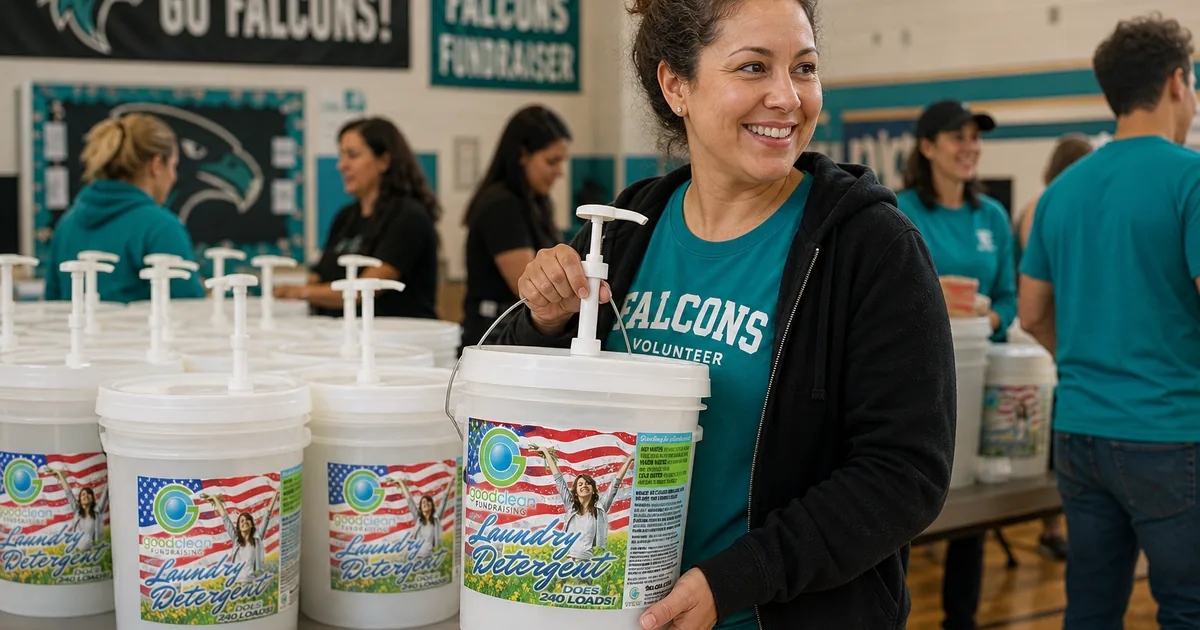
Detergent may be a strong fundraising product because it is a household necessity most families already buy, which means it may reach more potential supporters than a treat or novelty item. A bulk household-necessity fundraiser built around detergent can offer supporters a price of roughly half the per-ounce price of premium national brands based on a September 2026 retailer price check, with a per-bucket profit to the group — $13.45 to $15.45 per bucket at 100 or more buckets with Good Clean Fundraising — and a $0 upfront cost because the group collects payment first and submits a paid order. The product is non-perishable, so it avoids the timed-delivery logistics of food fundraisers, and it asks supporters to shift a purchase they may already be making. This guide has no measured participation data, so results vary by group.
If you have run a cookie dough or candy fundraiser, you know the pattern: a narrow pool of buyers, families who run out of interested relatives fast, and logistics that turn delivery day into a scramble. The product can decide much of that.
Detergent may change the equation. It is a different kind of fundraiser, built around a product most households need and repurchase. That shift — from novelty to necessity — may widen participation and simplify logistics.
This article explains why detergent works so well as a fundraising product: who it reaches, how the economics compare, why the logistics are easier, what makes it different from traditional programs, and how Good Clean Fundraising's program is structured around it.
- Detergent is a household necessity most families already buy, so it may reach more potential supporters than dessert or novelty buyers alone.
- Good Clean Fundraising's bulk detergent is priced at roughly half the per-ounce price of premium national brands, based on a September 2026 retailer price check.
- It is non-perishable, which avoids the frozen-delivery logistics and storage headaches that complicate food fundraisers.
- A necessity product asks supporters to shift a purchase they may already be making rather than spend extra, which may lower resistance and widen participation.
- With Good Clean Fundraising the group collects payment first and submits a paid order, so it never fronts money for inventory; the minimum order is 50 buckets.
- Detergent has no age or dietary restrictions and is a consumable, so it may be repeatable; this guide has no repeat-purchase data.
What makes detergent different from traditional fundraising products?
The core difference is necessity versus novelty. Traditional fundraisers — cookie dough, candy, popcorn, wrapping paper — are often bought mainly because the buyer wants to support the group, not because they need the item itself. Detergent is something most households already purchase whether or not there is a fundraiser. That distinction changes who buys, how many people buy, and how the sale feels to both the seller and the supporter.
When a product is a necessity, the pitch is not 'would you like to buy this' — it is 'you are buying this anyway; buy it here and save money while supporting us.' That reframe may reduce resistance. Supporters may not be spending extra or going out of their way; they may simply be shifting a purchase they were already making. The possible result is that more families find buyers, though this guide has no measured data.
The second major difference is value. Many traditional fundraisers price the product above its everyday worth because both the group and the fundraising company profit from that single sale. A bulk detergent fundraiser can instead offer a useful product at roughly half the per-ounce store price based on a September 2026 retailer price check, so the value to the supporter may be more than a courtesy purchase.
Who actually buys detergent in a fundraiser?
Potentially many households. That is the practical advantage. A dessert fundraiser reaches the relatives and neighbors who want a treat; a detergent fundraiser may reach grandparents, coworkers, neighbors, and extended family who would never buy cookie dough but always need laundry detergent. The buyer pool may be much closer to all of your supporters than a treat fundraiser's.
For a group that switches from a food fundraiser to detergent, families who struggled to find buyers for cookie dough may find it easier to find buyers for detergent — not because they became better salespeople but because the product appeals to people who were never in the market for a novelty item. This is an editorial observation, not measured data, and this guide includes no group case studies.
The demographic breadth may matter too. Detergent has no age skew and no dietary restriction. It is a household staple, which may make it workable for schools, teams, churches, scouts, and other groups.
How does detergent compare on profit?
Profit depends on your program's structure. With Good Clean Fundraising, groups sell a 5-gallon bucket for $49.95 (about $50) and keep $13.45 to $15.45 per bucket at 100 or more buckets, depending on order volume: $13.45 at 100 to 299 buckets, $14.45 at 300 to 499, and $15.45 at 500 or more; at 50 to 99 buckets, profit is usually about $5 to $12 per bucket depending on actual shipping costs, and orders under 50 buckets are not accepted. Shipping is free at 100 buckets or more, and there is a $0 upfront cost. This guide has not compared that per-bucket profit with specific traditional programs, so compare each program's per-item profit.
The more important comparison may be total dollars raised, which is participants times average sales per family times profit per unit. Detergent may do better on the first two terms if more families participate and find buyers because the product appeals broadly. A modest per-unit margin across a wide base of participants can raise more than a high margin on a narrow product only a few families can move; this guide has no measured comparison.
Here is what the supporter sees: a 5-gallon bucket holds 640 ounces for $49.95 — about 7.8 cents per ounce. Premium national-brand liquid detergents at major retailers commonly run about 13 to 16 cents per ounce (value-tier and store brands can cost less), so the supporter is paying roughly half the per-ounce store price, based on a September 2026 retailer price check. The supporter may feel they are getting a good deal while the group profits, which may support repeat participation.
Why is detergent easier to run than food fundraisers?
Logistics. Food fundraisers — especially frozen products like cookie dough — require timed delivery, freezer storage, and careful handling. Orders arrive on a set day, have to be sorted and distributed immediately, and need families to have freezer space ready. That can turn delivery day into a high-stress event.
Detergent is non-perishable, so there is no delivery-day scramble, no freezer space needed, and no spoilage risk. With Good Clean Fundraising, the product ships in one delivery to a commercial delivery address (a loading dock or forklift is recommended) about two weeks after the paid order, and the group distributes buckets to families. The buckets are heavy, so plan for unloading help.
The other simplification is order tracking. With a $0-upfront-cost program such as Good Clean Fundraising's, the group collects orders and payment first, then submits a paid order. There is no speculative unsold inventory to manage or return, and no cash-flow risk if participation comes in lower than hoped, subject to the 50-bucket minimum — the group still receives, sorts, and hands out the paid orders.
How does a detergent fundraiser compare to other non-food options?
Not all non-food fundraisers work the same way. Consumable household staples — cleaning products, paper goods, and similar necessities — are one category of alternative to traditional food programs, because they share the same broad appeal and repeat-use advantage. Detergent may be a strong choice in that category because it is a frequent purchase for most households and the bulk format may deliver clear per-ounce savings; this guide has not compared it with other specific products.
Reusable or one-time non-food items — water bottles, tote bags, seasonal goods — avoid perishability but lose on repeat use. They work as fundraisers, but they are still novelty purchases rather than necessities, so the buyer pool stays narrow. A household staple that gets repurchased may be a stronger long-term choice for a group that wants to run the same fundraiser year after year.
Digital and no-inventory fundraisers remove logistics entirely, which is appealing, but many do not give supporters a physical product in return; this guide has not measured how that affects repeat participation. A physical product with a lower per-ounce price — especially one they were going to buy anyway — may generate more enthusiasm.
What are the economics that make detergent work as a fundraiser?
The economics of a bulk detergent fundraiser are straightforward: the group sells a large-format product at a per-ounce price below typical retail, keeps a per-bucket profit, and the supporter pays a lower per-ounce price. Good Clean Fundraising publishes its price ($49.95) and profit tiers ($13.45, $14.45, or $15.45 per bucket at 100 or more buckets).
Many traditional fundraisers mark up a product so both the vendor and the group can profit from a single sale. A bulk household-necessity model instead offers a product at about half the per-ounce store price based on a September 2026 retailer price check. This guide has not verified how Good Clean Fundraising's costs are structured, so it does not explain why that pricing is possible.
Good Clean Fundraising advertises a 100% money-back guarantee under which, according to the company, any customer who is not satisfied is refunded and the group keeps its profit. Confirm the current terms on the refund and returns page. It also provides a Getting Started packet, instructions, marketing materials, and social media strategies.
Why do groups switch to detergent from traditional fundraisers?
Some groups may consider a switch after a coordinator runs a traditional fundraiser and hits one of three walls: low participation because families could not find buyers, logistical chaos on delivery day, or financial stress from fronting money for inventory that did not all sell. Detergent may ease all three.
Participation may rise because the product may be easier to sell — it is something people need and it costs less per ounce than a national brand, based on a September 2026 retailer price check. Logistics may simplify because the product is non-perishable. Financial risk is lower because Good Clean Fundraising has a $0 upfront cost and the group collects payment first. Those three shifts — easier to sell, easier to run, lower financial risk — are the reasons a group might switch.
Another possible reason is repeatability. A novelty fundraiser may hit buyer fatigue after a campaign or two; a necessity product people repurchase may not. Whether groups run Good Clean Fundraising's program twice a year is not established in this guide; confirm the schedule and order requirements with Good Clean Fundraising.
| Factor | Traditional Fundraiser | Detergent Fundraiser |
|---|---|---|
| Buyer pool | Treat/novelty buyers only | Most households |
| Value to supporter | Often marked up | ~½ per-ounce store price (retailer price check) |
| Repeat customers | Occasional purchase | Consumable; may be repurchased |
| Perishable? | Often yes (frozen/food) | No |
| Delivery logistics | Often timed delivery, freezer needed (varies by item) | Ships & stores easily |
| Upfront cost | Often required | $0 upfront cost (50-bucket minimum) |
| Profit per unit | Varies by program | $13.45–$15.45 per bucket (100+) |
Common mistakes to avoid
Assuming detergent is 'just another product fundraiser'
Detergent is a different category from cookie dough. The buyer pool, the value proposition, and the logistics may all be different, which may help explain why some groups consider switching.
Worrying that the bucket size will scare off buyers
A 5-gallon bucket sounds large, but supporters may see the value: it holds 640 ounces, costs about half the per-ounce price of premium national brands based on a September 2026 retailer price check, and (per Good Clean Fundraising's program) comes with a pump. Ask the program about the bucket's weight and dimensions before you promote it.
Running it like a novelty fundraiser with a long, open-ended timeline
Even a necessity product needs a clear deadline. A focused two-to-three-week campaign with a real kickoff and a firm end date can keep momentum better than leaving it open for months.
Not explaining the savings clearly at the kickoff
Families may sell more when they can tell supporters exactly what they are getting: a 640-ounce bucket for $49.95, roughly half the per-ounce price of premium national brands based on a September 2026 retailer price check. Make that math simple and visible.
- Detergent price comparison — per-ounce pricing for premium national-brand liquid laundry detergent at a major U.S. retailer, price-checked September 2026 (about 13 to 16 cents per ounce across standard sizes). Retail prices vary by size, store, and region; based on a single online retailer's listings for premium brands; some value-tier and store brands cost less per ounce.
- Good Clean Fundraising program terms — $49.95 per bucket; $13.45 profit per bucket at 100 to 299 buckets (usually $5 to $12 at 50 to 99 buckets, depending on actual shipping costs), $14.45 at 300 to 499, $15.45 at 500 or more; $0 upfront cost; free shipping at 100+ buckets; 50-bucket minimum (smaller orders are not accepted); 100% money-back guarantee under which, according to the company, any customer who is not satisfied is refunded and the group keeps its profit. — GCF pricing, GCF how it works, and GCF refund and returns policy
- Household necessity versus novelty appeal is presented here as an editorial hypothesis; this guide cites no independent study and has no measured participation or repeat-fundraiser data.
Our recommendation
If you are evaluating detergent as a fundraising product, Good Clean Fundraising's bulk laundry-detergent program is one option. Groups sell a 5-gallon pump bucket of detergent for $49.95 (about $50) — a household staple supporters may buy at roughly half the per-ounce price of premium national brands, based on a September 2026 retailer price check — and keep $13.45 to $15.45 per bucket at 100 or more buckets, depending on order volume, with a $0 upfront cost and free shipping at 100 buckets or more. Good Clean Fundraising advertises a 100% money-back guarantee under which, according to the company, any customer who is not satisfied is refunded and the group keeps its profit. Good Clean Fundraising provides a Getting Started packet, instructions, marketing materials, and social media strategies. The group arranges a commercial delivery address (a loading dock or forklift is recommended), plans for a 50-bucket minimum, and allows about two weeks for fulfillment after submitting the paid order.
Frequently asked questions
Detergent may be a strong fundraising product because it is a household necessity most families already buy, so it may reach more potential supporters than a treat or novelty item. Good Clean Fundraising's bulk detergent is priced at roughly half the per-ounce price of premium national brands based on a September 2026 retailer price check, with a $0 upfront cost and none of the perishability of food fundraisers. Whether it is best for a given group depends on that group's goals and participation; this guide has no measured comparison.
It depends on the program. With Good Clean Fundraising, groups sell a 5-gallon bucket for $49.95 (about $50) and keep $13.45 to $15.45 per bucket at 100 or more buckets, depending on order volume, with free shipping at 100 buckets or more; at 50 to 99 buckets, profit is usually about $5 to $12 per bucket. Participation matters too: because detergent may appeal broadly, more families may find buyers.
It may be, mainly because it is non-perishable. Cookie dough and many food fundraisers require frozen delivery, freezer storage, and careful timing. Detergent ships and stores at room temperature, so there is no delivery-day scramble and no spoilage risk, though the buckets are heavy and need a commercial delivery address. A $0-upfront-cost program such as Good Clean Fundraising's also avoids fronting money for inventory.
Some may, because they may be buying it anyway and the fundraiser offers it at about half the per-ounce store price based on a September 2026 retailer price check. Supporters may not be spending extra money — they may simply be shifting a purchase they were already making. This guide has no survey data on supporter preference.
Detergent may be a strong non-food choice because it is a frequent household purchase with clear per-ounce savings. Other consumable staples — cleaning products, paper goods — may share some of those advantages. Reusable or one-time non-food items avoid perishability but may lose on repeat use. Digital and no-inventory fundraisers remove logistics but lack a tangible product exchange. This guide has not compared specific products.
It may be possible. Because detergent is a consumable that people repurchase, buyer fatigue may be lower than with treats, though this guide has no repeat-purchase data. Confirm the schedule and order requirements with Good Clean Fundraising.
It may be for some. A 5-gallon bucket holds 640 ounces and, with Good Clean Fundraising, comes with a pump. This guide does not state the bucket's weight, so ask the program for its weight and dimensions and plan help at pickup.
The Good Clean Fundraiser is Good Clean Fundraising's bulk laundry-detergent program. Groups sell a 5-gallon pump bucket for $49.95 and keep $13.45 to $15.45 per bucket at 100 or more buckets, with a $0 upfront cost and free shipping at 100 buckets or more. Good Clean Fundraising provides a Getting Started packet, instructions, marketing materials, and social media strategies, and advertises a 100% money-back guarantee under which, according to the company, any unsatisfied customer is refunded and the group keeps its profit.
Detergent may work as a fundraising product because it can benefit everyone involved: supporters may save money on something they were buying anyway, sellers may have an easier pitch, and groups may raise money with less logistical stress. Results vary by group.